Full Article
about Torrelobatón
Historic town with one of the best-preserved castles (Comuneros Interpretation Centre)
Ocultar artículo Leer artículo completo
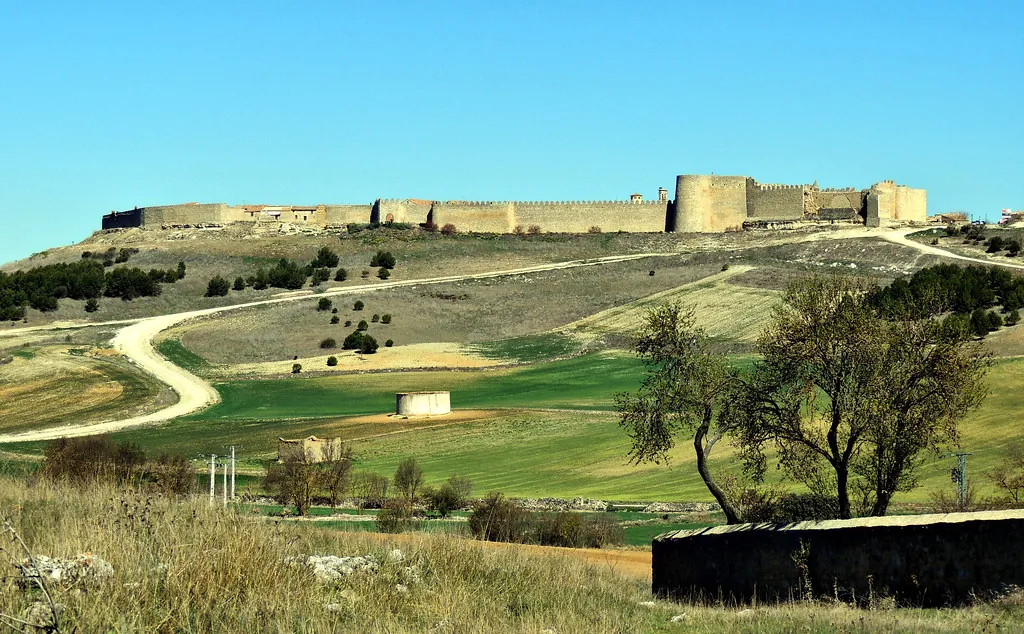
The castle appears first – a square tower punched out of the horizon long before the village itself comes into view. Approach Torrelobatón from any direction across the Tierra de Campos and the effect is the same: a 24-metre keep floating above wheat fields, the only interruption for miles of pancake-flat Castile. At 751 metres above sea level the hill is modest, yet enough to make the fortress look like a ship adrift on a golden ocean.
That visual punch is the reason most drivers pull off the A-601. They park on the small Plaza de España, climb three minutes of cobbled lane and find themselves staring up at walls built from the same ochre stone as the surrounding fields. The castle is thirteenth-century, battle-scarred during the 1521 rebellion when the Comuneros tried to prise Castile from Emperor Charles V, and still complete enough that you can walk the entire perimeter on a grassy bank. Entry is free, the gate never closes, and on weekdays you will probably share the battlements only with a pair of storks nesting on the northeast turret. Bring water: there is no café inside the walls and the only shade is the keep's shadow sliding across the courtyard.
Inside the keep – or not
Despite what the regional tourism posters suggest, you cannot actually go into the tower. The interior has served as a grain silo since the 1950s and the regional government keeps the door padlocked. What you can do is circle the base, run your fingers along grooves cut by medieval masons, and climb the external stair to the wall-walk. From there the plain stretches away like a map: kilometre-square plots of cereal, a scatter of stone farmhouses and, on clear days, the faint silhouette of the Montes Torozos 30 km to the north. British visitors tend to spend forty-five minutes up top; photographers linger for the low light that turns the stone copper-coloured just before supper.
If you arrive on a Saturday or Sunday the tiny interpretation centre tucked into the gatehouse opens (10:00-14:00, 16:00-18:00, free). Inside, a scale model shows how the castle once controlled the road between Valladolid and León, and panels explain why the local lord backed the losing Comunero side – useful context before you wander the village below.
A grid of earth-coloured houses
Torrelobatón's inhabited quarter is barely four streets square. Houses are rendered in the same sandy mortar as the fortress, giving the whole place the look of a village carved from its own soil. Timber doors open straight onto the lane; geraniums in white plastic pots add the only bright notes. Population hovers around 386, so a quiet Tuesday in February can feel almost post-apocalyptic. Yet the place is alive, not museum-frozen: a baker's van toots at 11 a.m., women in housecoats swap gossip outside the small Coop supermarket, and the bar on Calle Real keeps local hours – open at 07:00 for coffee and sticky pastries, closed by 22:00 when the last domino game finishes.
The sixteenth-century church of Santa María sits at the geometric centre. It is sturdy rather than beautiful: a single nave, a squat tower, a Renaissance portal added after the Comunero wars. Push the south door; if it is unlocked you will find shadowy interior walls painted with faded floral motifs and a wooden Virgin whose face has been darkened by centuries of candle smoke. Locals leave her offerings of plastic flowers and, mysteriously, small metal keys. No one seems able to explain why.
What to eat when the wind blows
Castilian cooking is built for weather that can hit zero Celsius in January and nudge forty in August. In Torrelobatón that means roast lamb (lechazo) cooked in a wood-fired brick oven, thick vegetable soup (sopa castellana) laced with smoked paprika, and discs of soft sheep's cheese that taste faintly of thistle. The safest bet is Mesón Rincón de Daniel on the main street. A plate of grilled lamb chops with chips costs about €12; add a half-bottle of local red from the Torozos hills and you are still under twenty euros. Portions are large enough that two can share a main and still have room for the ubiquitous tarta de queso, a crustless baked cheesecake that arrives slightly wobbling and browned on top. Vegetarians get the soup and a side of pimientos del piquillo; vegans should probably pack sandwiches.
When the castle is not enough
Torrelobatón is a detour, not a destination. Most visitors combine it with the nearby Monastery of Santa Espina, ten minutes' drive east. Approach from the N-601 and the building erupts from the plain like a stone ship, all flying buttresses and a single defiant tower. Inside, the cloister is peaceful enough to hear swallows banking overhead; outside, a small kiosk sells cold beer and lottery tickets. If you are travelling with children, the lack of admission charges at both sites keeps the day cheap even by Spanish standards.
Walking options are limited: the surrounding landscape is agricultural, fenced and flat. A 5-km loop south to the abandoned village of San Pedro de Eva and back makes a pleasant evening stroll; take the farm track opposite the cemetery and keep the castle in view as your compass. Otherwise settle on a bench in the plaza and watch the light change. Shadows lengthen, storks clatter overhead, and the stone walls glow briefly the colour of Burnished Amber before the sun drops behind the grain silo.
Arriving and leaving
Public transport is patchy. A weekday bus leaves Valladolid at 15:15 and returns at 07:00 next morning, timing so inconvenient that almost everyone drives. Hire a car at Valladolid airport (VLL) – a 45-minute hop down the A-62 and A-601 – or fly into Madrid and allow an hour and three-quarters north-west on the AP-6. Petrol stations are scarce once you leave the motorway; fill up in Medina de Rioseco if you are exploring further. There is no accommodation in the village itself, though the converted grain stores at nearby Almenara de Adaja offer four rustic rooms and a swimming pool that feels decadent after a dusty afternoon on battlements.
Spring and autumn deliver the kindest light and temperatures that rarely stray outside the teens. August is furnace-hot; January brings sharp frosts and a wind that whips across the plain like a blade. Whenever you come, aim for weekday mornings if you want silence; drop in on a Saturday evening in June during the fiestas of San Pelayo if you prefer brass bands and teenagers racing mopeds around the plaza until 03:00.
Torrelobatón will not change your life. It will, however, give you a clean hit of Castile distilled into one tower, one plaza and one perfectly grilled lamb chop – which, on a quiet Spanish afternoon with the storks circling overhead, feels like more than enough.