Full Article
about Urueña
Spain’s Book Town; perfectly preserved medieval walled town with bookshops and museums.
Hide article Read full article
A hilltop on the Montes Torozos
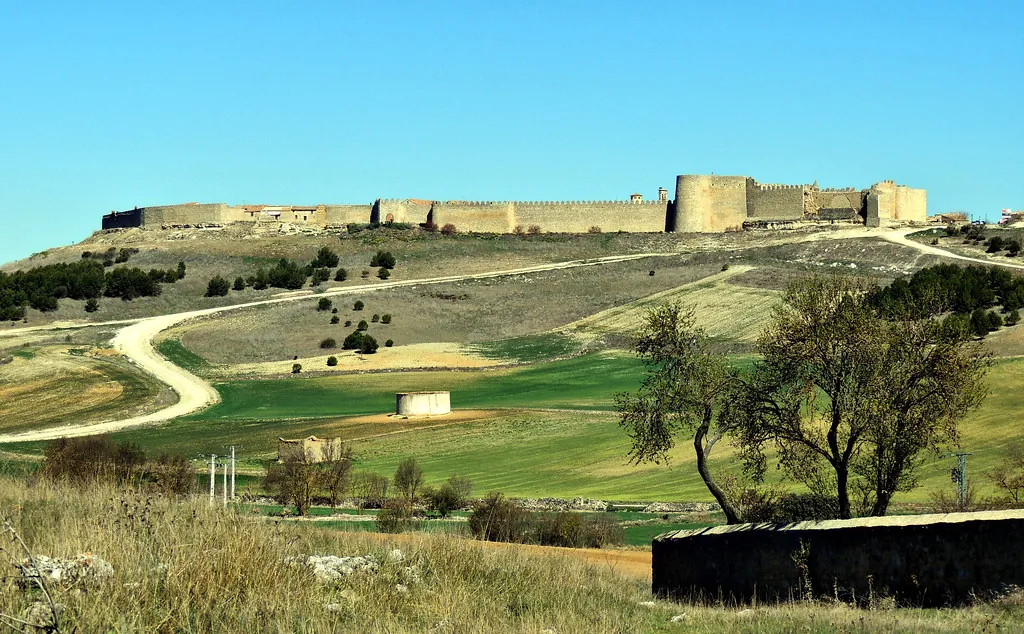
Some places you reach by chance. Others you visit because someone has told you, “Go on, it’s worth an hour.” Tourism in Urueña often begins like that. You are driving across the Montes Torozos, with kilometres of open countryside on either side, when a hill rises ahead with a wall running along its crest. It is not an exaggeration. The entire village appears outlined at the top, as if placed there to keep watch over the plain.
Urueña has fewer than 200 residents and stands at around 830 metres above sea level. From the ramparts, the Tierra de Campos spreads out like an enormous tabletop. On a clear day the horizon stretches a long way; one of those landscapes that makes you realise just how flat everything is once you have been looking for a while.
The setting explains much about the atmosphere. This is inland Castilla, broad skies and cereal fields in every direction. The sense of space is part of the experience.
Walking the medieval walls
One of the first things that stands out in Urueña is its medieval wall, still almost complete. It is not a fragment tucked between later buildings. Here the wall genuinely encircles the village.
It is often said that around 80 per cent survives, and in several sections you can walk along the adarve, the walkway on top of the wall. The circuit is short, yet memorable. From above, the cereal fields extend on all sides. When the wind blows, which is quite common here, the landscape seems to move as a whole.
The two main entrances continue to mark the way into the historic centre: the Arco de la Villa and the Postigo del Azogue. Passing through them feels like a clear transition from open countryside to compact streets within the walls.
Inside, everything is close at hand. The scale of the place makes it easy to grasp its layout quickly, with the wall always nearby as a reference point.
The story behind the Villa del Libro
Urueña is also known as the Villa del Libro, the Book Village. The idea began years ago as a way to bring cultural activity to a very small community. Over time, several streets filled with specialist bookshops and spaces dedicated to reading.
This is not a rural version of a large book fair. The premises are small and generally quiet. Often the visit turns into a conversation with the person behind the counter about whatever subject happens to arise: old maps, poetry, traditional music. The kind of exchange that happens when nobody is in a rush.
The project has given Urueña a distinct identity. In a village of fewer than 200 people, finding multiple bookshops is unexpected. The atmosphere remains low key, closer to browsing than to an event. For visitors unfamiliar with the concept, it helps to think of it as a cultural initiative rooted in books rather than a commercial district.
Alongside the bookshops, there are cultural centres linked to reading and to traditional sounds. As with many small towns, opening times vary depending on the season, so it is sensible to check in advance.
Romanesque churches and cultural spaces
In the main square stands the church of Santa María del Azogue. It is Romanesque and rather sober, very much in keeping with this part of Castilla. The style is simple and solid, matching the restrained character of the village itself.
A little outside the urban core is the ermita de la Anunciada. It is one of those buildings that makes you slow down without quite noticing. Small and very well preserved, it has carved capitals that reward a careful look. Even for those without a background in architecture, the detail invites a pause.
Within the village there are also several cultural spaces. The Museo Etnográfico Joaquín Díaz brings together traditional instruments and objects from everyday life in Castile. It offers an insight into local customs and popular culture through tangible items rather than long explanations. Other centres focus on books or on traditional sounds, reinforcing Urueña’s cultural profile.
Again, practical details such as opening hours change with the time of year, which is worth bearing in mind before setting out.
Wandering without a plan
Urueña is small enough that you can walk every street in a single morning without effort. In fact, it works best when approached without a fixed plan.
Stroll past houses built of tapial and adobe, traditional earth-based materials common in this region. Walk outside the walls and circle them from the exterior. Lean over at different points to look across the fields. Because the village sits on top of a hill, there are several natural viewpoints without needing to search for them.
If you enjoy walking, paths lead from here towards the páramos of the Montes Torozos. These are open landscapes with scattered pine woods and the occasional traditional dovecote appearing along the way. The surroundings remain broad and exposed, defined more by sky and horizon than by landmarks.
The scale of the place shapes the visit. There are no long distances to cover, no packed schedule to follow. The rhythm is set by the terrain and the weather, especially the wind that often sweeps across the plain.
Eating in inland Valladolid
The cooking reflects what you find across much of inland Valladolid province. Roast cordero lechal, milk-fed lamb, is a classic. Sheep’s cheeses and substantial pulses also feature strongly.
At weekends there are usually places open where you can sit down to eat without too much complication. During the week the pace drops considerably, so it is wise to arrive with flexible expectations or to check beforehand.
The food follows the character of the landscape: straightforward, rooted in local produce, suited to a region of cereals and livestock.
A visit that fits the scale
Urueña is the sort of place that works best when you do not try to stretch it too far. It is not designed for two full days of constant activity.
What suits it well is a morning or an afternoon. Walk along the wall, step into a bookshop, spend a while looking at the horizon and have something to eat nearby. In a few hours you come away with a clear sense of the village.
In the middle of the meseta, the high central plateau of Spain, sometimes that is enough. A pause, a view across the Tierra de Campos, and the quiet streets within medieval walls.


