Full Article
about Villanubla
Home to Valladolid’s airport; a high-plateau village with a cold climate and a long-running trades fair.
Ocultar artículo Leer artículo completo
The 06:40 Ryanair departure to Stansted rattles the windows of Bar El Tercer Tiempo, momentarily drowning out the coffee machine and the morning debate about cereal prices. By 06:43 the aircraft is a shrinking silver dot above the endless Castilian plain, and Villanubla slips back into what it does best: being an ordinary farming village that just happens to share its postcode with an international airport.
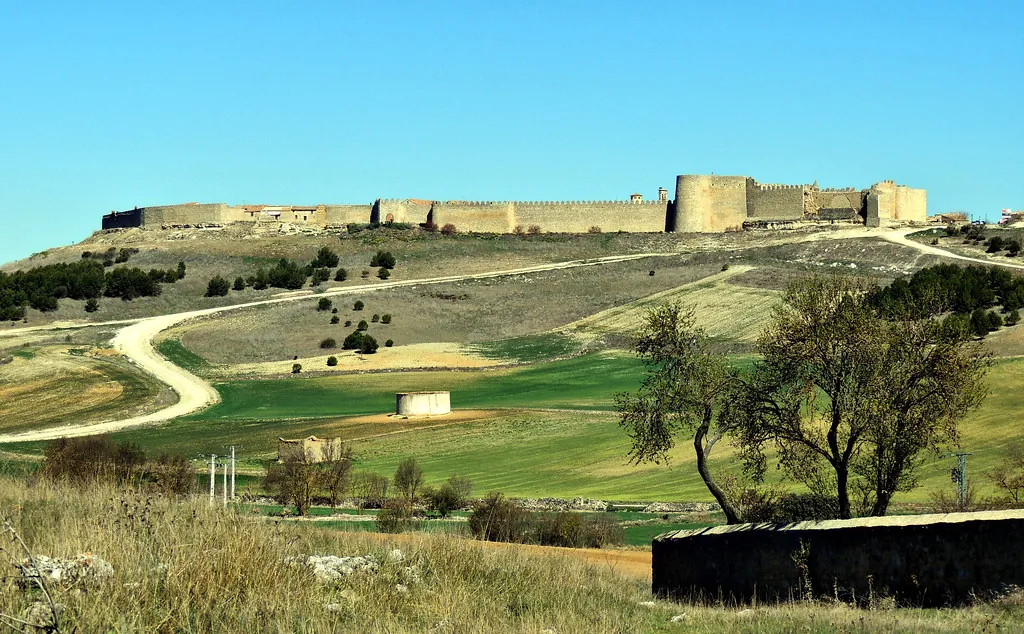
At 843 m above sea level, the air carries a sharp edge from October to April; frost feathers the wheat stubble and breath hangs in small white clouds. The airport may have planted Villanubla on the map, but the real geography is dictated by the Montes Torozos, a limestone slab that tilts the village slightly skywards and funnels the wind straight from the Meseta. Locals joke that you can watch the weather arrive half an hour before it hits: first a dark seam on the western horizon, then the barley bending in sequence like spectators doing the wave at a football match.
Arrivals & Departures
Most British visitors see only the runway approach and the inside of Motel Venus, a functional brick block whose neon sign flickers “NO VACANCY” in purple Comic Sans. It is three minutes from terminal to reception, which explains why the car park fills with UK number plates every Friday night. The rooms are clean, the Wi-Fi patchy, and the café con leche served from 05:30. Charm is not on the menu, yet at €55 a double it does not need to be.
If your flight lands after 21:15 you are essentially stuck: that was the last bus to Valladolid. A taxi to the city costs €25–30, so unless you fancy a 15-kilometre night hike along the VA-221 with no pavement, book ahead. The same rule applies in reverse—Sunday morning departures require Saturday-night reconnaissance because the village shuts down completely from lunchtime on Saturday until Monday. Cash machines? Both are inside the same bar; when it closes, plastic becomes useless.
One Street, Two Bars, Infinite Sky
Leave the airport perimeter and Villanubla reveals itself as a single main artery, Calle Real, flanked by stone houses the colour of dry toast. The church of Santa María squats at the far end, its tower patched so many times it resembles a patchwork quilt in limestone. Step inside and the temperature drops five degrees; the nave smells of candle wax and centuries of grain dust blown in on the wind. There is no guidebook spiel, just a printed A4 sheet taped to a pew asking visitors to switch off mobile phones “por respeto”.
Outside, the street is wide enough for tractors to perform three-point turns. Grandmothers manoeuvre shopping trolleys over uneven slabs while discussing the price of lentils in voices trained to carry across open fields. The only commercial action happens in two establishments: Bar El Tercer Tiempo (football shirts on the wall, tapas €2.50, excellent tortilla) and Bar Parque (terrace under plane trees, house red from Ribera del Duero €2 a glass). Between them they account for breakfast, gossip, and the entire evening economy.
Lunch at 1, Siesta at 3, Wheat Forever
Order the lechazo asado at Mesón de Villanubla and you receive a quarter of milk-fed lamb, its skin blistered into parchment-thin crackling, served on a metal plate hotter than the runway in August. Chips come piled like edible Jenga. The waitress will ask “¿Pan?”—say yes, because the village bakery still uses a wood-fired oven and the crust could double as body armour. Vegetarians should request judiones, giant butter beans stewed with saffron and bay; the kitchen keeps a pot on the go for the occasional peregrino who has wandered off the Camino by mistake.
Meals are rationed by the clock: 13:30–16:00, 20:30–23:00. Miss the window and you will discover that the supermarket closes at 14:00, the bakery at 14:30, and the world at 15:00. Siesta is non-negotiable; even the dogs seem to observe it, flopped in whatever shade the plane trees cast across the plaza.
Walking on the Roof of Castile
Once digestion is complete, pick up the dirt track that leaves from the cemetery gate and head south. Within ten minutes the village sinks behind you and the Meseta opens like a beige ocean. Stone walls divide the horizon into chessboard squares; every so often a stone hut, or chozo, erupts from the wheat like a fossilised mushroom. These hemispherical cabins, built without mortar, once stored tools and provided shelter for shepherds. Their doorways face east, away from the prevailing wind, and inside the temperature stays constant winter and summer.
Continue for 4 km and you reach the edge of the Torozos escarpment. From the rim Valladolid appears as a distant Lego set: the cathedral tower, the bulk of the football stadium, the flashing beacon on the hospital roof. Below, the land drops 200 m into the Pisuerga valley, a sudden interruption in the pancake flatness. On clear days the snow-capped peaks of the Sierra de Guadarrama shimmer 100 km to the south-east; more often the view dissolves into a heat haze that makes the city seem to float.
Turn back when the sun touches the wingtip of a Ryanair 737 banking over the village—an airborne sundial that signals beer o’clock. The return walk takes forty minutes, time enough to plan supper and to remember that you have not locked a door all day.
When the Wind Drops
Spring arrives abruptly in mid-March: green washes across the fields overnight, and larks launch themselves into the sky like small brown fireworks. This is the sweetest season, warm enough for lunch outside yet cool enough to walk at midday. By late May the cereal heads turn gold and the combine harvesters emerge, monstrous orange Claas machines that crawl across the landscape until July. August is brutal—35 °C by 11:00, shade as scarce as English accents, and the smell of hot tarmac drifting from the airport. Autumn brings stubble burning and the smell of wood smoke; winter clamps down with fog that swallows the runway lights and strands planes in Madrid.
Choose your month carefully. Come in April and you can cycle the back road to Wamba (12 km) through fields of crimson poppies, stopping at the 11th-century crypt famous for its stacked human skulls. Visit in August and you will understand why the Spanish invented the siesta: the thermometer hits 38 °C, the asphalt softens, and even the sparrows pant.
Departure Lounge
Villanubla will never feature on a “Top Ten Castilian Villages” list because it offers neither castles nor quaint cobbled alleys. What it does provide is an unfiltered shot of rural Spain: bread baked at dawn, lamb roasted at midday, and a sky so wide it makes your urban problems feel trivial. Book the motel, set your alarm for 05:00, and you will reach the departure gate in under ten minutes. Or stay an extra day, walk the escarpment at sunset, and discover that the real departure is from the assumption that every Spanish village must be “picturesque” to be worth your time.