Full Article
about Wamba
Spain’s only town beginning with W; known for its Mozarabic church and its striking visitable ossuary.
Hide article Read full article
A village that opens like an old photo box
Some places feel like those boxes of old photographs kept in a grandparent’s house. You open them without expecting much, and suddenly stories start to spill out. Wamba, in the Montes Torozos, has something of that quality. It is home to just 289 residents, with quiet streets and a kind of silence that at times feels like a Sunday afternoon after everyone has gone.
Tourism in Wamba revolves around its history, and it does not take much imagination to notice it. The stones have been in place for centuries. Some houses seem to have watched generations pass without shifting an inch.
The village takes its name from the Visigothic king Wamba, who ruled in the 7th century. That link is still visible today, in archaeological remains and in the character of the place. Over time, traces of earlier buildings and decorative elements have come to light, pointing to the early medieval period. This is not history confined to books. It shows up in the walls and in the way things were built.
Walking through the village is straightforward because everything is small and direct. Stone houses, some with adobe hidden beneath more recent layers of paint, thick doors and walls designed to last rather than impress. It is practical planning, the kind shaped by winter and daily work rather than appearance.
Santa María and the ossuary below
The church of Santa María is the main reason many visitors make their way to Wamba, and the appeal is immediately clear.
The building contains layers from different periods. Its origins are usually placed around the 10th century, with later Romanesque changes. That may sound technical, but inside it is easy to see. There are simple sections, thick walls and small windows that let in just enough light. Decoration is kept to a minimum.
The most striking feature lies beneath the choir. There is an ossuary. It is not arranged like a brightly lit museum display. It feels more like stepping into an old storage space where bones have been organised over generations. Rows of skulls, stacks of tibias, and an atmosphere that leads people to move slowly and speak quietly.
It can be unsettling. Some find it uncomfortable. It also reveals how burials were managed when space was limited.
At the head of the church, elements linked to Mozarabic style are still recognisable. The vaults and small windows maintain that austere look found in very old churches across the plateau. A Renaissance altarpiece adds another layer to the building’s timeline, with traces of its polychrome decoration still visible despite the passage of time.
From outside, the tower acts as a point of reference. In a landscape as flat as the Torozos, it works like a familiar landmark seen from the road, confirming that the village is just a few minutes away.
Quiet streets and cellars beneath the ground
The centre of Wamba is compact and orderly. There are no winding mazes of streets. Instead, straight routes, some with a gentle slope, that can be covered in a short walk. It feels like moving through a very small neighbourhood where everything is just around the corner.
The houses keep the rural character of the Castilian plateau: thick walls, large gates and interior courtyards. Some buildings reveal older details when plaster falls away or when renovation exposes the original stone underneath.
Beneath the ground, there are cellars carved into the earth. For centuries they were used to store wine and food, making use of the constant underground temperature. Going down into one is a bit like entering the basement of an old house. Uneven steps, the smell of cool earth, and passages that do not always follow a straight line.
There is little commercial activity in the village. The most common sounds are the occasional passing car or dogs in the distance. That quietness, more than any monument, is part of what defines Wamba.
The open landscape of the Montes Torozos
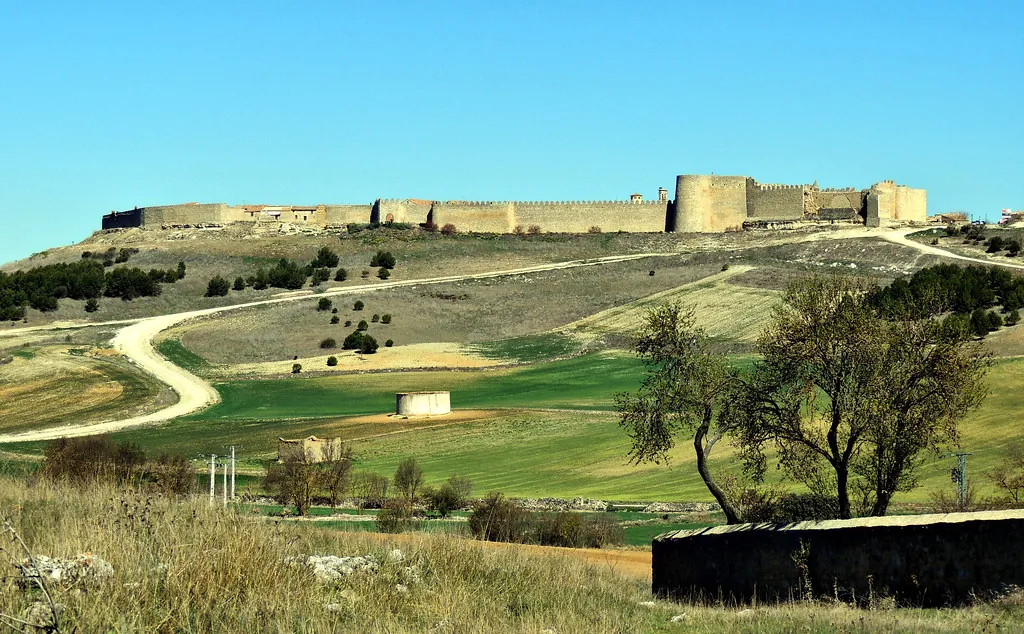
Around Wamba stretches the landscape of the plateau. Fields of cereal shift in colour with the seasons, and scattered holm oaks appear here and there, as if placed across the land without a pattern.
By car, several rural tracks cross these open plains. They are the kind of routes where it is possible to drive for minutes without seeing anyone. With a bit of patience, birds of prey can sometimes be seen gliding high above, or groups of large birds gathered in the fields.
There are also other nearby villages that preserve medieval remains or old churches. Linking them together in a single route helps to give a sense of how this area once functioned, when these settlements were more connected than they might seem today.
As for food, the region stays true to what has long defined Castilla. Wood-fired ovens, local produce and simple preparation. Roast lechazo appears on many tables in the area, alongside pulses and bread with a firm crust. It is a cuisine shaped by the land and by habit, with little need for reinvention.