Full Article
about Castrojeriz
Major landmark on the Camino de Santiago, shaped like a sickle beneath the ruins of a castle.
Hide article Read full article
Arriving and getting your bearings
If you are heading to Castrojeriz, it helps to think about the car first. The village is organised around Calle Real, which acts as its main axis and is where most people try to park. During busy periods on the Camino de Santiago, this fills up quickly. When that happens, the simplest option is to leave the car higher up and walk down.
The layout makes this easy enough. Castrojeriz stretches out rather than clustering tightly, so distances are manageable on foot. A short walk gives a good sense of how the place fits together.
A village stretched along the hillside
Castrojeriz lies at the foot of a long hill, with the settlement pulled out along its base. Calle Real runs through most of it, shaping how the village is experienced. Walking along it reveals a mix of old and newer elements.
On one side, there are houses with carved coats of arms and stone doorways. These details point to an earlier period when the town held more prominence. On the other side, there are empty plots and more recent buildings. The contrast is noticeable and suggests a place that once had a larger population than it does today.
One of the entrances to the built-up area is marked by the bridge over the Odra river. Several of its arches are old, although it has been repaired over time. It does not stand apart as a monument but functions as part of everyday life, used as people come and go.
The climb to the castle
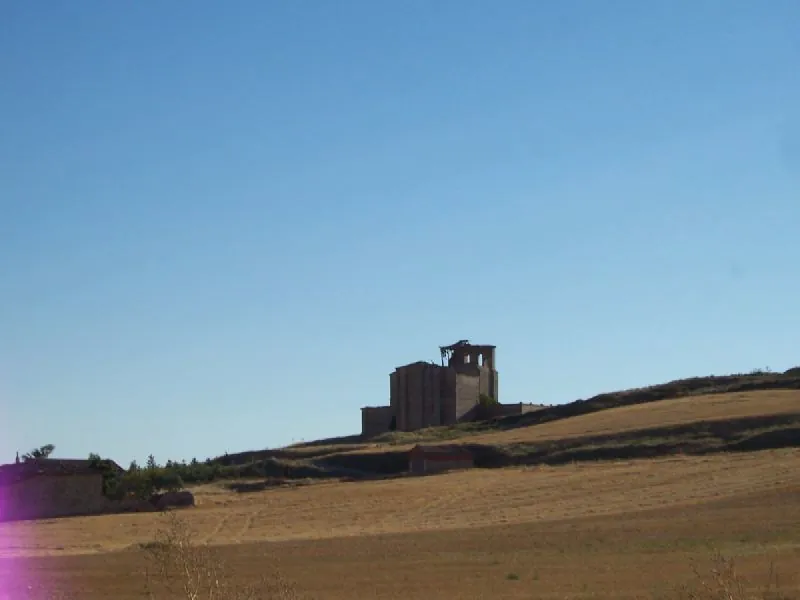
At the very top of the hill sit the remains of the castle. What survives today includes stretches of wall and a few towers, rather than a complete structure. Even so, its position dominates the view.
The climb up is steep and the ground is dry. On hot days, the ascent can feel longer than expected. There is no technical difficulty, but the slope demands a bit of effort.
At the top, the view explains the setting clearly. The surrounding landscape is largely flat, covered by cereal fields in almost every direction. The village itself appears pressed against the base of the hill, its elongated shape easy to pick out from above. That perspective helps make sense of the geography in a way that is not obvious from below.
Churches and traces along the Camino
The most important religious building in Castrojeriz is the Colegiata de Santa María del Manzano. Inside, different historical phases are visible, rather than a single uniform style. Anyone interested in late Romanesque architecture or religious sculpture will find it worth stepping inside, even briefly.
Other churches remain, including San Juan and Santo Domingo. Both have been heavily altered over time. They are better understood as part of the village’s historical fabric than as standout artistic landmarks.
On the outskirts, the ruins of the convent of San Antón form one of the most recognisable images linked to this stretch of the Camino de Santiago. Two Gothic arches span the road, and the pilgrimage route passes directly beneath them. For those walking the Camino, this point has become a familiar reference.
Open fields and long paths
Beyond the urban area, the landscape becomes consistent and open. Fields of cereal crops dominate, intersected by agricultural tracks. There is little variation in terrain or cover.
The Alto de Mostelares lies nearby and is crossed by many people following the Camino on foot. The route itself is not technically difficult, but conditions can be demanding. Wind often blows strongly, and there is no shade along the way.
The dirt tracks around Castrojeriz can be used for walking or cycling. They tend to be straight, long and exposed. This creates a particular rhythm to moving through the area, with few interruptions or changes in scenery.
A simple way to plan your time
An early visit makes a difference if you want a quieter impression of Castrojeriz. The village is not large and can be explored in a relatively short time. Walking along Calle Real, climbing to the castle and covering a small section of the Camino nearby is enough to form a clear picture of the place.
After that, it becomes a question of pace. Some continue their journey, especially those following the Camino de Santiago. Others choose to stay a while longer, taking in the wide, open views over the surrounding plain.