Full Article
about Palencia
Quiet, monumental provincial capital on the banks of the Carrión River; famous for its Cristo del Otero and its Gothic cathedral known as La Bella Desconocida.
Hide article Read full article
A city shaped by the plain
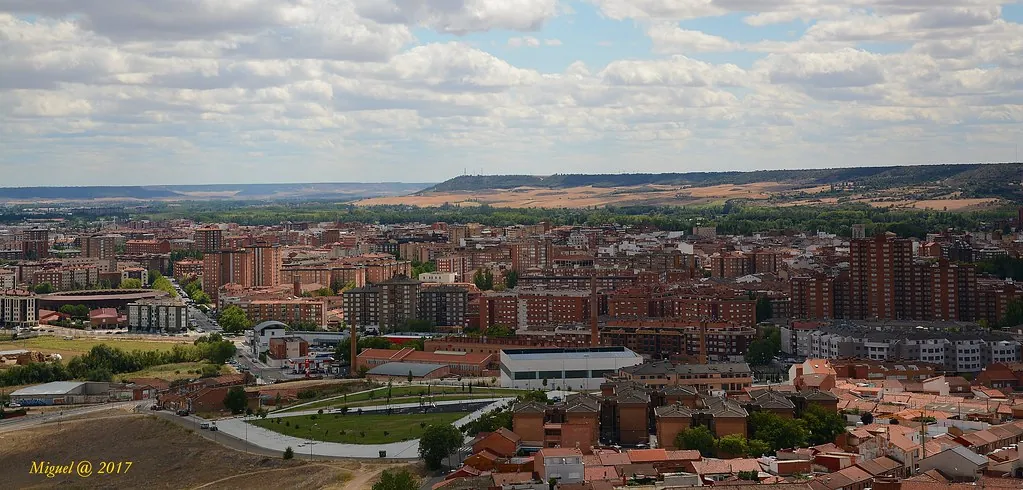
From the hill of the Otero, Palencia appears as a compact spread of rooftops and towers gathered around the river Carrión. The view makes the setting immediately clear. This is Tierra de Campos, a wide cereal-growing plain that has influenced both the local economy and the character of the place over centuries.
At the top stands the Cristo del Otero, a 20th-century sculpture by Victorio Macho. The figure faces south, looking out over the fields that have surrounded the city since long before the Vaccaei referred to it as Pallantia. The relationship between the city and the land is easy to read from here: Palencia does not stand apart from the plain, it sits firmly within it.
A quiet provincial capital
Palencia is not a city that draws attention to itself. For many, it is more familiar as a stop along a motorway or railway line than as a destination. That low profile has a long history behind it. For centuries, it shared importance with nearby cities that carried more political or administrative weight. Valladolid developed its institutional role, Burgos became associated with its Gothic cathedral, while Palencia remained closely tied to agriculture and the cereal trade.
That background helps explain the tone of the city today. Wheat does not lend itself to grand narratives, yet it underpins much of what this territory has been.
The historic centre, however, tells a different story at street level. For a city of its size, the density of heritage is notable. Medieval churches appear within short walking distance of each other. Sections of old defensive walls still survive. There is also an archaeological museum whose collection spans a long period, from pre-Roman communities through to the Middle Ages.
Nothing feels overstated, but there is a steady accumulation of history that reveals itself as you move through the centre.
The cathedral and what lies beneath
The Cathedral of San Antolín began construction in the 14th century, although the site itself had been a place of worship long before that. Beneath the current building lies a Visigothic crypt linked to the earliest documented church in the city. This layering of periods helps explain the mixture of styles visible both outside and inside.
Within the cathedral, the main altarpiece dominates the central nave. It is a large structure in gilded wood, organised as a visual narrative made up of many scenes and figures. It rewards a slower look. From a distance it reads as a whole, but closer up smaller details emerge that are easy to miss otherwise.
A short walk away stands the church of San Miguel. It is associated with a well-known episode in medieval chronicles: the marriage of Rodrigo Díaz de Vivar, known as El Cid, and Jimena Díaz, which tradition places here in the 11th century. The line between history and legend is not always clear in this case. Beyond that story, the church itself retains a solid tower that continues to define this part of the old town skyline.
The Cristo del Otero and the surrounding landscape
The walk up to the Cristo del Otero remains a familiar route for local residents. The hill is not especially high, yet it is enough to overlook the city and, more importantly, to grasp the scale of the surrounding plain.
The sculpture is marked by vertical lines and a restrained design. It forms part of a wider ensemble that also includes the burial place of Victorio Macho. From the base, several elements of the city fall into place: the cathedral tower, the course of the Carrión, and the industrial areas that expanded during the 20th century beyond the historic centre.
On clear days, the view stretches northwards until the first outlines of the province’s mountains begin to appear in the distance. The contrast between the flat foreground and those far-off elevations adds another layer to the landscape.
Cooking shaped by the land
Food in Palencia follows a practical logic. Dishes are designed for cold weather and long working days. One of the most recognisable is lechazo asado, roast lamb, closely linked to the churra sheep raised across many villages in the province.
Other staples appear regularly. Garlic soup is common, as are legume stews based on lentils or beans. Local cured meats often include a noticeable use of onion. The overall approach is direct and filling rather than elaborate.
Among traditional sweets, biscotes stand out. This is a dry sponge cake typically eaten with milk or coffee.
Wine usually comes from local cooperatives or nearby denominations within the Duero valley. It is often served in a straightforward way, without much ceremony, which fits the general tone of the city’s food culture.
Festivities and local rhythms
The main celebrations in Palencia are held in honour of San Antolín, the city’s patron saint, at the beginning of September. During these days, activity shifts into parks and squares. Local groups known as peñas organise meals and music, and the pace of the city changes.
The procession of the saint remains one of the most attended moments of the festival. Alongside this, other celebrations take place throughout the year. Some are linked to religious images with strong local roots, while others reflect popular traditions, particularly in areas near the river and in the older neighbourhoods.
These events do not transform the city into something else, but they do reveal a more collective side of daily life.
Moving through the city
The historic centre of Palencia is easy to explore on foot. Calle Mayor forms the backbone of a typical walk through the city. It runs from the main square towards the river, lined with arcades, traditional shops and several civil buildings of interest.
Following the course of the Carrión offers a different perspective. The riverside walk passes through green areas and opens up views back towards the urban centre.
Palencia is connected by train to nearby cities and to Madrid. For those arriving by car, it is generally most practical to leave the vehicle in one of the public car parks close to the centre and continue on foot.


