Full Article
about Lubián
Last village in Zamora before Galicia, at Puerto de la Canda; high mountains with typical Sanabria-style architecture and the Santuario de la Tuiza.
Ocultar artículo Leer artículo completo
The road to Lubián climbs so steadily that your ears pop long before you see the first stone house. At 1,030 m, the village sits higher than Ben Nevis’s summit cairn, yet the surrounding Sierra de la Cabrera tops out at a modest 2,000 m. The result is a landscape that feels Scottish rather than Mediterranean: wind-scoured moor, oak and birch woods, and stone walls that disappear into bracken. Mobile signal dies somewhere around the 900 m mark; by the time the scattered hamlets of Lubián appear, Vodafone has given up entirely.
This is Spain’s north-western hinge, the point where Castilla y León nudges both Galicia and Portugal. The border is not an abstract line here but a physical ridge you can walk in under an hour. On a clear afternoon you can pick out the radio mast at Montalegre in Portugal’s Minho region, 25 km away, while the slate roofs beneath your feet still drain to the Duero. Locals switch between castellano and Portuguese mid-sentence; surnames like Ferreiro and Souto betray centuries of to-and-fro.
Don’t expect a neat plaza mayor and a single church tower. Lubián is a federation of tiny settlements—Aciberos, Padornelo, A-Mezquita—strung along 15 km of mountain lane. The council headquarters, a functional 1970s brick box, stands next to the only bar that doubles as grocer, post office and public-phone booth. Order a coffee and you’ll be handed the key to the petrol pump if the delivery van needs refuelling. Population is officially 300, but that includes the diaspora who return for August fiestas and are counted whether they stay or not.
Stone, Slate and the Smell of Woodsmoke
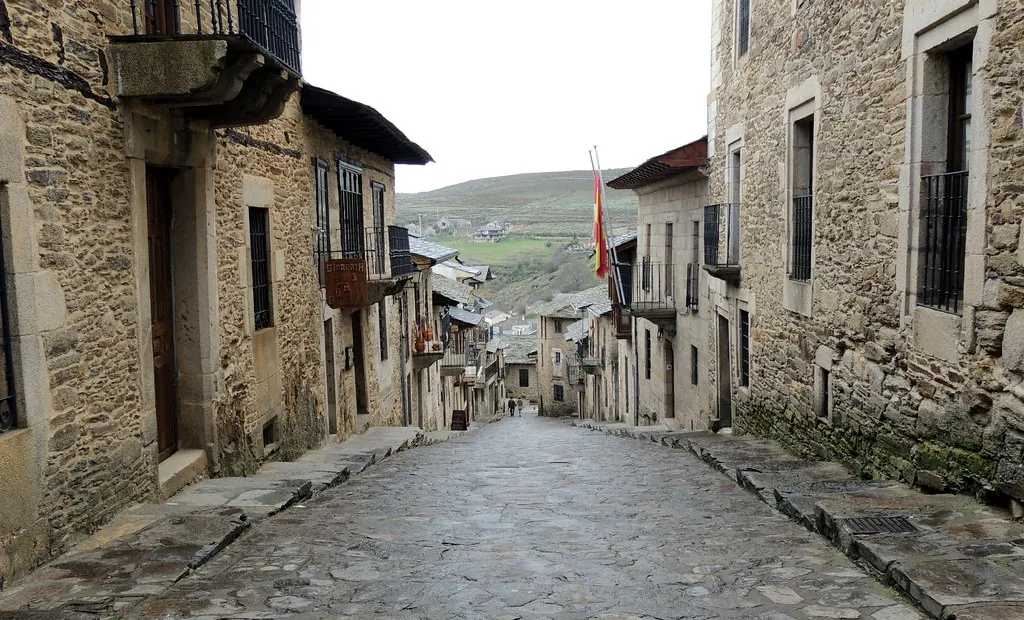
Architecture is pragmatic rather than pretty. Houses are built from whatever the hillside provided: granite boulders at the bottom, thinner slate slabs higher up, timber balconies added later when someone needed an extra bedroom above the stable. Most roofs still carry 30 cm of overhang so the winter snow can slide off without ripping the gutters away. You’ll spot horreos—raised granaries on stilts—beside modern tractors; both are working tools, not museum pieces. If a door is open, the owner will probably wave you in to see the chestnut-drying rack above the hearth, but photographs are discouraged while the harvest is still curing.
The parish church of Lubián itself is locked unless the priest is in residence, but the key hangs on a nail inside the bar. Inside, the nave is cool and plain, the stone floor worn into shallow ruts by centuries of hobnail boots. A single Baroque retablo glitters incongruously at the east end, paid for in 1789 with money earned running contraband coffee and Portuguese brandy over the hills. Ask politely and the barman will tell you which pews still conceal false bottoms once used to hide tobacco.
Walking the Smugglers’ Highway
The best way to understand the place is to follow the Ruta de los Contrabandistas, a 12 km loop that starts behind the church and climbs to the 1,350 m Portela de Padornelo. The path is way-marked, but only just: red-and-yellow flashes appear every kilometre or so on fence posts, and twice the trail becomes a stream-bed after heavy rain. Take the free leaflet from the bar—printed on the back of last year’s electoral roll—and still carry GPS. On the crest you walk through wind-twisted birches and suddenly Portugal is only a dry-stone ditch away. Farmers on both sides used to meet at midnight to swap maize for Portuguese salt; the custom died when Spain joined the EU, but the path remains an unofficial border crossing. Locals still use it to reach the Sunday market in neighbouring Montalegre, waving ID cards at the occasional Guardia Civil patrol.
Cyclists find the same route on asphalt. The N-525 from Puebla de Sanabria is a favourite training climb for Vigo club riders: 22 km at an average 4 %, but the last 5 km ramp up to 8 %. Traffic is light—three cars an hour outside August—and the reward is a 30 km descent towards Verín with only one junction. Mountain-bikers have narrower options: forest tracks that turn to peanut-butter mud after October storms and can ice over by December. Bring mudguards and a spare brake pad; the nearest bike shop is 60 km away.
What Passes for Gastronomy
Food is mountain fuel rather than fine dining. The only fixed menu is served at Bar La Estación, weekdays at 14:00 sharp, €12 for three courses and a quarter-litre of house wine. Expect cocido sanabrese, a mild chickpea and pork stew that arrives in an individual clay pot. Ask for the half-portion—cocido pequeño—unless you’ve just walked 20 km. Dessert is usually tarta de la abuela, a custard-and-biscuit slab Brits describe as “banoffee pie without the banana”. The cheese board is simply whatever the owner’s cousin has brought from his flock that week; the semi-cured sheep cheese is closer to Wensleydale than Manchego and travels well if you want to risk customs on the way home.
Outside mealtimes provisions come from the cold cabinet: vacuum-packed chorizo made during the January matanza, jars of shredded beef in fat, and bread that arrives twice weekly from a van out of Puebla. If you’re self-catering, stock up before Monday—everything shutters except the bar, and even that closes by 21:00.
When to Come, and When to Stay Away
Spring arrives late; snow can fall well into April and the birches don’t leaf until early May. By June the hills turn bright green, meadows fill with orchids and the first pilgrims on the Sanabrés route of the Camino start appearing. July and August are peak season: temperatures reach 28 °C by day but drop to 12 °C at night—pack a fleece even in midsummer. This is also when emigrants return, the population quadruples and every house sprouts a Brazilian flag or Swiss number plate depending on where the money was earned. Book accommodation early; there are only 25 beds in the entire municipality, split between two small guesthouses and a municipal albergue that charges €8 for a bunk.
September brings mushroom pickers and the chestnut harvest; the air smells faintly of smoke as families fire up drying rooms. October can be spectacular—clear skies, russet woods—but also sees the first Atlantic storms that wash away forest tracks. From November to March the place empties. Daylight is scarce, roads ice over, and the albergue closes. If you do come in winter, bring chains and expect temperatures of –5 °C at night. The reward is silence so complete you can hear a tawny owl half a mile away.
Getting There, and Away Again
There is no railway station; the nearest trains stop at A Gudiña, 25 km south on the Madrid–Vigo line. From there a pre-booked taxi costs €35—more than the rail fare from Madrid if you’ve booked in advance. UK travellers usually fly to Madrid, collect a hire car and head north-west on the A-6 and A-52; the turn-off at Puebla de Sanabria is 3 h 30 min from Barajas airport, assuming you ignore the speed cameras. Buses exist but run only on Tuesdays and Fridays, timed to get villagers to the market in Verín and back before siesta.
Leave early for the airport on the return leg: fog can close the A-52 without warning, and the alternative mountain road through Ourense adds two hours. Fill the tank at the 24-hour Repsol at Benavente; after that petrol stations are as rare as cash machines.
Lubián will not suit everyone. Nightlife is a choice between the bar’s slot machine or counting shooting stars from the church steps. If it rains, there is no museum to duck into, no spa, no artisan chocolate shop. But for walkers, cyclists, or anyone who measures a holiday in lungfuls of cold, clean air, it offers something increasingly scarce: a Spanish village that functions for its own inhabitants first, and for visitors only by accident. Come prepared, expect little, and you might leave wondering why more of the country doesn’t still work like this.