Full Article
about Requejo
Set on the climb to Padornelo among forests of thousand-year-old yews; the Tejedelo Wood is an unmissable natural gem.
Ocultar artículo Leer artículo completo
The church bell tolls at noon, echoing across stone roofs and narrow lanes where wild cats stretch in the sunshine. At 1,050 metres above sea level, Requejo sits high enough that the air carries a bite even in May, and the views stretch across layers of oak-covered ridges towards the snow-dusted peaks of the Sierra Segundera. This is not postcard Spain. It's better: a working mountain village where farmers still drive cattle through the streets and the evening meal depends on what grew, grazed or swam nearby.
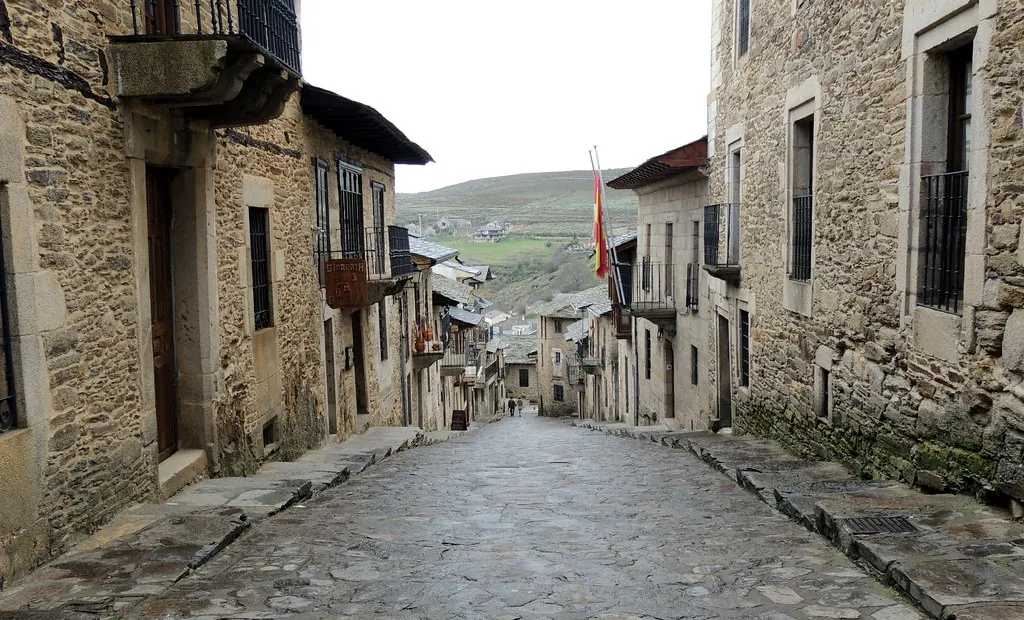
Stone, Slate and Silence
Requejo's houses are built from the ground they stand on. Granite walls two feet thick keep interiors cool in summer and bear the weight of heavy slate roofs that turn silver-black after rain. Look closely and you'll spot the old grain stores—small stone huts raised on stubby legs to keep rodents out. They stand in back gardens like miniature castles, reminders that self-sufficiency here wasn't a lifestyle choice but survival.
The village layout follows the ridge, so every street tilts or twists. Walking from one end to the other takes ten minutes, yet the gradients are enough to test calf muscles accustomed to city plains. Traffic is light: a delivery van, a tractor, perhaps a local taxi making the 15-minute run to Puebla de Sanabria. What you hear instead is the clink of a goat bell, the squeak of a weather vane, and—if the wind swings north—the faint rush of the Tera river slicing through the Cañones del Tera two kilometres away.
A Practical Base for High-Country Exploration
Requejo's position on the southern lip of the Sanabria basin makes it a sensible base rather than a destination in itself. The glacial Lake of Sanabria, Spain's largest, lies ten minutes down the ZA-104. In July its beaches—yes, sand imported to create coves beside the alpine water—fill with Spanish families. Arrive before 10 a.m. and you get the mirror-calm lake striped with mist and the first kayak rentals still chained to the pier. Hire costs €12 an hour, paddles included, and the water is cold enough to numb feet in minutes.
More rewarding, and emptier, are the high trails. The PR-ZA 95 "Ruta de las Cascadas del Sotillo" starts 4 km west of the village. A three-hour loop climbs through sessile-oak woods past two waterfalls powerful enough to soak the path until June. Wear boots; the stones are polished shale and treacherous when wet. For a long day, the Trevinca massif beckons. Leave the car at the 1,650 m Portela de Manzanal and follow cairns upwards for 700 m of ascent to the 2,125 m summit of Peña Trevinca, the roof of both Galicia and Zamora. On a clear Wednesday in early October you might share the ridge with two German hikers and a flock of migrating honey-buzzards. In August, bring at least two litres of water—there is none above the tree-line and temperatures can nudge 30 °C despite the altitude.
Winter transforms the same roads into a lottery. Snowploughs reach the village quickly enough—the main route to the ski-lifts at Manzanal passes through—but side roads to hamlets like Robledo freeze solid. Chains become compulsory, and the lake access road closes if drifts exceed half a metre. Book accommodation with parking; overnight frost will turn a hire-car into an immovable ice block.
Food Without the Fanfare
Sanabrian cooking is mountain fuel, not art. In Requejo, dinner is likely to arrive on a wooden board: a thick slab of local beef (rubia gallega crossed with Alpine breeds), roasted potatoes and a green pepper so charred it looks fossilised. The pepper tastes of smoke and rain. Expect to pay €12–14 at the only bar-restaurant, which opens when the owner hears voices outside. If the chalkboard says "trucha a la navarra", order it. The trout come from the Tera, gutted within the hour and pan-fried with jamón scraps for salt.
Vegetarians survive on tortilla and setas when in season. Mushroom hunters here are territorial; join a foray with a guide (€35 pp, minimum four people) or risk a hostile encounter. Dessert is usually absent—coffee comes with a shot of orujo de hierbas that clears sinuses at 40% ABV. The nearest supermarket is in Puebla de Sanabria, so stock up before you arrive unless you fancy driving 20 minutes for milk.
When Tradition Outranks Tourism
Visit on the first Sunday after Twelfth Night and you'll meet the "zamarracos", masked figures wrapped in sheepskins whose cowbells clatter through the alleys at dawn. The ritual predates written records and is performed for the villagers, not for you. Photographs are tolerated, but flash photography earns sharp looks. Summer brings the fiestas patronales around 15 August, when emigrants return and the population triples. A marquee goes up in the plaza, brass bands play until 3 a.m., and roast suckling pig is carved with a plate instead of a knife. Accommodation within the village sells out months ahead; stay 15 minutes away in Lubian and you'll still hear the bagpipes on the night breeze.
Getting There—and Away
The practical way is to fly into Valladolid or Porto, collect a hire car, and drive. From Valladolid it's 145 km on the A-52 and N-525, roughly two hours once you clear the city ring road. Public transport exists in theory: a Monday-to-Friday bus links Puebla de Sanabria with Zamora, but the timing is useless for a weekend break. Without wheels you're stranded, so factor diesel into the budget—mountain roads drink fuel.
Sleeping options are thin. "A Curuxa" cottage lists on Airbnb for £85 a night and delivers what it promises: stone walls, wood-burning stove, blackout shutters dark enough for astronomers. Bring slippers—the floors are chilly even in June—and expect the wifi to wheeze whenever cloud rolls in. Hotel alternatives cluster around Lake Sanabria, ten minutes distant, but then you lose the dawn hush of the village itself.
Worth the Effort?
Requejo will not dazzle with monuments or Michelin stars. Its appeal is subtler: the smell of wet slate after storm, the way evening sun catches chestnut leaves so they glow copper, the sudden sight of a wild boar trotting across the lane at dusk. Come prepared for changeable weather, patchy phone signal and restaurants that close because the cook's cousin got married. Accept those terms and you'll leave plotting a return—ideally in spring, when the broom flowers turn the hillsides yellow enough to rival anything the Med can muster.