Full Article
about Béjar
Historic textile town in the sierra with a medieval old quarter and industrial heritage; gateway to the ski station.
Hide article Read full article
About 370 metres long, the tunnel on the Vía Verde cuts straight through the mountain like a feat of nineteenth-century railway engineering. Step inside and the temperature drops abruptly. Footsteps echo against the stone vault, and halfway along there is barely any light. The contrast says a great deal about tourism in Béjar. Industrial heritage, mountain landscape and an old hill town sit close together here, each within easy reach of the other.
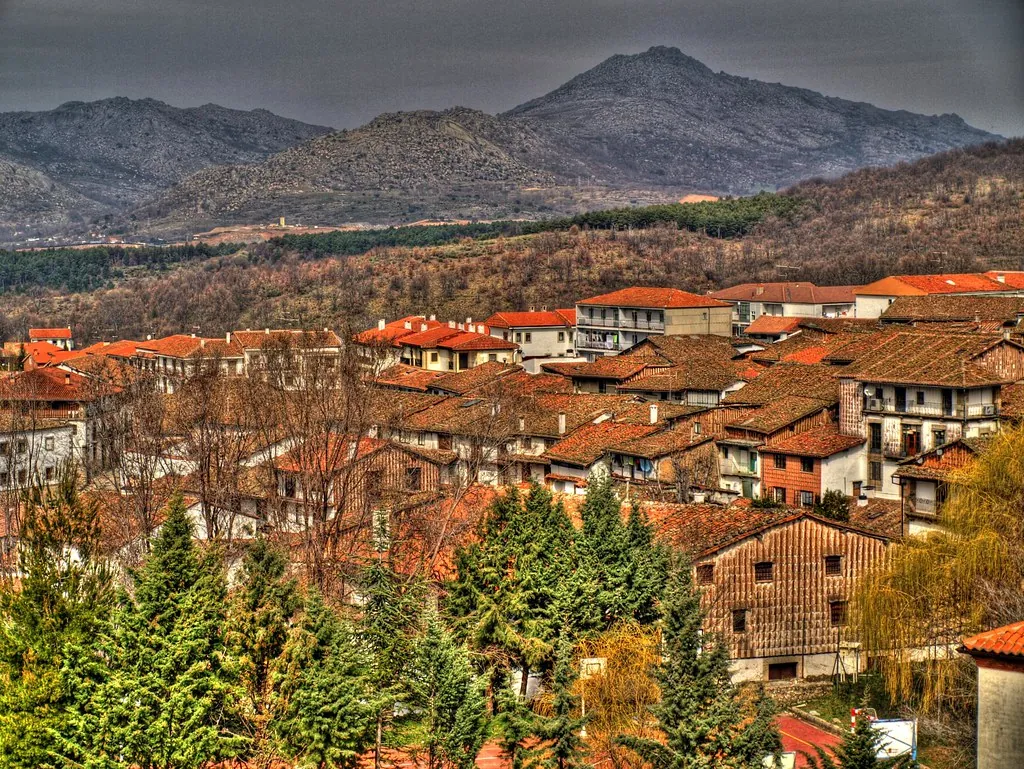
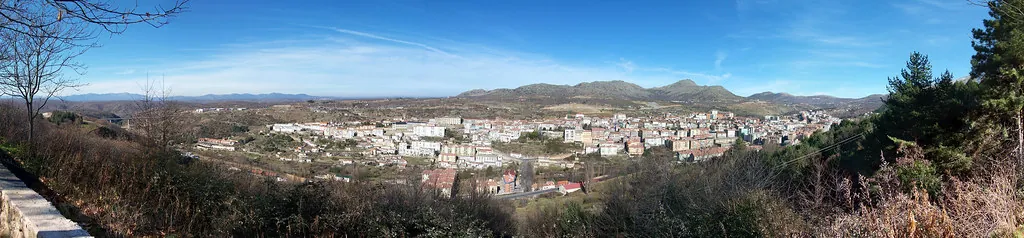
A town shaped by a steep hillside
Béjar occupies an awkward position in the Sierra de Béjar, spread across a slope that falls towards the valley of the river Cuerpo de Hombre. The terrain explains much of what visitors notice straight away: steep streets, stepped neighbourhoods and a layout that can feel irregular at first glance. In reality, it reflects how the ground was settled from the Middle Ages onwards, adapting to the hillside rather than imposing a strict plan.
There was a Muslim presence in the area, and a fortification was built to control the natural passage between the Meseta, Spain’s central plateau, and Extremadura. After the Christian conquest, the population expanded within and around the walled enclosure. The result is a historic centre where streets climb and dip with little apparent order, shaped more by gradient than by design.
The former Jewish quarter stood near the walled area, in what is now known as the Barrio de la Villa. No identifiable synagogue or specifically Jewish houses survive, which is common after centuries of rebuilding and alteration. Even so, the street pattern and certain place names preserve the memory of that community, which disappeared at the end of the fifteenth century.
Ducal power and a Renaissance residence
The Palacio Ducal stands on the site of the old alcazaba, the earlier fortress. The current building dates from the sixteenth century, a period when the Dukes of Béjar were among the leading noble families in Castile. Its Renaissance appearance sets it apart from much of the surrounding old town. There is an arcaded courtyard, stacked galleries and a façade more in keeping with a grand residence than a defensive stronghold.
One of the towers houses a cámara oscura. This optical device projects a real-time image of the exterior onto a surface by means of lenses and mirrors. The principle has been known for centuries, yet it still draws interest because it allows detailed views of the town and the landscape around it from inside the tower.
On the outskirts lies the estate of El Bosque, also linked to the dukes. This Renaissance villa includes a historic garden, a pond and leisure pavilions. Within Castilla y León there are few comparable examples of this type of aristocratic residence connected to leisure and landscape rather than purely to defence or administration.
The Hombres de Musgo
Each September, one of Béjar’s most recognisable traditions takes to the streets: the Hombres de Musgo, or Moss Men. Participants parade wearing outfits covered in natural moss attached to a fabric base. The full costume is heavy, which forces a slow, deliberate pace.
The custom is tied to a medieval legend. According to the story, Christian soldiers managed to enter the town at night disguised with vegetation, enabling them to retake it. There are no documents confirming the tale in the form it is told today, but the narrative has been passed down through generations.
The figure of the Hombre de Musgo is part of the celebrations of the Virgen del Castañar, the patron saint of Béjar. During these days of festivity, the moss-clad figures walk through parts of the historic centre, accompanying the various events held in her honour.
Mountain cooking
Local cooking reflects life in a mountain area with long winters. One of the best-known dishes is calderillo bejarano, a meat stew seasoned with paprika and cooked with potatoes. Traditionally, it was prepared for popular gatherings rather than for formal occasions.
Other dishes are simple and substantial: patatas revueltas with paprika, dressed roasted peppers and cured meats associated with the annual pig slaughter. These are home-style recipes, created to nourish rather than to impress.
In baking, traditional sweets made from almonds, sugar and egg are still prepared. Some were historically linked to convent kitchens or to specific celebrations in the religious calendar.
Walking through Béjar at an unhurried pace
The historic centre can be explored on foot in a relatively short time, although the gradients encourage a slower rhythm. Around the Palacio Ducal, the medieval origins of the town are particularly clear.
The church of Santa María la Mayor preserves Mudejar elements in its apse, a reminder of artistic influences that blended Christian and Islamic traditions. The church of Santiago retains parts of its original Romanesque structure, despite later alterations.
Roughly three kilometres from the centre lies El Castañar, a wood of centuries-old chestnut trees. Here stands the sanctuary of the Virgen del Castañar, who shares her name with the forest. It is one of the usual places where local residents go for a walk.
The former railway line, now converted into a Vía Verde, makes it possible to follow the valley northwards or towards the boundary with Extremadura. The tunnel section is among the best-known points along the route, a reminder of the infrastructure that once connected this mountain town to wider networks.
Béjar does not set out to rival the region’s larger monumental cities. Its appeal lies elsewhere: in the combination of a serrana town shaped by slopes, traces of medieval communities and ducal ambition, and a landscape that is always close at hand. The shifts in temperature inside a railway tunnel, the climb through the Barrio de la Villa, the slow procession of the Hombres de Musgo each September all form part of a place where geography and history continue to overlap within a compact area.