Full Article
about El Cerro
Mountain village overlooking the valley and chestnut forests
Hide article Read full article
A mountain village that keeps things simple
Anyone planning a visit to El Cerro should pay attention to the approach. The final stretch is along a mountain road with plenty of bends, especially near the top. At the entrance to the village there is usually space to leave the car, but there are no formal facilities. After heavy rain or snowfall, it is worth taking things slowly. The tarmac can be dirty, and in winter patches of ice sometimes appear.
El Cerro is small and does not take long to walk around. Morning is the best time to arrive, when there is still a bit of everyday movement and the streets feel calm without being empty.
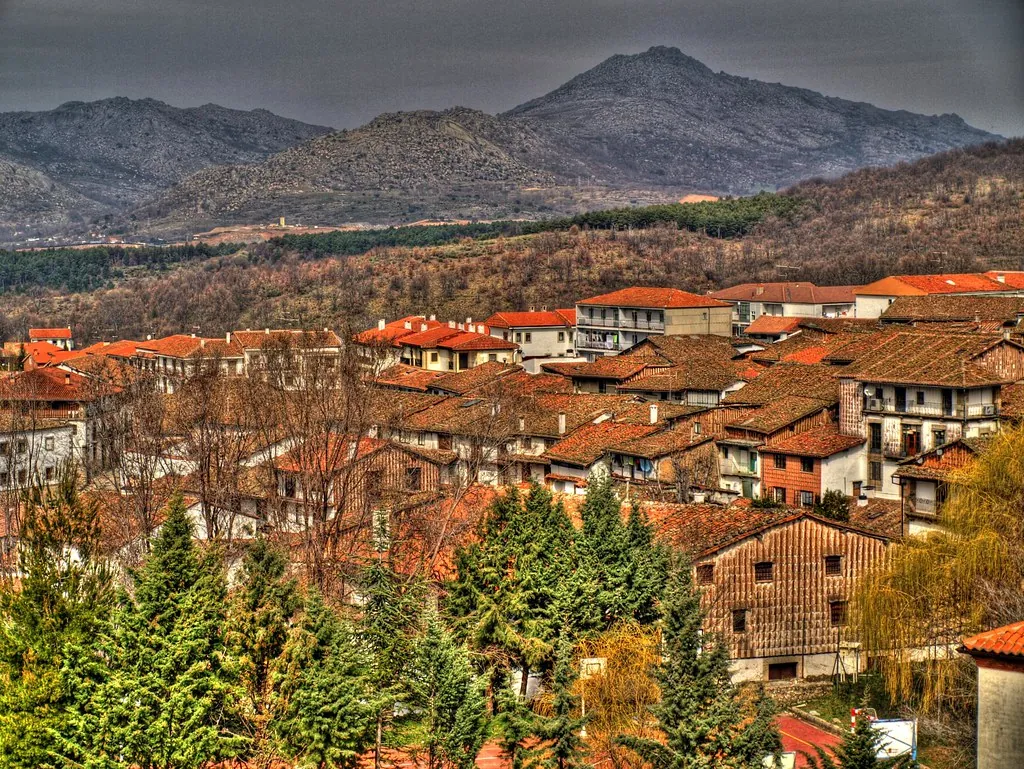
Set in the Sierra de Béjar, El Cerro is not a place of grand monuments or a historic quarter redesigned for tourism. What you see is what you get: granite houses, some with timber framing, narrow streets and slopes that force you to slow your pace.
Many of the houses are lived in all year round. This is not a village turned into a row of weekend second homes, although there are noticeably more people during the summer months.
Climbing to the church
The parish church stands at the highest point of the village. It is simple and functional, with no grand decorative features. It serves its purpose and little more.
Reaching it means climbing along cobbled streets that twist upwards between stone façades. On some houses you can still spot enclosed wooden galleries. Traditionally these were used to dry chestnuts and other produce gathered from the surrounding hills. There are not many left in this part of the region, which makes the examples in El Cerro stand out quietly.
The old streets are narrow and uneven in places. There is no curated route or explanatory signage. Walking here is simply a matter of following the slope and seeing where it leads.
Open views over the valley
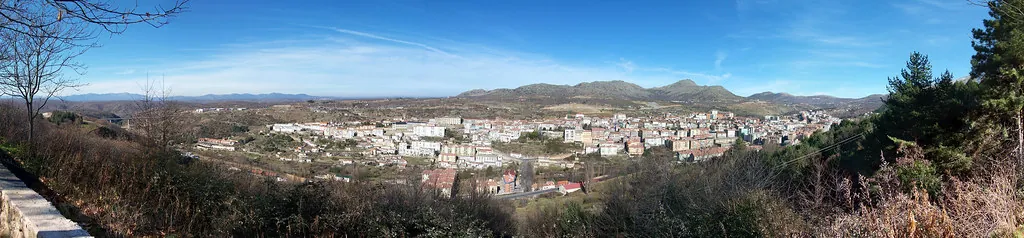
There are no designated viewpoints and no information panels pointing out the landscape. Even so, from the edges of the village there are clear views towards the valley and the surrounding hillsides.
All it takes is a short walk to the upper edge of El Cerro and a glance between the houses. Beyond the last walls, the land opens up into meadows, old chestnut trees and terrain that has long been worked for livestock or small vegetable plots. The sense is of an agricultural landscape shaped over time rather than a dramatic scenic attraction.
It is a place to pause briefly rather than settle in for hours. A few minutes looking out over the slopes is enough to understand the rhythm of the area.
Walking beyond the village
Often, the most interesting part of a visit lies outside the built-up area. From El Cerro, paths lead towards other villages in the Sierra de Béjar and into stretches of open countryside.
These are everyday tracks used by local residents, livestock and anyone heading out for a walk. Some sections involve changes in height, and after rainfall they can be muddy. Standard outdoor footwear is sufficient.
In autumn, many people come for mushrooms. Various species grow in the nearby woods, although it is important to know exactly what is being picked. This is not a managed foraging experience, simply a seasonal habit that draws visitors into the forests.
Wildlife can also be seen in the surrounding area, especially early in the morning or at dusk. Roe deer and wild boar appear with some frequency along the edges of the woodland in this part of the sierra. Birds of prey are often visible circling above the meadows. There is no formal nature reserve or wildlife observation centre here. It is open countryside, and encounters depend on timing and luck.
Food and seasonal traditions
The cooking that continues in El Cerro and the wider area is traditional mountain fare. Dishes are substantial, designed for people who spend long hours working outdoors. Meat stews, patatas meneás and embutidos de matanza remain common in many households.
Patatas meneás are a local potato dish, typically mashed and seasoned, associated with rural cooking in this part of western Spain. Embutidos de matanza refers to cured meats produced during the matanza, the traditional family pig slaughter that has long formed part of winter life in rural communities.
Chestnuts also feature strongly in season, reflecting the presence of chestnut trees across the Sierra de Béjar. They are used in different ways and remain closely tied to the identity of the area.
When the village fills up
August brings a noticeable change. During the patron saint festivities, people who live elsewhere return, and the streets become busier than usual. The atmosphere shifts, even if the physical setting remains the same.
In winter, some households still maintain the tradition of the family matanza. It is a private, domestic practice rather than a staged event for visitors, rooted in older forms of self-sufficiency.
Around San Antón, there is usually some form of blessing of animals or a bonfire where people gather for a while. These moments punctuate the quiet calendar of a small village that otherwise moves at a steady pace.
Getting there and moving on
From Salamanca, the drive takes a little over an hour. The final access is via a secondary mountain road with curves but no particular difficulty if driven carefully.
On arrival, do not expect extensive signage or visitor services. If there is any doubt at a junction, the simplest solution is still to ask someone in the village.
El Cerro is best approached as a short stop rather than a full-day destination. It can be seen quickly, but it works well as part of a broader route through the Sierra de Béjar, linking together several villages and stretches of open countryside.