Full Article
about El Maíllo
Mountain village ringed by oak and chestnut woods; noted for its food and natural setting.
Hide article Read full article
A village shaped by land and altitude
Tourism in El Maíllo begins with a simple reality: a small village on the southern side of the Sierra de Francia where landscape and traditional ways of life still set the pace. At close to a thousand metres above sea level, the settlement sits among oak and chestnut woodland that has supported the local economy for centuries, alongside livestock farming.
Its location explains much of its character. This edge of the Sierra de Francia has historically been more connected to the use of woodland than to major trade routes. As a result, El Maíllo developed without large-scale urban change and still keeps a layout that is easy to read.
Houses built with the slope
The village is arranged around a main street that follows the natural incline of the terrain. Houses are built with granite masonry and slate roofs, materials typical of the area. Many façades still feature wide doorways that once led to yards or stables, a reminder that livestock shaped daily life for generations.
Some walls display carved lintels or small family crests. They are not especially common, though they point to families who once held a certain standing within the community. In the older parts of the village, there are also cellars dug into the rock. These spaces were used to store wine or food, taking advantage of the steady underground temperature.
San Juan Bautista and the village centre
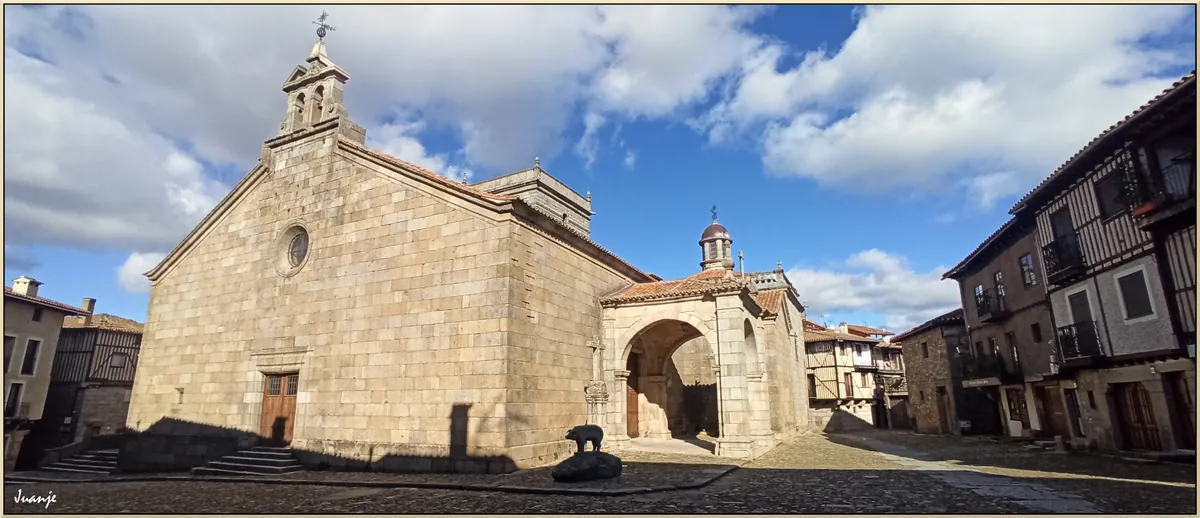
The parish church of San Juan Bautista stands in the middle of the small square. The building is usually dated to the 16th century, although it has been altered over time. It is not a monumental church, yet the stone bell tower and the restrained façade fit the kind of rural religious architecture found across many villages in the sierra.
Its position matters as much as its appearance. From the square, the structure of El Maíllo becomes clear: short streets, gentle changes in level and houses grouped around the church, which for centuries served as the main meeting point.
Chestnuts, oaks and moving water
The surrounding landscape forms part of the wider system of woodland that defines the Sierra de Francia. Chestnut groves stand out in autumn, when paths are covered with fallen leaves and split husks. Many of these trees are several decades old, some likely over a century, and they remain part of traditional woodland use.
Seasonal streams run down the nearby slopes, feeding small gorges. Maps show the upper course of the Yeltes not far away, though in the immediate surroundings what appears most often are these smaller watercourses descending towards the valleys.
The area is also a regular habitat for birds of prey associated with woodland. It is common to see short-toed eagles in flight or to hear woodpeckers in the oak woods, particularly in spring and early summer.
Paths linking the sierra
Several traditional paths start from El Maíllo and connect it with other settlements in the region. For centuries, these routes were used to move livestock or reach orchards and wooded areas. Today they can be followed on foot and offer a clear sense of the mountain landscape, with pasture, dry stone walls and patches of forest that appear and disappear with the contours of the land.
Some routes link up with other villages in the Sierra de Francia. It is worth checking maps or local information before setting out, as not every stretch is signposted.
Seasonal food and shared customs
The annual slaughter of the pig, known locally as the matanza, remains an important cultural reference in the area. From it come products closely tied to the region, such as farinato, a traditional sausage made with breadcrumbs and pork fat, along with various cured meats. Chestnut gathering in autumn is also part of the agricultural calendar.
These are not activities organised for visitors. Many families still collect chestnuts from their own groves, and these areas often have private owners. Boundaries should be respected and permission sought before picking anything.
Local cooking leans towards substantial winter dishes: pork-based foods, simple stews, seasonal mushrooms and recipes in which chestnuts appear frequently.
A quiet rhythm
The main festivities take place around 24 June, the day of San Juan Bautista. During those days there are religious events and neighbourhood gatherings that follow patterns typical of villages in the sierra.
Outside these dates, El Maíllo keeps a slow pace. It is a small place with few services, where daily life remains closely tied to the countryside and the woodland. Visitors tend to find quiet, walking routes and the sense of being in one of the less travelled corners of the Sierra de Francia.