Full Article
about El Tornadizo
Small village on the road to the sierra; livestock and forest
Hide article Read full article
A village shaped by its setting
El Tornadizo sits on the northern side of the Sierra de Francia, in the province of Salamanca, and offers a clear sense of how life once worked in this part of inland Spain before modern roads changed daily routines. At around 870 metres above sea level, its position is not accidental. The village developed with a practical aim: shelter from the mountain climate while making use of the available slopes.
For centuries, local livelihoods depended on livestock, small vegetable plots and the careful use of surrounding woodland. That balance between settlement and landscape is still easy to read today. El Tornadizo is small, but it reflects a way of organising space and work that was common across the region.
Building along the hillside
The village centre stands on a slight rise with open views towards the valley of the Alagón river. Its layout follows the terrain rather than a strict plan. Streets are narrow and, in places, slope steeply, adapting to the hillside instead of reshaping it.
The buildings combine stone walls with timber frameworks, a construction method widely used across the Sierra de Francia. It allowed sturdy homes to be built using materials found nearby. This practical approach defines much of the architecture here.
Several details still hint at how these houses functioned in the past. Wide gateways can be seen, once used to access stables or storage spaces. Windows often feature simple wrought-iron grilles. El Tornadizo is not a monumental site, but it is a good example of traditional mountain architecture, shaped by necessity rather than decoration.
San Pedro and the village centre
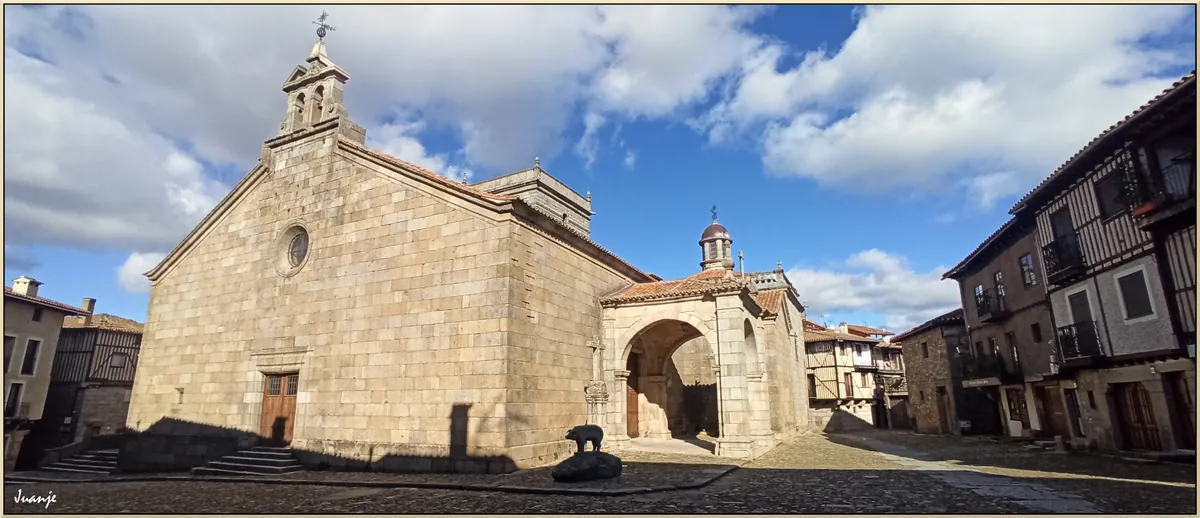
The parish church is dedicated to San Pedro. The current structure is usually dated to the 16th century, with later alterations that likely took place in the 18th century. This kind of gradual change is typical of rural churches, which were adapted or repaired over time rather than built in a single phase.
Its importance lies less in size and more in its role within the village. The church stands on a small square that acts as the centre of El Tornadizo. In places of this scale, such spaces were essential. They served as meeting points for celebrations, public announcements and everyday conversation, especially in the evening.
The square still helps define the rhythm of the village, even if daily life has become quieter than in the past.
Paths, woodland and the surrounding landscape
Around El Tornadizo, the landscape is made up of scrubland, oak trees and chestnut groves, a combination typical of this part of the Sierra de Francia. Not far away begins the area of the Natural Park of Las Batuecas–Sierra de Francia, though much of the immediate surroundings reflect long-standing human use: grazing land, chestnut orchards and small plots.
Old paths lead out from the village towards neighbouring settlements. Some are still used today as walking routes. They are not always signposted. These are earth tracks, sometimes muddy after rain, edged by stone walls and brambles. Walking along them gives a fairly accurate sense of how people once moved between villages before cars reshaped distances and habits.
In autumn, it is common to see people searching for mushrooms in the nearby woods. This activity remains an established part of local life, carried out with attention to land ownership and local rules.
Festive dates and daily rhythm
The village calendar becomes more active in summer. Many families who now live elsewhere return during this period, bringing a noticeable change in atmosphere. El Tornadizo fills with movement again: processions take place, shared meals are organised and music returns to the square. These celebrations follow patterns seen across many villages in the Sierra de Francia.
Outside these periods, life is quiet and closely tied to the pace of the countryside. The contrast between summer activity and the rest of the year is part of the village’s character.
A small place to explore on foot
El Tornadizo is very small and can be explored in a short time. It makes sense to leave the car at the entrance and continue on foot, especially in the narrower streets where space is limited.
Those interested in traditional building techniques will find plenty to notice. Timber frameworks remain visible in several houses, and some old gateways are still in place. On the edges of the village, dry stone walls mark out vegetable plots and paths, adding another layer to the landscape shaped over generations.
El Tornadizo does not rely on major landmarks. Its interest lies in how clearly it reflects a way of life adapted to terrain, climate and local resources, a pattern that can still be traced in its streets and surroundings today.