Full Article
about Herguijuela de la Sierra
Mountain village with Europe’s southernmost beech and traditional architecture
Hide article Read full article
A village where the volume drops
Herguijuela de la Sierra is one of those places that makes you check your phone to see if it’s on silent mode. You park the car, walk past three or four stone houses, and realize the loudest sound is your own footsteps. It’s not eerie, it’s just… quiet. The kind of quiet that feels physical.
With about two hundred people calling it home, this village in the Sierra de Francia doesn’t do fanfare. You won’t find a castle or a famous museum. What you get instead is the blueprint of mountain life: vegetable plots terraced into the hillside, paths that disappear into oak woods, and houses built from local stone that look like they’ve grown there. It’s functional, not decorative.
Coming here expecting a list of attractions is like bringing a surfboard to a reservoir. It misses the point. Herguijuela works as a full stop in your itinerary, a place where doing very little is the whole plan.
The square and everything else (it won't take long)
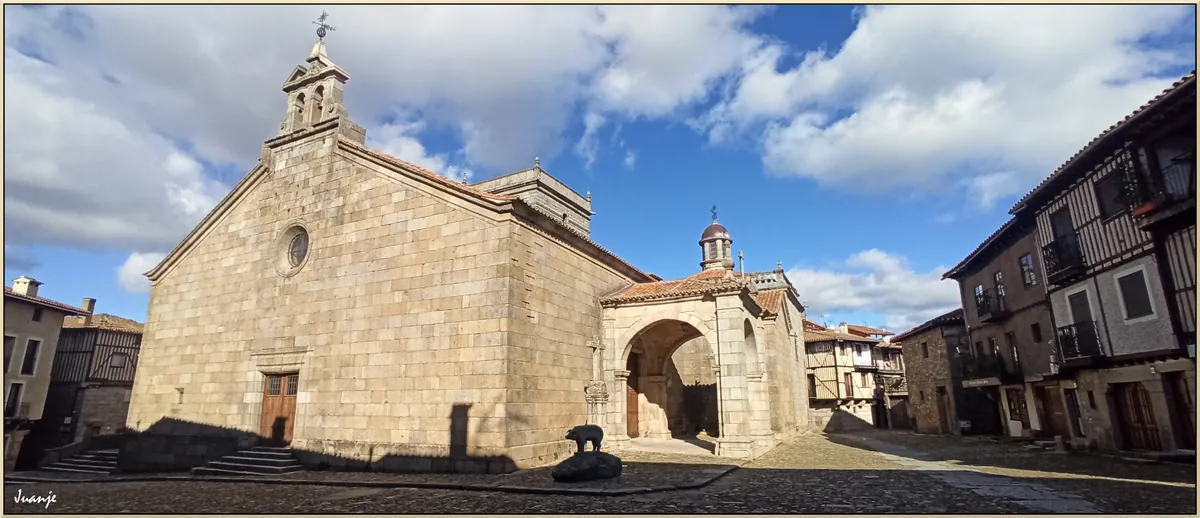
Life, such as it is, happens around the Plaza Mayor. It’s basically a widened bit of street with some benches and the church attached. You can cross it in twenty seconds. On a good day, you might see someone coming out of the bakery or a neighbour having a five-minute chat. The excitement level is roughly equivalent to watching paint dry, in the best possible way.
The church fits right in. It’s solid, simple, and smells faintly of old wood and wax. It feels used, like a well-worn tool, not a display case for religious art.
You can walk every street in Herguijuela de la Sierra in under an hour. The lanes are narrow enough to touch both walls if you stretch your arms. You’ll see geraniums on balconies, firewood stacked neatly by doorways, and maybe an old tractor parked up as if it’s taking a nap. You don’t need a map; getting lost is practically an achievement.
That small scale isn't a flaw. Think of it less as a day-trip destination and more as a quiet spot to crash after spending the day walking the sierra.
Where the pavement ends
Follow any lane downhill and you’ll hit the Herguijuela stream. In spring, after the thaw, it actually makes some noise. By late summer, it’s often just a trickle between the rocks—pretty standard for these mountains.
The real shift happens when you cross one of the little bridges and leave the last house behind. Suddenly you're in chestnut and oak woodland on paths padded with years of fallen leaves. In autumn, the colour change is subtle but everywhere; it turns a simple walk into something slower and more deliberate.
Keep your eyes open near the village edges and you'll see huertos, those terraced vegetable gardens held up by dry-stone walls. They still get used. It's not uncommon to spot someone bent over rows of potatoes or greens, working at a pace that hasn't changed much in fifty years.
Walking to the neighbours
The best thing about Herguijuela might be where it sits: right among other Sierra de Francia villages like Mogarraz or Cepeda. On paper they look close. On foot, you feel every metre of elevation gain on those stony trails that connect them.
The walks aren't extreme, but they're proper mountain paths—uneven underfoot with some honest climbs. Wear decent boots and bring water; even in spring, the sun here has bite.
Come autumn, you'll see cars parked along tracks and people wandering into the woods with baskets. They're after boletus and níscalos. If you're not sure what you're doing with mushrooms here, don't guess. Go with someone who knows.
This connectedness is what makes staying here worthwhile. Herguijuela itself isn't packed with things to do, but it puts you right in the middle of everything else.
Eating like you've been working outside
Don't expect multiple restaurant choices in a village this size. Often there's just one place open, if that. For variety, you drive to nearby towns.
The food here is built for recovery after physical work: thick stews, pulses cooked slowly with meat offcuts (cocido), hunks of local cured sausage (embutido). A real local quirk is farinato—a pale sausage made from breadcrumbs and pork fat that you fry up with eggs or peppers for breakfast or lunch—it's heavier than it looks but weirdly satisfying after hiking all morning. It's peasant food: filling, uncomplicated fuel for mountain life.
The bottom line
Let's be clear: nobody plans their summer holiday around Herguijuela de la Sierra alone. It doesn't have that kind of pull. What it offers is silence so deep you can hear yourself think, and access to walking country where you might not see another soul for hours. It's for when you want to switch off completely, or need an unassuming base between longer hikes. The sierra moves slowly here, and for once, that's exactly what feels right