Full Article
about La Alberca
Mountain village with untouched traditional architecture; first village declared a Historic-Artistic Site of Spain.
Hide article Read full article
A Mountain Village Shaped by History
La Alberca stands on the western slopes of the Sierra de Francia, in the province of Salamanca, at more than 1,000 metres above sea level. Its altitude and position in the hills have always mattered, shaping both daily life and the look of the village itself.
Tourism in La Alberca often begins with a well-known fact: in 1940 it became the first village in Spain to be declared a Conjunto Histórico‑Artístico, a protected historic ensemble. The title explains its fame, yet the real reason for that protection lies in its streets. The urban layout has changed very little over the centuries, and the overall fabric still reflects its medieval and early modern past.
The Sierra de Francia was an area of medieval repopulation linked to the Kingdom of León. Many of La Alberca’s features make more sense in that context: relatively isolated settlements, an economy centred on livestock, and a close, practical relationship with the surrounding woodland. The pattern of streets and the arrangement of houses follow that mountain logic rather than any formal urban plan.
Homes are built with stone, timber and adobe. Wooden frameworks are visible on façades, and balconies often hold flowerpots or small religious inscriptions. Phrases such as “Ave María Purísima” appear painted or carved on lintels. The steep terrain forces streets to twist and climb; architecture adapts to the hillside instead of imposing order upon it.
Despite its protected status, La Alberca is not a frozen museum. Many of these houses are still lived in, and everyday life continues to follow a rural calendar. The nearby Parque Natural de Las Batuecas‑Sierra de Francia remains part of that rhythm. The woodland, seasonal chestnuts and the traditional slaughter of the pig all play their role in local routines.
The Heart of the Village
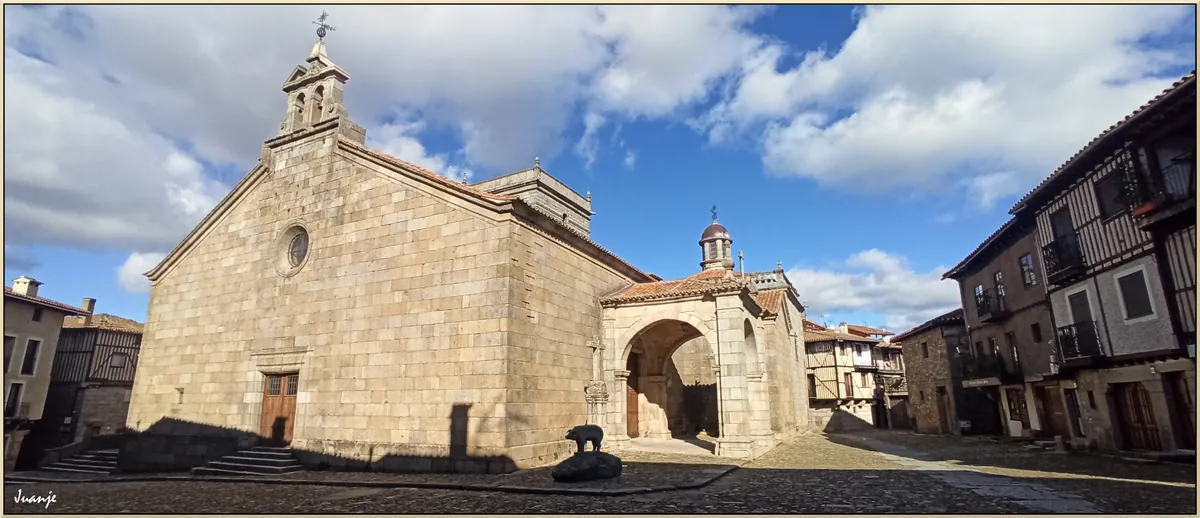
La Plaza Mayor acts as the village’s centre. Its irregular shape and wooden arcades recall a time when local trade was central to community life, and when the square doubled as a market space. At its centre stands an 18th‑century granite cruceiro, a stone cross typical of parts of the Iberian Peninsula, beside a fountain with four spouts that long served as a key water source.
Overlooking the rooftops is the parish church of Nuestra Señora de la Asunción. The present building dates from the 18th century and was constructed over earlier structures. Its baroque bell tower can be recognised from various points in the village. Inside, the atmosphere is sober. Elements such as the granite pulpit feel more in keeping with a mountain parish than with a large urban church.
From the square, the best approach is simply to wander. Calle de la Iglesia, the Cuesta de San Antonio and the Barrio del Castañar all preserve traditional architecture. On many façades, the timber beams have darkened over time. Upper storeys project outwards, and in some places the overhangs almost meet across the narrow streets.
Beyond the last houses, paths lead towards the Parque Natural de Las Batuecas‑Sierra de Francia. The landscape combines oak and chestnut with cork oak. Narrow gorges descend towards the valley, reinforcing the sense that village and mountain are closely intertwined.
Routes and Mountain Views
One of the best-known walks descends from La Alberca to the valley of Las Batuecas. There, a Carmelite monastery founded in the 16th century stands in a secluded setting. The route involves a significant change in altitude, so time and the return ascent need to be considered carefully.
Another frequent excursion heads to the Peña de Francia, which rises above 1,700 metres. On clear days, the view stretches across much of western Salamanca and, in the distance, towards lands in Extremadura. The height underlines how elevated this part of Castilla y León feels, with horizons that open wide when the weather allows.
The mountain roads attract many cyclists because of their long, steady climbs. For mountain bikes, forest tracks cut through chestnut groves and oak woods. Conditions vary considerably depending on the season, which affects both the terrain and the overall experience.
Local cooking remains closely tied to the pig. Hornazo, a bread dough filled with cured meats, often appears on outings and during celebrations. Chanfaina, a rice dish prepared with meat, is another staple. There are also limones serranos, a preparation that combines citrus fruit with cured sausage and egg. In autumn, chestnuts feature prominently in home cooking, reflecting the surrounding woodland.
Craft traditions still have a presence in the village. Traditional embroidery can be seen, along with fine goldsmithing. These techniques have been passed down through generations in the area and remain part of its identity.
Traditions That Continue
The festive calendar includes well-known celebrations in the Sierra de Francia. The most talked-about is the Marrano de San Antón, held in January. On that day a pig is released into the village streets. For months it roams freely, fed by residents, before being raffled for charitable purposes. The custom draws attention because of its unusual nature, yet it is rooted in a strong sense of community.
Beyond specific festivals, many customs remain linked to collective life. Processions, gatherings in the square and celebrations connected to the agricultural cycle continue to mark the year. These events reinforce the relationship between neighbours and the shared spaces they inhabit.
La Alberca is best understood at a slow pace. Details reveal themselves gradually: slanting beams, inscriptions on façades, the way balconies lean out over steep lanes. The constant presence of the sierra, visible at the end of a street or beyond a rooftop, frames everything. Here, the village and the mountain have evolved together, and that connection still shapes daily life.


