Full Article
about La Rinconada de la Sierra
Village on the slope of La Quilama; legend of the Cave of La Mora
Ocultar artículo Leer artículo completo
The only traffic jam in La Rinconada happens at 08:00 when five goats discover the bakery delivery van is carrying stale bread. They block the single lane for ninety seconds, horns tap the bumper, and then everyone carries on. At 1,050 m above sea level, this is the Sierra de Francia’s idea of rush hour.
A Village that Measures Time in Centuries, Not Seasons
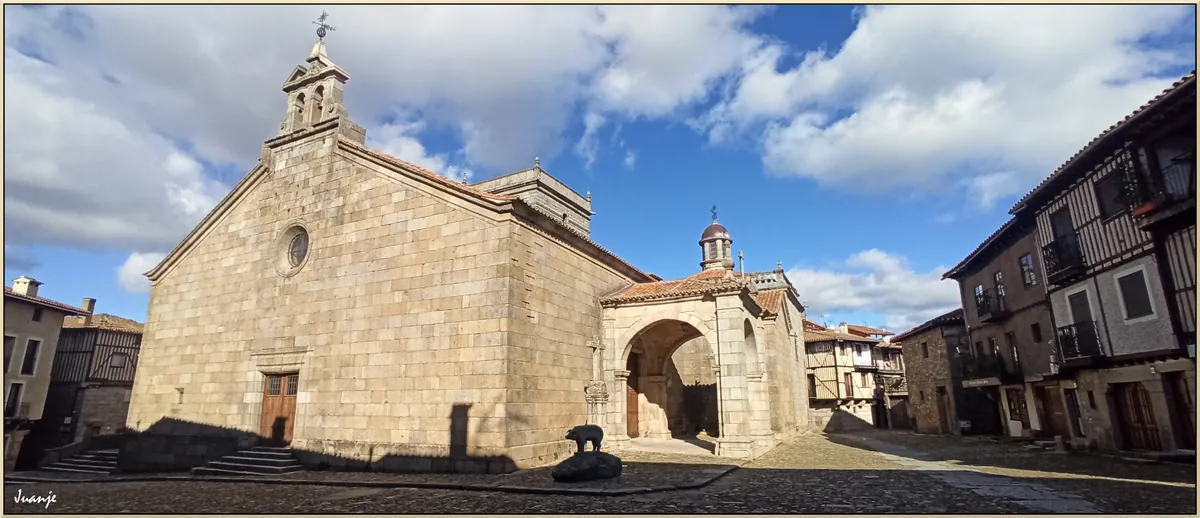
Stone walls the colour of weathered tweed press close together, their timber balconies jutting just far enough to shake hands across the alley. Most houses still wear the name of the family that built them—Casa Salva, Casa Mateos—carved into granite lintels dated 1783, 1821, 1897. The population has fallen, risen, and fallen again; today it hovers around a hundred souls, plus whichever grandson is fixing the roof for the weekend.
The altitude does strange things to the clock. July afternoons hit 30 °C, yet after sunset the thermometer can plummet ten degrees in the time it takes to finish a glass of local limón serrano. Bring a fleece even in August; night-time here is honest mountain air, not the soft stuff Madrid breathes.
Walking Tracks that Begin at the Front Door
No visitor centre, no ticket booth, no interpretive panels. Instead, a yellow arrow painted on a barn points towards Puerto de Linadero, 7 km away across oak dehesa where black Iberian pigs graze between acorns. The path is an old drovers’ road wide enough for two mules; it climbs gently, then drops into a chestnut wood where autumn leaves lie ankle-deep and the smell is cider and damp earth. Allow three hours there and back, and take a stick: the local shepherd says it discourages the mastiff that guards the goat herd halfway.
If that sounds too gentle, continue another 6 km to La Alberca, the region’s tourist darling. The reward is a bar that serves judiones—buttery white beans the size of conkers—though you will have to phone for a taxi back unless you fancy a 400 m climb to re-cross the ridge.
What passes for a High Street
There isn’t one. A single grocery van parks on Plaza de la Iglesia on Tuesday and Friday mornings; bread, milk, tinned tomatoes, gossip. The parish church keeps its doors unlocked; inside, the air is cool wax and 300-year-old pine. A laminated sheet lists the dead from both sides of the Civil War—six names under each heading, families still living opposite one another.
For anything more exotic than chorizo you drive 25 minutes to La Alberca or 45 to Salamanca. Stock up before you arrive: La Rinconada has neither cash machine nor petrol station, and the nearest pharmacy is a white-knuckle descent to Villanueva del Conde.
Winter Comes Early and Stays Late
December turns the village into a whisky advert without the distillery. Snow is patchy but possible; roads are gritted only after someone phones the council. Most second-home owners retreat to Salamanca, leaving a handful of pensioners and the British couple who bought Casa Salva for its nine bedrooms and now heat just two. Rental prices halve between November and March; if you crave silence, book then. Just remember to bring chains and a sense of self-reliance—when the electricity fails (twice last January) the outage lasts until an engineer drives up from the valley.
Summer is kinder. Day-trippers from Madrid appear at weekends, cameras slung, voices loud, but by 18:00 even they have moved on. The village’s own fiesta, around 15 August, doubles the head-count for forty-eight hours: a brass band, a paella pan three metres wide, and teenagers who have flown in from Barcelona suddenly remembering how to speak the local dialect. If you dislike spontaneous fireworks at 03:00, choose another weekend.
Food that hasn’t Noticed the 21st Century
No tasting menus, no foam. In Casa Salva’s kitchen you slice jamón ibérico from Guijuelo—twenty minutes west, tasting room open daily—and fry it with eggs from the neighbour who knocks at nine o’clock with a basket and a running total. Patatas meneás, potatoes smashed into paprika-streaked chorizo oil, taste better eaten on the stone doorstep while swallows cut arcs overhead.
The one restaurant within the municipal boundary opens Friday through Sunday only. It has four tables, no written menu, and serves whatever María Luisa bought that morning. Goat stew arrives in an earthenware bowl, the meat still on the bone, gravy thick enough to mop with rough bread. Expect to pay €14 including wine that arrives in a plastic bottle and tastes better than it should.
Getting Here Without Losing Your Nerve
Fly London–Madrid (2 h 15 min), collect a hire car at Barajas, and head west on the A-50. After Salamanca, the SA-300 twists south for 38 km; allow 45 minutes because you will brake for wild boar. The final 6 km are tight switchbacks with stone walls instead of crash barriers—first-timers swear, locals text while overtaking. Sat-nav loses signal in the last gorge; download offline maps before you leave the motorway.
No bus serves the village. A taxi from Salamanca costs €90 each way and the driver may refuse if snow is forecast. In short, bring wheels or stay home.
Honest Epilogue
La Rinconada de la Sierra will not change your life. It offers no souvenir shops, no sunset yoga, no boutique anything. What it does give is a measuring stick: against the hiss of village fountains you will notice how loud your own thoughts have become. Stay three nights and the goats will recognise you; stay a week and the baker remembers how you like your coffee. Leave before the novelty turns to restlessness—this place is a mirror, not an escape.