Full Article
about Linares de Riofrío
Gateway to the Sierra de Francia; known for its strawberries and the wooded natural setting of La Honfría.
Hide article Read full article
A place you recognise before you see it
Some places announce themselves before you’ve even taken a proper look around. Linares de Riofrío does it through smell. If you happen to arrive on Lunes de Aguas, a local springtime celebration, the scent of hornazo hits as soon as you step out of the car. This traditional pastry, filled with meat, becomes the centre of the day.
Half the village seems to be running the same operation: cool boxes packed, folding tables under arms, everyone heading up towards the Cerro del Buen Suceso. At certain moments, the queue to buy hornazos stretches out in a way that feels more like a cinema premiere than a village gathering.
It sets the tone quickly. Linares is not a place that stays quiet when something is happening.
The lime that built beyond the village
There’s a visual clue that ties Linares de Riofrío to the wider province. Many of the houses are built with a dark stone that looks familiar if you’ve spent time in the city of Salamanca. That resemblance is no coincidence.
For decades, lime kilns operated here, and much of the stone produced ended up in construction projects across the region. What is now a landscape of woodland and walking paths was once busy with activity: carts moving up and down loaded with stone, smoke rising from the kilns, workers spread across the hills.
The kilns have long since fallen out of use. What remains are fragments: partial walls, structures softened by vegetation, outlines that only fully make sense once you know what stood there.
There is a walking route that links several of these old kilns between Linares, Escurial de la Sierra and Navarredonda. It is not the kind of trail filled with large explanatory panels. Much of the story survives through conversation. Older residents still remember how the kilns worked, and talking to them often fills in more than any sign could.
Strawberries, meat and meals that keep going
Ask about Linares in nearby villages and two things tend to come up: strawberries and meat.
Strawberries have become a small but clear marker of local identity. During the season, stalls appear and people come specifically to buy them. They are known for tasting like proper strawberries, the kind that stain your fingers and give off their scent before you even take a bite.
Then there is the food more broadly. In this part of the Sierra de Francia, eating well is simply part of life. Sit down at a local table, whether in a private home or at a village gathering, and the rhythm is familiar. First come the cured meats, then something grilled, and just when it seems the meal is winding down, another dish arrives.
It is the sort of meal that makes a walk afterwards feel less like a choice and more like a necessity.
A church shaped over time
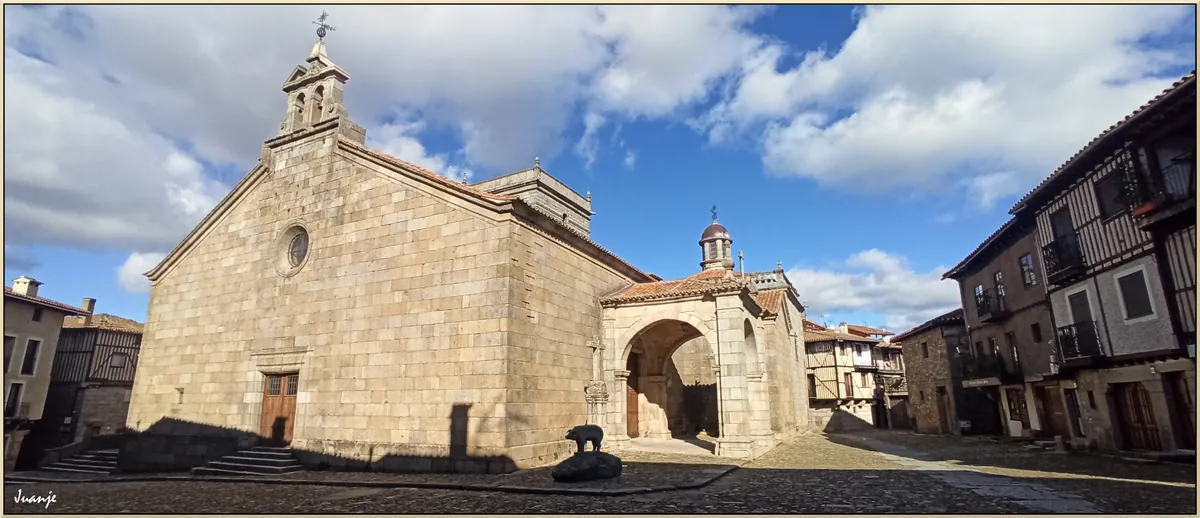
The church of Nuestra Señora de la Asunción carries the layered feel of a building that has changed across centuries. Its apse preserves a notably old Romanesque arch, while the rest of the structure was completed later. The differences become clear with even a brief look.
From the square, the bell gable stands out. With its rounded stone details at the corners, it draws the eye without needing to be especially large or imposing. There is something slightly puzzling about how its elements fit together, the kind of detail that invites a longer look.
A little further uphill sits the ermita del Buen Suceso. It is much simpler: stone walls, quiet surroundings, and that familiar mix of wax and damp that lingers in chapels still in regular use. When the romería, a traditional pilgrimage-style gathering, takes place, the hill fills with families carrying folding chairs and bags of food. From a distance, it looks less like a solemn event and more like a shared outdoor meal.
La Honfría and the pull of the hills
The route towards La Honfría begins gently, then gradually demands more effort. The round trip covers several kilometres, with stretches of climbing that make themselves felt in your legs.
The reward is the holly forest. In some sections, the trees close in so tightly that even in the height of summer the atmosphere turns cool and dim, as if the season has quietly shifted. Decades ago, this landscape served as a filming location for a Jaime de Armiñán film, a detail that still comes up in local conversation from time to time.
For those who continue upwards, Pico Cervero marks the highest point in the area. From there, the structure of the Sierra de Francia becomes clear: chains of mountains, villages clinging to the slopes, and roads that appear carefully traced across the terrain.
Getting the timing right
It helps to arrive with the right expectations. Linares de Riofrío is not a village that stays sleepy all year. In August, it becomes noticeably busier, especially with people returning to family homes or spending time in the hills. The atmosphere is livelier, though it comes with more movement and activity.
Spring tends to suit the area particularly well. There is water in the hills, strawberries begin to appear, and walking routes are manageable without turning into a battle with mud. Autumn brings a shift in colour to the chestnut groves, though good footwear becomes important if there has been rain.
One simple habit works in any season: spend some time sitting in the main square without rushing. In places like Linares de Riofrío, conversations unfold at their own pace. Ask about the old lime kilns or about what life was like here decades ago, and someone will usually pick up the thread. When that happens, the village stops feeling like a point on a map and starts to take on a clearer voice.