Full Article
about Miranda del Castañar
Walled medieval town on a promontory; noted for its castle and intact defensive layout.
Hide article Read full article
A hilltop village shaped by its past
On the western side of the Sierra de Francia, set on a rise overlooking the surrounding valleys, stands Miranda del Castañar. Tourism here revolves largely around its medieval form, which is not a reconstruction but a layout that has remained in use over time. The old walls still define the edge of the historic centre, and they explain why the village gathers into narrow, steep streets.
This position was deliberate. In the Middle Ages, Miranda del Castañar controlled routes leading from the southern mountains towards the Meseta, the central plateau of Spain. That defensive role can still be read in the gateways through the walls and in the way the houses are arranged. The structure of the village continues to reflect that earlier purpose.
Streets within the walls
The historic centre has an unusual sense of continuity. The wall encircles the settlement and preserves several of its traditional प्रवेश points, which once regulated access to the interior.
Inside, the streets follow the natural slope of the land. There are cobbled stretches and tight passages where buildings combine stone, timber framing and overhanging wooden balconies. Some façades display carved coats of arms. These hint at families who held local importance in later centuries, when Miranda had commercial activity linked to the surrounding mountains.
The village was recognised as a Conjunto Histórico-Artístico in the 1970s, a designation in Spain that highlights places of historical and artistic value. That recognition came largely because the urban layout had been preserved with so little alteration.
The castle of the Zúñiga
At the highest point within the walls stands the castle of the Zúñiga, built in the 14th century. Its outline dominates the village skyline.
Today the building is privately owned and is not usually open to visitors inside. Even so, its position helps explain how the settlement functioned. From here, it was possible to watch over the approaches to the Sierra and the routes connecting with the plains around Salamanca. The castle anchors the layout, both visually and historically.
Churches and small shrines
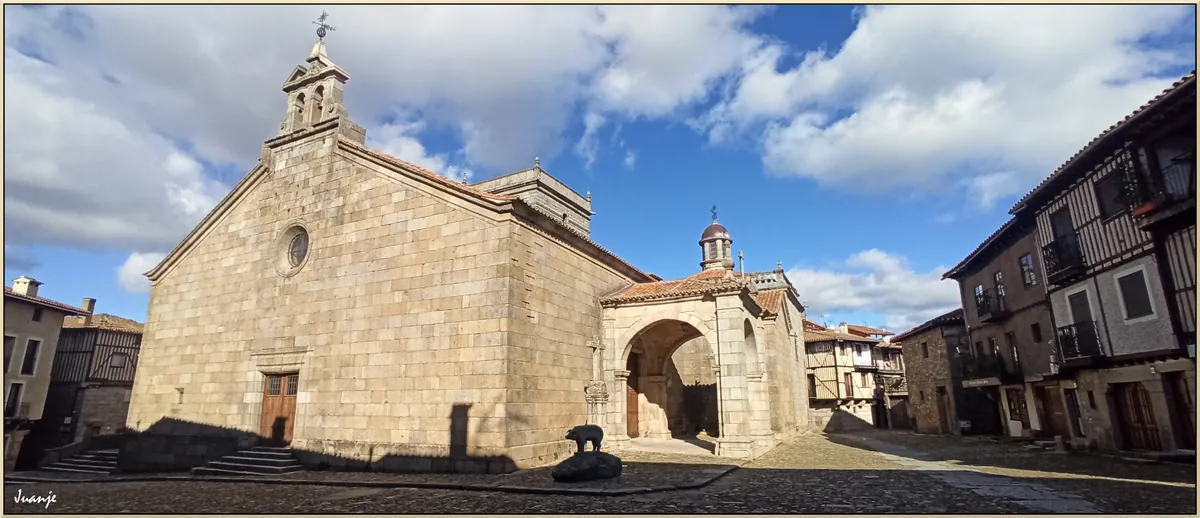
In the centre of the old quarter is the church of San Ginés de Arlés, a 17th-century building with a simple bell gable. It is not a monumental structure, yet it plays a central role in village life, closely tied to the nearby square and its daily rhythm.
Near one of the gateways in the wall stands the ermita of Nuestra Señora de la Cuesta, usually dated to the 13th century. The slope around it gives a sense of how access to the village once worked, before the arrival of modern roads. Approaching on foot would have meant negotiating this terrain, with the walls and their entrances marking a clear boundary.
A bullring within the walls
One of the more unusual features of Miranda del Castañar is its bullring, built at the beginning of the 18th century inside the walled enclosure. Its structure adapts to the limited space and is integrated into the surrounding houses.
When there are no events taking place, the space blends into the everyday life of the neighbourhood. It illustrates how certain traditions became part of the built fabric in mountain villages like this one, rather than existing as separate or purpose-built venues.
Paths and woodland beyond the village
Step outside the walls and the landscape shifts quickly. The surroundings of Miranda del Castañar combine chestnut groves, oak woods and small agricultural terraces.
Several marked paths begin in or near the village. One of the best known leads to the Chorrero de la Serrá, a waterfall that usually carries more water during wetter months. The condition of the path can vary depending on recent rainfall, so the experience changes with the seasons.
Autumn brings a different kind of activity. The nearby hills attract both locals and visitors for mushroom foraging. Níscalos, boletus and other species appear in the pine and chestnut woods of the area. Local regulations apply, and private land is taken seriously, so it is important to be aware of where access is permitted.
The chestnut trees themselves are tied to the traditional economy of the region. For centuries, chestnuts were dried in small structures scattered across the Sierra, allowing them to be stored and used throughout the winter months. This practice shaped both the landscape and local livelihoods.
Walking through Miranda del Castañar
The village is best explored on foot. Cars are generally left outside the historic enclosure, and the natural way in is through one of the gateways in the wall.
A relaxed walk through the main streets takes around an hour. Along the way, small details stand out: wooden galleries, interior courtyards glimpsed through large doors, and walls that still show traces of old repairs. These elements are easy to miss at first glance, yet they reveal how the village has evolved without losing its continuity.
Miranda del Castañar does not feel like a place designed for display. Its streets and buildings have remained in use over centuries, and that ongoing life is visible in the layout, the materials and the way the space is organised.