Full Article
about Monforte de la Sierra
Small village with privileged views of the sierra and quiet.
Ocultar artículo Leer artículo completo
The church bell strikes noon and the sound carries clear across the valley, bouncing off slate roofs and stone walls before dissolving into the chestnut forests below. From the village edge, the view drops away through terraces of ancient trees to the River Francia, 300 metres beneath. This is Monforte de la Sierra, a settlement so small that conversations carry from one side of the plaza to the other without anyone raising their voice.
At 835 metres above sea level, the village sits high enough that summer nights require a jumper, even when Salamanca city swelters forty kilometres away. The altitude shapes everything here: the architecture, the agriculture, the pace of life. Houses huddle together, their southern-facing balconies designed to capture every ray of winter sun. Streets climb at angles that would give a mountain goat pause, paved with stones worn smooth by centuries of hooves and boots.
The Architecture of Survival
Monforte's buildings tell the story of a community that learned to work with what the mountain provided. Local slate forms the roofs, heavy slabs that keep houses cool in July and withstand the snow that arrives most winters. The stone walls, thick as a forearm is long, incorporate whatever the builders found to hand—chunks of quartz, river pebbles, the occasional fossil. Wooden beams, dark with age and woodsmoke, criss-cross the facades in the traditional mountain style known locally as entramado.
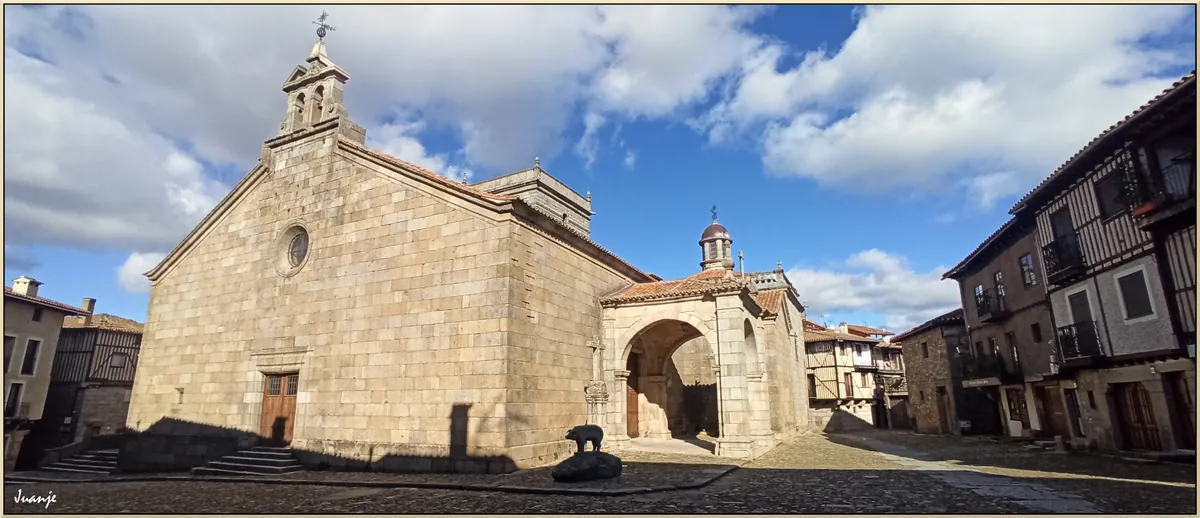
Walk the lanes at dusk and you'll spot the remnants of communal bread ovens, their blackened mouths set into walls like missing teeth. These served entire neighbourhoods until the 1960s, when electricity finally reached the village. Near the upper fountain, someone has carved 1789 into a door lintel, though whether this marks construction or renovation, nobody seems certain. The church, modest and proportioned to serve a congregation that has never exceeded 200 souls, stands sentinel over it all, its bell still rung by hand for services and funerals.
The village proper takes roughly forty minutes to traverse at strolling pace, assuming you stop to peer into the plazoletas where elderly residents sit in semicircles of plastic chairs, discussing the price of chestnuts and whose grandson has found work in Madrid. These impromptu gatherings happen nightly between May and October, dissolving only when the mountain air turns too sharp for comfortable conversation.
What Grows Between the Stones
October transforms Monforte into a copper kingdom. The chestnut harvest begins when the nuts start dropping onto corrugated roofs with sounds like gunshots, continuing until the first serious frost. Local families still practise the traditional munteo—collecting with long-handled wooden tools that resemble lacrosse sticks, working methodically through designated plots that have passed through generations. The going rate runs €3-4 per kilo at the cooperative in nearby Villanueva, though most villagers keep enough back for their own winter stores.
The forests support more than chestnuts. From late October through November, mushroom hunters disappear into the oaks and pines, returning with baskets of níscalos (golden chanterelles) and the prized boletus edulis. But this isn't amateur foraging territory—the regional government requires permits for collection, and the Guardia Civil do patrol popular areas. Unprepared visitors have been known to spend cold nights in the woods after underestimating both the terrain and how quickly mountain fog can descend.
Spring brings different treasures. Wild asparagus pushes through abandoned terraces during April, and the local council maintains several kilometres of marked paths specifically for its collection. The spears sell for €8 per kilo in Salamanca's markets, but here they're simply dinner, scrambled with eggs from village hens and served with farinato—a local sausage of bread, pork fat and paprika that tastes far better than it sounds.
Walking the Old Ways
The network of traditional paths connecting Monforte to neighbouring villages predates the Romans, though today's waymarkers owe more to EU funding than ancient stones. The GR-14 long-distance trail passes within two kilometres, offering serious hikers access to 35 kilometres of marked routes through the Sierra de Francia. More manageable options include the circular walk to Villanueva del Conde (12 kilometres, four hours) or the shorter ascent to Cerro de Miranda, which at 1,230 metres provides views clear to Portugal on crystalline winter days.
Summer walking requires strategy. Start early—by 10 am the sun hits the southern slopes with intensity that makes exposed sections unpleasant. Carry more water than seems necessary; village fountains marked agua potable are safe, but streams can run dry between July and September. Proper footwear matters more than fancy kit—these paths served mules and goats long before tourists, and loose scree waits to punish the overconfident.
Winter access presents its own challenges. Snow falls on average fifteen days per year, and while the main access road stays open, the final five kilometres from La Alberca become treacherous without chains. The village keeps one 4×4 for emergencies, but visitors shouldn't count on rescue. January and February offer solitude and spectacular photography conditions—if you can reach the village at all.
Eating and Sleeping, Mountain Style
Monforte contains no hotels, no restaurants, no bars. Accommodation means renting a village house—expect to pay €60-80 nightly for a two-bedroom place with functioning fireplace, though check whether firewood costs extra. The village association maintains four restored properties, all bookable through the regional tourism office in Salamanca. Each includes kitchens stocked with the basics: decent knives, pressure cookers for the altitude, and usually a bottle of local orujo left by previous guests.
Shopping requires planning. The tiny ultramarinos in Villanueva del Conde, six kilometres down the mountain, stocks essentials but closes for siesta between 2 pm and 5 pm. Better to provision in Salamanca before ascending. The village fountain provides excellent drinking water—bring containers, as plastic bottles make no sense environmentally and glass is heavy to carry uphill.
For meals out, La Alberca offers several decent options fifteen minutes' drive away. Try Casa Gregorio for judiones—giant butter beans slow-cooked with ham hock—or the simpler Bar Franchi for patatas meneás, potatoes mashed with paprika and chunks of farinato. Both serve local arribes red wine, though at altitude it goes to your head faster than coastal Spaniards care to admit.
The Quiet Reality
Monforte de la Sierra will never suit everyone. Mobile reception remains patchy—Vodafone works near the church plaza, Movistar requires walking to the cemetery for signal. The nearest cash machine stands twenty kilometres away in Miranda del Castañar, and it ran out of money last August bank holiday weekend. English is barely spoken; attempts in Spanish are appreciated, but the local accent carries a mountain thickness that even Madrid natives sometimes struggle to parse.
Yet for those seeking somewhere that tourism hasn't optimised into oblivion, where the night sky still overwhelms with stars and where neighbours share gossip across lanes barely two metres wide, Monforte offers something increasingly rare. Just don't expect to find it listed in every guidebook—or indeed, any of them.