Full Article
about Monsagro
Village in the heart of the sierra, known for the marine fossils visible on house façades.
Hide article Read full article
A mountain village shaped by stone
Monsagro stands on the western side of the Sierra de Francia, in the province of Salamanca, at around 930 metres above sea level. Home to just over a hundred residents, it has the form typical of a mountain settlement. Streets climb the slope in irregular lines, and houses adjust to the terrain rather than imposing order upon it. From various points in the village the land opens out towards the west, where lower sierras and open scrubland mark the gradual transition into Extremadura.
The architecture reflects this upland way of life. Stone dominates, sometimes combined with timber framing on façades and topped with slate roofs. Many homes still have corrals or small vegetable plots close by. For generations, domestic livestock and self-sufficiency have played an important part in daily life here, and that pattern has not entirely disappeared.
Not everything has been restored or arranged with visitors in mind. That lack of polish gives the village a certain clarity. Monsagro remains, above all, a place where people live.
One detail stands out when walking slowly through the streets. Several façades contain fossils embedded in the stone blocks. These are very ancient marine remains, visible in the masonry of some houses. They were not placed there as decoration. They form part of the local rock traditionally used for construction. Their presence is a reminder that this whole area lay beneath the sea hundreds of millions of years ago, a geological aspect that has attracted growing attention in recent years.
Church, houses and fossils in the walls
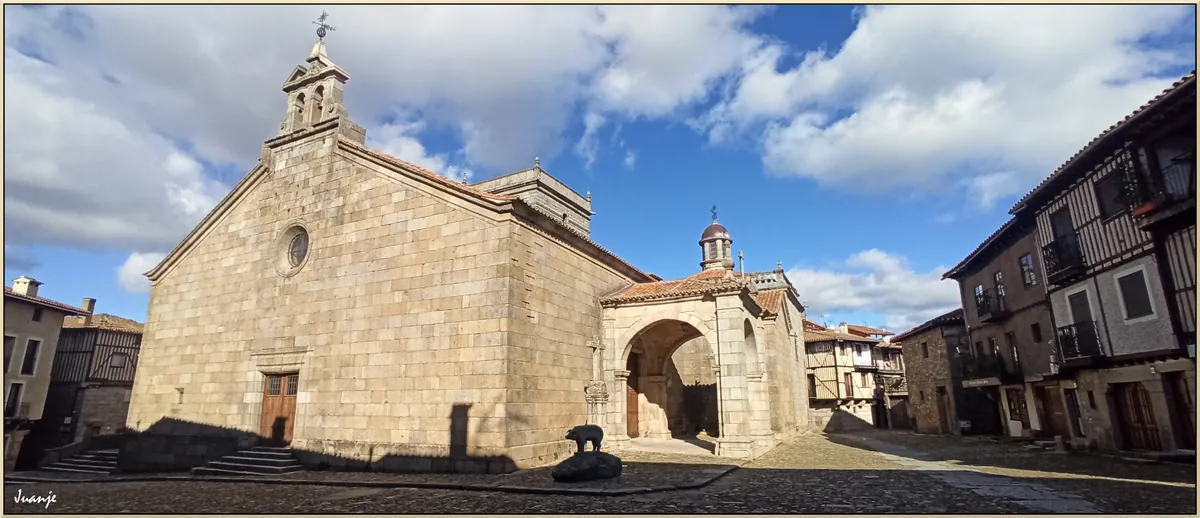
The church of San Pedro Apóstol occupies one of the highest points in the village. The present building reflects different phases of construction, something common in settlements that have been in continuous use for centuries. Its tower acts as a visual reference point from the surrounding valley.
The interest of the historic centre lies more in its details than in a single landmark. Wooden lintels appear above doorways. Wide gateways were designed to allow animals or carts to pass through. On some walls, mason’s marks and carved dates are still visible. The houses do not follow one single pattern. Some display simple rubble masonry, while others combine stone and timber, with south-facing balconies or galleries positioned to capture winter sun.
The fossils embedded in many of the façades are probably the village’s most distinctive feature. With a little attention, the shapes of trilobites and other marine organisms can be recognised in the stone. They are not individually signposted. Part of the appeal lies in spotting them independently while wandering through the streets.
Paths through chestnut and oak
The immediate surroundings consist of scrubland mixed with woodland. Chestnut trees, oaks and holm oaks grow on the slopes around the village. In autumn the change in colour is noticeable across the hillsides.
Traditional paths lead out from Monsagro towards other settlements in the sierra. Some of these routes are still used for walking today and offer a sense of how people moved around before modern roads were built. The terrain demands constant effort. Ravines cut into the land, small agricultural terraces interrupt the slopes, and hillsides open towards nearby valleys.
On clear days, the highest points within the municipal area offer views of the Peña de Francia, one of the main geographical landmarks of the region. Its silhouette forms part of the broader landscape of the Sierra de Francia and provides a point of orientation in the distance.
Everyday rhythms and local traditions
The main festival centres on San Pedro, the village’s patron saint, at the end of June. Celebrations are simple and intended primarily for residents and those who maintain family ties to the area.
For much of the year, daily activity follows the rhythm of a small rural community. Fieldwork continues. Vegetable plots require regular care. Small-scale livestock farming remains part of local life. In autumn, chestnut gathering and mushroom foraging still have a presence, although these activities are increasingly regulated in order to prevent problems in the countryside.
Traditional cooking in the area relies on what the surroundings provide. Cured sausages prepared in winter are common, along with substantial stews and seasonal produce. There are not many places to eat in the village, and some open only at certain times of the year.
Practical notes for a visit
Access to Monsagro is via a mountain road. It is in good condition but includes narrow stretches and bends, so a calm approach is advisable.
The village centre can be explored on foot in a short time, although the slopes are noticeable. Rather than following a fixed route, it makes sense to walk slowly through the streets and look closely at the stonework of the façades. Many of them contain fossils that are visible to the naked eye.
Services are limited, and activity varies considerably depending on the season. It is usually wise to arrive with some prior planning if you intend to spend several hours in the village.