Full Article
about Nava de Francia
Village at the foot of Peña de Francia; starting point for the climb to the sanctuary.
Hide article Read full article
Before You Set Off
A trip to Nava de Francia requires a bit of planning. From Salamanca, the drive takes around an hour and a half. The road climbs up from the area of La Alberca, and the final stretch includes tight bends. In rain or fog, progress is slow and demands attention.
Parking is rarely an issue. The village is small, and many cars are left along the edges of the centre. From there, everything is reached on foot within a few minutes. Distances are short and there is no need for long walks between sights.
This is not a place that overwhelms with landmarks. It is a small settlement in the Sierra de Francia, and it feels like one.
A Small Village with Traditional Roots
Nava de Francia has just over a hundred residents. It does not take long to walk from one end to the other. A handful of streets form the layout, with stone houses and noticeable quiet during the week.
The buildings follow the traditional style of the sierra. Thick walls help with insulation, wooden window frames add contrast to the stone, and large gates open into courtyards. Some houses still have corrals and small vegetable plots attached to them, reminders of a way of life that centred on agriculture and livestock.
There are no grand civic buildings and no wide, formal squares. The main street runs through the village square and ends near the church. That simple route gives a clear sense of the place. The scale is modest and the pace unhurried.
Silence defines much of daily life here, particularly outside the summer months.
Santa Ana Church and the Rhythm of the Year
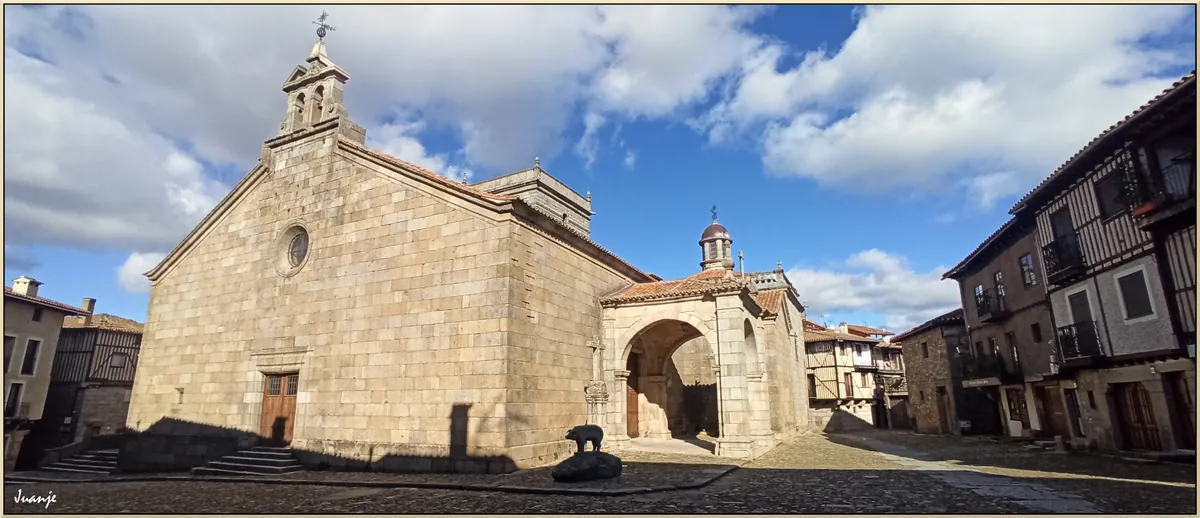
The parish church of Santa Ana is the most visible building in Nava de Francia. Built in stone, it has a simple volume and very little decoration. Its appearance matches the rest of the village. It is functional and unadorned, with no attempt at grandeur.
During summer, the atmosphere changes. Families who spend the rest of the year elsewhere often return, and the streets feel livelier. In August, a traditional procession takes place. It is a small, very local event rather than a large festival. For visitors unfamiliar with Spanish village life, a procession usually involves carrying a religious image through the streets, accompanied by neighbours and relatives. Here, it remains intimate and rooted in community ties.
Outside those dates, the mood is calm. At times, it can feel extremely calm. Shops and services are not guaranteed to be open throughout the year. This is normal in small mountain villages, where activity follows seasonal rhythms.
Walking Beyond the Village
The most rewarding part of Nava de Francia lies beyond the built-up area. Forest tracks and footpaths spread out around the village, crossing chestnut groves and oak woods. Not all routes are well signposted, so it is sensible to carry a map or download the route onto a mobile phone before setting out.
There are no constructed viewpoints and no platforms designed for photographs. These are agricultural and forestry paths, used for practical purposes rather than tourism. Even so, a short walk is enough to understand the landscape of the Sierra de Francia. The terrain, the trees and the open views over the valley gradually come into focus as you move away from the houses.
The scenery changes with the seasons. In autumn, the chestnut trees transform the hillsides. In spring, streams carry more water and green tones dominate the valley. Each period brings a different atmosphere, but the essential character remains rural and understated.
Close to the village, a few fountains and old washhouses appear along the paths. They are not part of a monumental complex. They are remnants of everyday life from earlier times, when water sources and communal washing areas were central to village routines.
Daily Life and Food
Life in Nava de Francia follows the pattern of a small mountain community. Agriculture continues to play a role, with vegetable plots and seasonal work shaping the year. Many houses open more frequently in summer than in winter, when the population decreases and the streets grow quieter.
Food in the area reflects the traditions of inland Castilla León. Embutidos, which are cured sausages and other pork products, feature prominently. Cured meats are common, as are substantial dishes such as patatas meneás. This regional recipe typically consists of mashed potatoes mixed with paprika and pork elements, and it is designed to be filling.
Visitors should bear in mind that services may not operate all year round. In villages of this size, it is common for businesses to close outside peak periods. The experience here centres more on atmosphere and landscape than on a wide range of amenities.
A Short Stop or a Base for Walking
Nava de Francia works best as a short stop or as a base for exploring the surrounding countryside on foot. The village itself can be seen quickly. Its appeal lies in its scale and setting rather than in a long list of attractions.
Those looking for more activity or a broader range of services will find more movement in nearby villages such as La Alberca, Mogarraz or Sequeros. These places offer a different level of bustle while remaining within the Sierra de Francia.
Approach Nava de Francia with the right expectations and it makes sense. It is a small settlement with traditional architecture, quiet streets and access to woodland paths. Expect a destination packed with sights and you may find yourself with time to spare. Come prepared for a brief visit or for unhurried walks in the hills, and the experience fits its setting.