Full Article
about San Esteban de la Sierra
Wine village on the mountainside; cellars and terraced landscape
Hide article Read full article
A slow morning in the Sierra de Francia
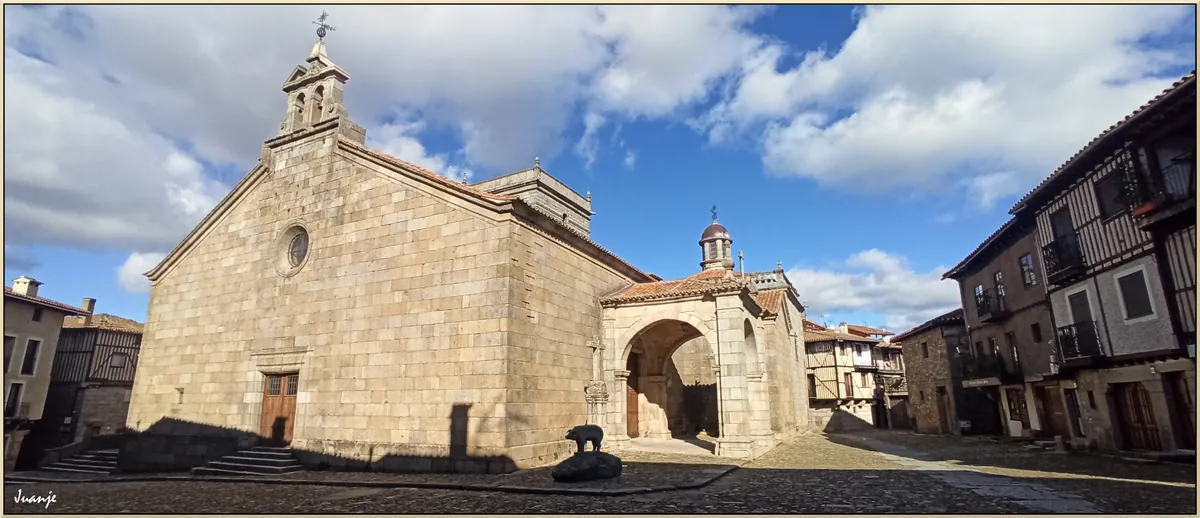
At ten in the morning, the stone streets of the old quarter are still almost empty. Sound travels easily between granite and timber houses, broken now and then by a dog barking or branches shifting in the breeze. Late winter light falls at an angle across the rooftops and lays a pale strip across the church façade. At that hour, tourism in San Esteban de la Sierra barely exists. What you hear are footsteps rather than conversations.
San Esteban de la Sierra sits at around 600 metres above sea level on a gentle slope in the Sierra de Francia, a mountain area in the province of Salamanca. The houses combine dark masonry, wooden beams and balconies that lean out over narrow streets. The layout was not designed with cars in mind, so it makes sense to leave a vehicle at the edge of the village and continue on foot. Within minutes, the structure of the place becomes clear: short streets, small squares and gradual inclines that lead up towards the church.
Around the parish church
The most obvious landmark is the parish church of San Esteban. It is not an imposing building. Its proportions are restrained, built in pale stone, with a bell tower that appears between the rooftops when approaching from the higher streets. Nearby, there are elements that hint at everyday life from decades ago: stone washhouses beside still-running fountains, and uneven walls covered in moss where the sun arrives later in the day.
The houses preserve features typical of this part of Salamanca. Timber framing is common, along with simple balconies and small windows designed to keep warmth inside during winter. As the afternoon fades, many façades take on a soft golden tone, particularly in spring and autumn when the light is lower.
Footpaths through chestnut and oak
Several traditional paths begin right from the village. Some lead down towards vegetable plots and old terraced fields. Others head into areas of chestnut and oak that surround the valley.
In autumn, the ground is covered with leaves and the spiky husks of opened chestnuts. The air often carries the scent of damp earth and wood. It is common to hear woodpeckers tapping against trunks or to see jays moving quickly between the treetops.
These footpaths link San Esteban de la Sierra with other nearby villages in the Sierra de Francia, such as La Bastida and El Cabaco. The routes are walkable, though they involve constant changes in elevation. Good footwear is advisable, as some stretches have loose stones or become muddy after rain.
Water and gorges near Las Hurdes
To the south, the landscape becomes more uneven. Not far away lies the boundary with the region of Las Hurdes, where water cuts narrow gorges through the rock. In that area, there are fast-flowing streams, small waterfalls after rainfall and natural pools that locals use during the summer.
Before heading along less clear paths, it is worth asking in the village. There are private plots and communal land, and not all routes are marked.
Food from the surrounding land
Cooking in this area still revolves around what the nearby countryside provides. Dishes are based on kid goat or lamb cooked slowly in stews, cured sausages prepared during winter and bread with a thick crust. In many homes, traditional recipes such as patatas meneás are still made. This is a simple dish of potatoes flavoured with paprika and pork fat.
Among the sweets, perrunillas are common, along with bollo maimón, both typically associated with family gatherings and local celebrations.
Autumn also brings chestnuts and wild mushrooms from the surrounding woods. In some places, collecting them is regulated, so it is sensible to check before heading out with a basket.
Dark skies and quiet nights
Once night falls, the village becomes very quiet. Street lighting is limited and the streets empty early, something that is increasingly rare in many places. On clear nights, the pale band of the Milky Way is visible, especially a short distance away from the centre.
The nearby forests remain active after dark. An owl may be heard in the distance, or the crack of a branch deeper along the path.
When to come
Spring and autumn are often the most comfortable times for walking in the area, with mild temperatures, active woodland and fewer visitors than in August.
Summer brings a change in rhythm. Relatives and visitors arrive, terraces fill in the evening and the streets carry more life. Those looking to experience San Esteban de la Sierra at a slower pace may prefer early mornings or weekdays.
A few kilometres away are other well-known villages in the Sierra de Francia, such as Mogarraz, where many façades display old portraits painted directly onto the walls. Visiting several of these villages in sequence gives a clearer sense of how this part of Salamanca works: small settlements, close ties to the surrounding land and paths that almost always lead on to another valley.