Full Article
about San Miguel de Robledo
High village surrounded by oak groves; mountain crossroads
Ocultar artículo Leer artículo completo
The church bell strikes noon, yet nobody appears. Not a soul emerges from the stone houses huddled at 1,050 metres, no shutters creak open, no diesel van rattles past. In San Miguel de Robledo the hour is announced, but the village keeps its own slower rhythm, tuned to oak-leaf fall and the first frost rather than clocks or calendars.
High-ground living
This is the Sierra de Francia's quiet roof. The handful of permanent residents—barely fifty—live above the heat haze that smothers Salamanca in summer and beneath snow clouds that can arrive overnight from November to March. Thick walls of unmortared granite and chestnut beams are built for both extremes: they swallow midday heat in August and release it again when the thermometer slips below zero. British visitors used to Cornwall's damp mildness should pack as if for the Pennines in October; even in May the wind across the plateau carries enough bite to make a fleece welcome at midday.
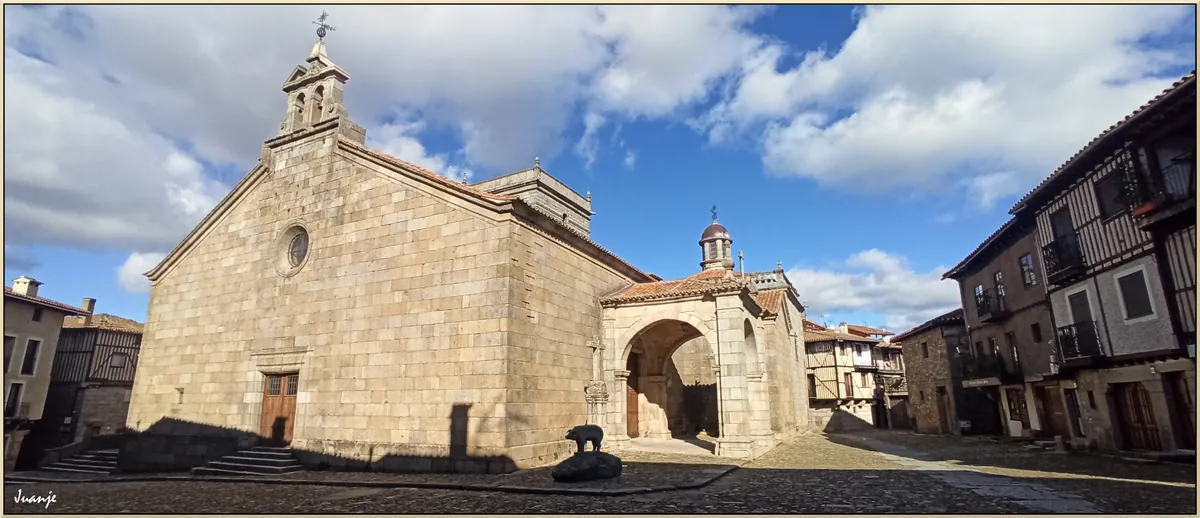
There is no centre to speak of, merely a slight widening of lane beside the parish church of San Miguel Arcángel. The building is modest, whitewashed, with a single squat tower; inside, the air smells of candle wax and centuries of wood smoke. Sunday mass still draws neighbours from scattered farmsteads, but on weekdays the door stays locked unless the priest is expected. When he does appear, the village comes briefly alive: wellingtons scrape stone, dogs bark, someone arrives with a crate of beer for afterwards. Ten minutes later the silence returns, deeper for having been interrupted.
What passes for a high street
Do not expect a plaza mayor lined with cafés. The only commerce is a tiny grocery that opens when its owner, María, finishes feeding her hens. Bread arrives twice a week in a white van that toots its horn; locals know to be outside at eleven sharp or they go without. The nearest bar is five kilometres away in Villanueva del Conde, so day-trippers usually arrive with cool-boxes in the boot. If you forget, the garage in Guijuelo—twenty-five minutes down the SA-220—has a fair selection of Manchego, chorizo and the local star, jamón ibérico de bellota. Buy before you climb back into the hills; night-time taxis are mythical beasts here.
Walking tracks leave the village as though embarrassed by their own abruptness. One minute you are between garden walls, the next you are among holm oaks and strawberry trees, the path barely wider than a sheep trail. Markers exist—faded yellow dashes on boulders—but a phone loaded with IGN Spain maps is wise. The most straightforward circuit drops into the Valle del Conde, climbs past abandoned charcoal-making platforms, and returns after two hours. Spring brings orchids and the sound of cuckoos; October turns the woods copper and sends wild boar rustling through the mast. Winter walkers should assume snow above 900 metres; the slate roofs of San Miguel glint white long after Salamanca's streets are clear.
Seasonal arithmetic
Timing matters. From May to mid-June the sierra is mild, green and loud with nightingales. July and August are dry, often 28 °C at noon but cool enough to sleep under a duvet once the sun drops behind the ridge. September is ideal: clear skies, ripening chestnuts, no mosquitoes. After that the equation changes. A single storm can strip the trees overnight and leave the village marooned until the council tractor clears the road. Residents keep stores of firewood and tinned tomatoes for a reason; visitors in hire cars should carry snow socks from late October onwards.
Accommodation inside the village is limited to three self-catering apartments grouped under the name Jardines del Robledo. They share a pool that overlooks the Robledal oak grove and have under-floor heating for the months when the mountains turn brutal. Expect €90 per night for two, linen and firewood included. Anything grander—spa hotels, English-speaking receptionists—lies half an hour away in La Alberca or Mogarraz. Many Britons base themselves there and drive up for the day, ticking off a string of stone hamlets before retreating to a proper dinner.
Eating beyond the front door
San Miguel itself offers no restaurants, yet the surrounding valleys harbour a handful of places that feed passing hikers. In Villanueva del Conde, Casa Fermín grills a chuletón de buey the size of a steering wheel; order it for two even if there are three of you. La Alberca's Mesón Las Arribes does a respectable patatas meneás—paprika-streaked potatoes topped with crisp chorizo—and will pour you a glass of Sierra de Francia red for €2.80. Vegetarians survive on tortilla and salads; vegans should self-cater. If you rent one of the village flats, cook chestnuts bought from the Saturday market in Salamanca and drink the local honey-infused orujo; the combination tastes like Christmas even in April.
Festivals without fanfare
The saint's day on 29 September is the only event that swells the population. Returned emigrants park hatchbacks along the lane, someone roasts a pig in a barn, and the priest blesses both animals and tractors after mass. There is no printed programme; visitors are welcomed with plastic cups of wine but expected to stand at the back. Fireworks are modest—twelve rockets at most—and the clean-up is finished by next morning. Larger, noisier carnivals take place down the road in La Alberca if you crave drums and fancy dress, yet many travellers find the understatement of San Miguel more telling than any re-enactment of ancient rites.
The honest verdict
San Miguel de Robledo will never elbow its way onto a Spanish "must-see" list, and that is precisely its appeal. The views are wide, the woods empty, the night sky still dark enough to recognise Orion without squinting. But the silence can feel confrontational after dusk, and the village offers no distractions beyond what you bring with you. Come for walking, reading by a log fire, or simply to remember what 10 °C mountain air tastes like. Treat it as a pause between the golden stone of Salamanca and the jamón shops of Guijuelo, and the sierra will reward you with a kind of hush the coast can no longer sell at any price.