Full Article
about Villanueva del Conde
Village with unusual inward-facing house architecture (huertanas)
Hide article Read full article
A village shaped by its setting
Tourism in Villanueva del Conde makes more sense once you picture where it sits. The village lies on the southern side of the Sierra de Francia, on a slope that drops towards the valley of the Francia river, at around 780 metres above sea level. Today, roughly 170 people live here. The settlement is fairly compact, following a pattern common across this part of Salamanca: tightly grouped houses, narrow streets, and a close relationship with the orchards and terraced plots that surround the village.
The Sierra de Francia is part of the Las Batuecas–Sierra de Francia Biosphere Reserve. Rather than a label, what stands out is a landscape shaped over centuries. Chestnut groves, small vineyards, meadows enclosed by stone walls, and agricultural terraces all reflect a long history of working the land. This is not a “wild” environment in the strict sense. It is a place formed gradually by generations adapting to difficult terrain.
The church and the shape of the village
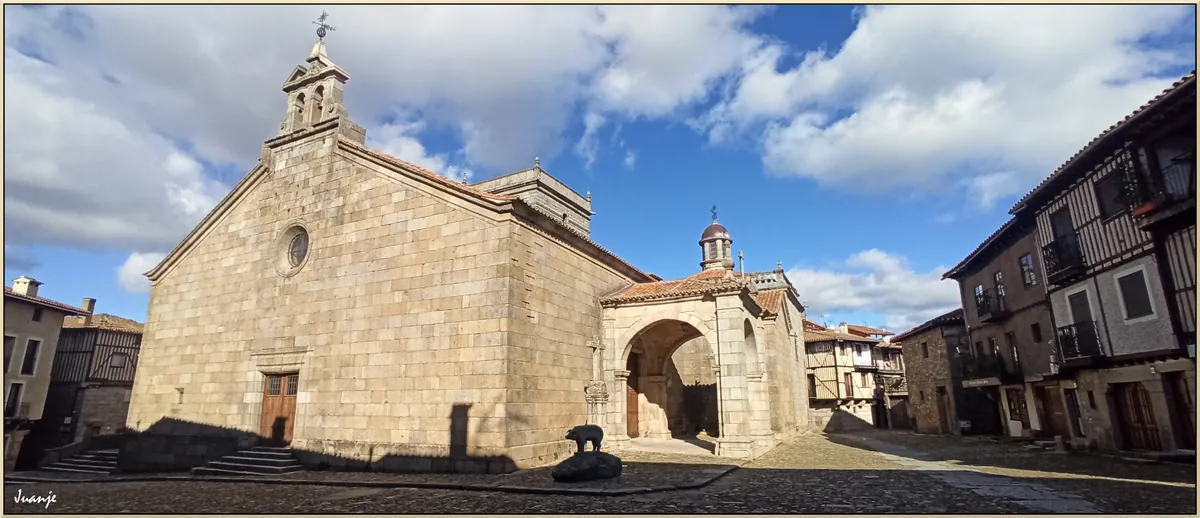
At the centre of Villanueva del Conde stands the parish church. The current building dates from the 16th century, with later modifications, something quite typical of rural churches in this area. It is not a monumental structure, but it helps explain how village life was organised: the square, the church, and the streets extending outwards from that point.
The layout of the village follows practical needs rather than formal planning. Streets are irregular and, in places, quite narrow, shaped by the slope and the available space. Many houses still preserve the traditional architecture of the Sierra de Francia, with stone walls, timber frameworks, and wooden balconies often made from chestnut. Slate roofs are another constant feature, along with small interior courtyards that were once used for storing tools, firewood, or animals.
For those interested in vernacular architecture, the wooden galleries and overhanging upper floors are worth a closer look. In this region, they were not decorative choices. They provided protection from rain and made better use of light and airflow within the home.
Paths, chestnut groves and the nearby landscape
Just beyond the edge of the village, agricultural paths appear almost immediately. These routes link orchards, meadows, and chestnut groves, and many follow long-established lines once used by farmers and livestock keepers moving between plots or travelling to neighbouring villages.
The surrounding landscape combines oak woods, chestnut groves, and small open areas of cultivation. In autumn, the chestnut trees change colour in a very noticeable way, drawing visitors from both the local area and further afield. It is also mushroom season, although gathering them here has traditionally been part of everyday life rather than a planned outing.
Wildlife is part of the rhythm of the place. Roe deer are sometimes seen early in the day in quieter areas, and birds of prey can often be spotted gliding over the open slopes as warm air rises from the valley. Streams descending from the mountains retain some moisture even in summer, allowing denser vegetation to grow along their edges.
Routes to other villages in the Sierra de Francia
Villanueva del Conde lies close to several well-known villages in the Sierra de Francia, and traditional footpaths remain one of the most interesting ways to move between them. Some of these routes connect with places such as Cepeda, Miranda del Castañar, or La Alberca, crossing orchards, chestnut groves, and small mountain passes.
Not every stretch of path is equally clear. In some areas, vegetation has begun to reclaim the route, or the ground has become uneven, which is typical of paths that were historically used mainly by local residents. Taking time and paying attention to the terrain is important, particularly after periods of rain.
Traditions and the pace of daily life
As in many small villages in the Sierra de Francia, the calendar in Villanueva del Conde is shaped by both religious festivities and agricultural work. The main celebrations are usually held in summer, when people who live elsewhere return and the village briefly becomes more lively.
For the rest of the year, the pace is quiet. The chestnut harvest in autumn, work in the orchards, and gatherings around the church continue to structure everyday life. There are no large-scale events or programmes designed specifically for visitors. What is visible here is simply the normal routine of a mountain village.
A short visit, a broader view
Villanueva del Conde can be explored in a short amount of time. Within an hour, it is possible to walk through the main streets and head out along one of the nearby paths.
The interest lies less in individual landmarks and more in understanding the whole setting: the cluster of houses adapted to the slope, the terraces that surround the village, and the chestnut groves that have supported the local economy for centuries. Approached in that way, the place becomes much easier to read.