Full Article
about Salas de los Infantes
Head of the Sierra de la Demanda; known for its dinosaur museum and exceptional natural setting.
Hide article Read full article
A town that grows on you
Salas de los Infantes is the kind of place that turns a quick stop into a longer wander. Nothing dramatic pulls you in, yet everything seems to fit together without effort. This small town in the Sierra de la Demanda, in the province of Burgos, has around two thousand residents and works as an informal hub for the surrounding area. People come here to run errands, do their shopping, meet neighbours from nearby villages and, along the way, exchange plenty of stories.
At roughly 960 metres above sea level, the setting makes itself felt. The air is noticeably cooler than in the plains of Burgos, and the landscape shifts accordingly: more pine forest, more hills, and that distinct feel of a Castilian mountain range where distances look short on the map but often involve a steady climb.
This is not a place preserved as a perfect historic centre. Stone streets appear here and there, but so do more recent buildings and neighbourhoods where daily life carries on as usual. Salas does not revolve around tourism. It revolves around the people who live here all year, and that shapes the atmosphere.
Its location also makes it a practical base for exploring the wider Sierra de la Demanda. Within a short distance, there are oak and beech woods, small villages where chimneys still send up smoke in winter, and valleys where silence feels almost literal.
Walking through the town
The place that has put Salas de los Infantes on the map is its Dinosaur Museum. It might sound like a niche plan, yet it often surprises visitors. The surrounding area has a number of fossil sites, and the museum brings together discoveries made locally: eggs, footprints and remains from different species dating back to the Cretaceous period. There is no need for specialist knowledge to enjoy it. The displays are clearly explained and help make sense of why this part of Burgos appears so often in studies of dinosaurs.
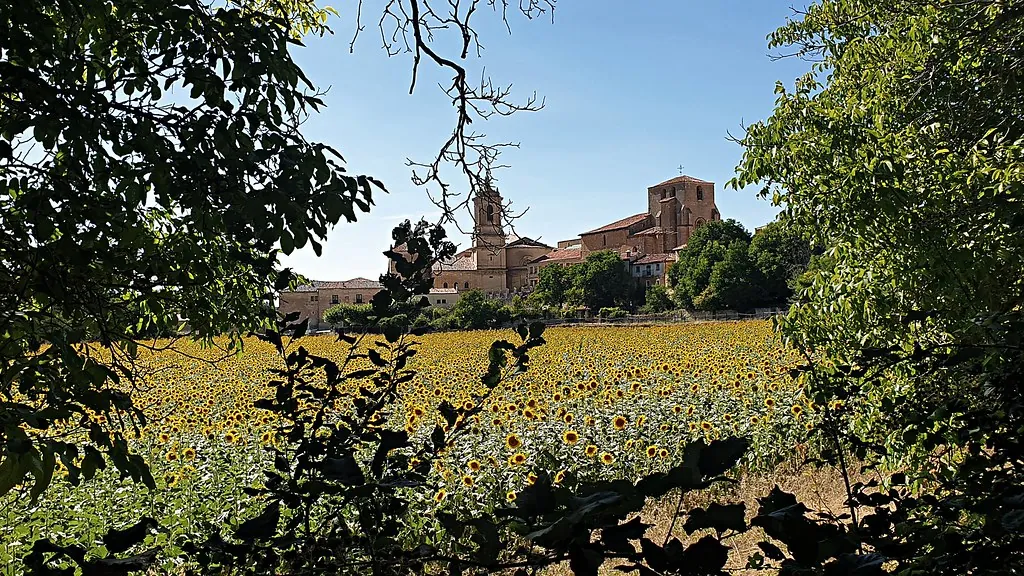
From there, a walk through the centre comes naturally and does not require a map. The church of Santa María shapes the skyline, its tower visible from several streets. The building has Romanesque origins, though like many in the region it has been altered over the centuries.
Nearby, fragments of the old medieval wall remain. There is no complete enclosure or monumental structure, but enough survives to give an idea of the town’s defensive past.
The Plaza Mayor continues to be one of the liveliest points in daily life. It features arcades and a few houses with coats of arms on their façades. Some buildings have not been heavily restored, their slightly worn stone telling its own quiet story.
Step just beyond the centre and the landscape changes quickly. A short walk brings you into pine woods or along paths that follow the valley. There are no dramatic viewpoints as such, yet the light at sunset over the mountains of the Demanda often creates rewarding views.
Paths, bikes and mountain food
The surroundings of Salas de los Infantes offer plenty of simple walking routes. Some lead towards areas where fossil footprints have been found or near old excavation sites. There are marked trails, although it is worth checking the route in advance, as the signage is not always perfect and some paths fade into the woodland.
For those who prefer two wheels, the area suits mountain biking well. Long forest tracks stretch across the hills, the kind where the climb builds gradually over several kilometres. The routes are not especially technical, but the elevation gain can catch up with you if you underestimate it.
Food here follows the logic of mountain cooking: filling and straightforward. Roast suckling lamb, known as cordero lechal, appears frequently, alongside game dishes in season or mushrooms in autumn. Morcilla, a traditional Spanish blood sausage, is also easy to find, along with other local products still made in a largely traditional way.
For families, the plan tends to be simple. A morning at the museum, then an afternoon walk in one of the nearby recreational areas. There are no crowds or large-scale facilities, and that is part of the appeal. The pace remains calm.
Festivities through the year
In August, the fiestas of San Roque shift the rhythm of the town for several days. Many residents who live elsewhere return during this period, and the streets become noticeably busier. The programme includes religious events, evening dances and the sense of reunion typical of mountain towns in summer.
At the end of June, San Pedro marks another key date in the local calendar. It is not a large-scale celebration, but it keeps traditions that still matter here: religious observances, gatherings among neighbours and a style of festivity that does not rely on elaborate staging.
Semana Santa, or Holy Week, also has a presence in Salas de los Infantes. Processions move through the historic streets in a restrained and sober style. It is not one of the widely broadcast celebrations seen elsewhere in Spain, yet that is part of its character. The floats are carried by local residents, and the atmosphere remains close to the community.