Full Article
about Santo Domingo de Silos
World pilgrimage site for its Benedictine monastery and unique Romanesque cloister
Hide article Read full article
At first light, when there is more silence than footsteps, the cloister of the monastery filters a cool glow through its arches. The stone still holds the night’s damp and every small sound, a door closing, fabric brushing, a distant cough, carries along the galleries. Tourism in Santo Domingo de Silos almost always begins here, although the village has more layers than the monastery alone.
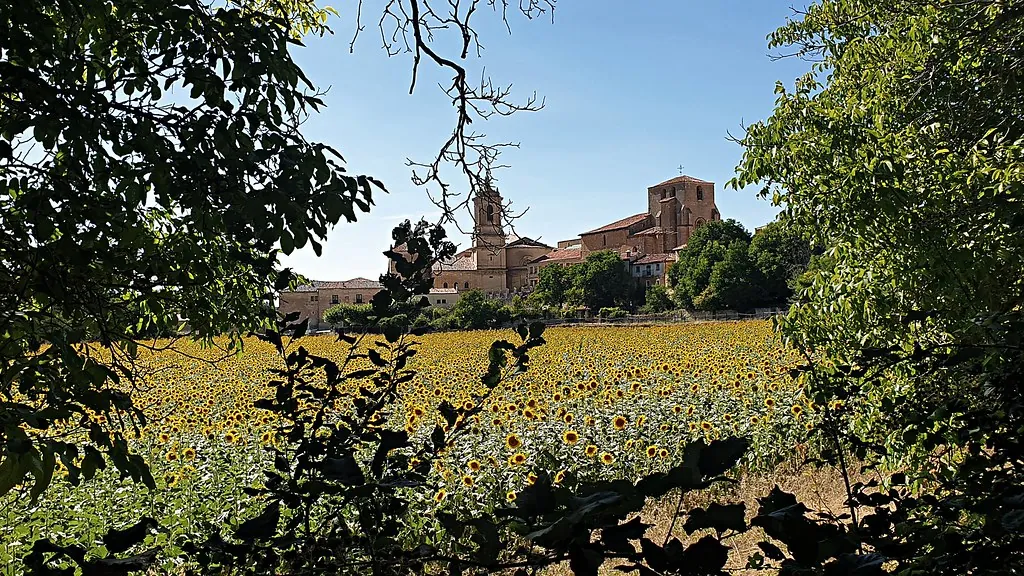
Santo Domingo de Silos lies in the south of the province of Burgos, surrounded by gentle hills, open meadows and patches of juniper that appear across the pale earth. The population is just over two hundred. Even on busier days, the pace remains unhurried. Streets are paved in stone and narrow in places. Houses keep their dark wooden balconies and large doorways, which are still opened early in the morning to air out the interiors.
The Monastery and the Rhythm of the Offices
The monastery sets the tempo of the village. Its Romanesque cloister, built in the 11th century, invites a slow circuit almost without noticing. The capitals draw visitors closer and make them look twice. Biblical scenes sit alongside animals and human figures with pronounced gestures. As the light shifts, in mid morning or towards the end of the afternoon, the reliefs cast deeper shadows and details emerge that had gone unseen before.
Inside the abbey church, Romanesque elements coexist with later alterations. There is usually a steady half light within, in contrast to the brightness of the open cloister. The former monastic pharmacy preserves shelves lined with ceramic jars. Looking at them offers a clearer sense of monastic life: repetition, patience, long stretches of time.
Those who wish to hear Gregorian chant can attend one of the daily offices. It is advisable to enter in advance and with discretion. This is not a concert or a staged performance. The monks follow their liturgy as they do each day, and visitors simply sit and listen.
The Plaza Mayor and Everyday Life
A few steps from the monastery is the Plaza Mayor. Stone arcades run along its sides and benches fill gradually by mid morning with local residents stopping for a chat before continuing with their day. There is little noise. A car may pass slowly through, a shutter rattles upwards, children cross the square on their way home.
Next to it stands the parish church of San Pedro. It is simpler than the abbey church and closely woven into village life. This is the kind of church that opens for a baptism, a funeral or Sunday mass, then returns to quiet.
Life in Silos does not revolve around a packed schedule of sights. It unfolds in small routines and familiar encounters. The proximity between monastery and square makes it easy to move from the solemnity of carved stone to the everyday rhythm of conversation and errands within minutes.
La Yecla: A Narrow Gorge in the Rock
A short drive from the village brings one of the area’s best known landscapes: the gorge of La Yecla. Here the river Mataviejas has carved a narrow channel between vertical rock walls. In some stretches the passage tightens to a very slim strip and daylight barely reaches the bottom.
The route follows metal walkways fixed to the rock face. It is not long, around half an hour in total, yet the setting holds attention. The echo of water against stone, the beat of wings from vultures that move along the high walls, the cool air that lingers even on hot days all shape the experience.
The nearby car park is not large. On summer weekends and public holidays it tends to fill quickly, so it makes sense to arrive early or later in the afternoon.
Beyond the gorge, the surroundings of Silos offer a number of straightforward tracks and footpaths. The juniper woodland close to La Yecla is one of the area’s most distinctive landscapes. The trees are low, their trunks twisted, their grey bark smoothed by the wind.
These are not demanding walks. With comfortable footwear it is possible to follow dirt paths that cross clearings and low hills. On dry days the scent of resin and warm earth becomes especially noticeable, particularly in mid afternoon.
Hearty Food and the Fall of Night
The cooking in this part of Burgos remains robust and closely tied to the land. Roast suckling lamb, morcilla de Burgos, aged cheeses and, in season, dishes prepared with mushrooms from nearby hills appear on local tables. These are recipes associated with winter and agricultural work, designed to satisfy rather than to complicate.
The monastery itself produces some goods that are sold on site, including a well known herbal liqueur.
As evening approaches, the village shifts in tone. The stone takes on a golden hue and the streets gradually empty once night falls. Far from major cities, the sky is often strikingly clear. A walk beyond the built up area calls for a torch. Darkness here is complete and unfiltered, and silence returns to the foreground.


