Full Article
about Abajas
Ocultar artículo Leer artículo completo
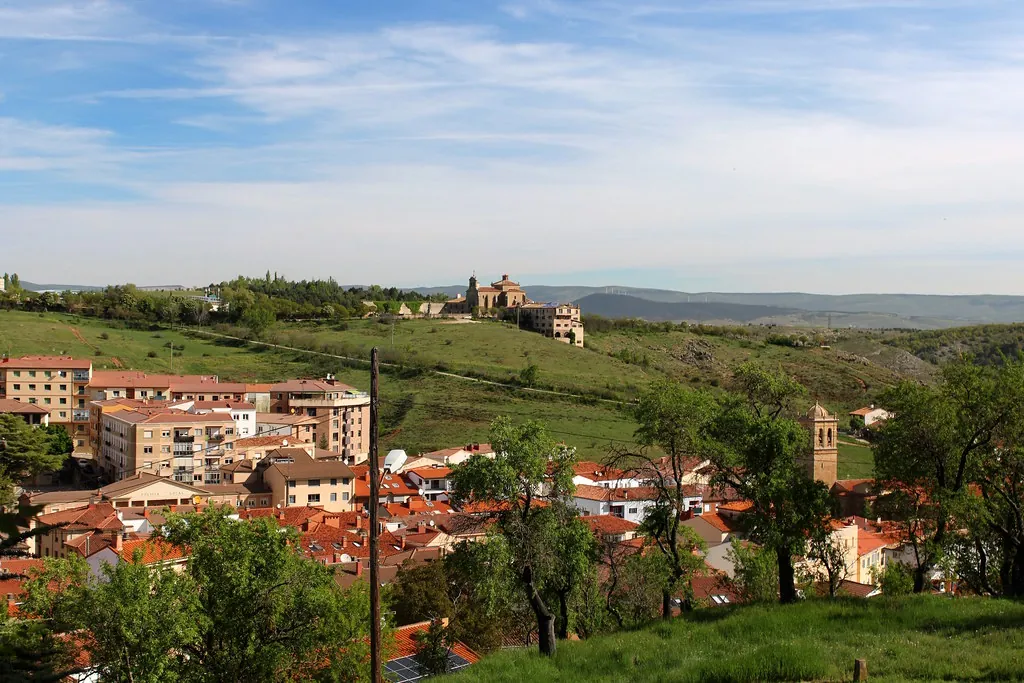
The church bell strikes eleven and nobody stirs. A single tractor crawls across the wheat-coloured horizon, its engine note flattening in the thin air. This is Abajas, a scatter of stone houses on the high plateaux of southern Burgos, where the loudest sound is often the wind scraping across 900 metres of open sky.
Most motorists barrel past on the CL-116, bound for the cathedral city 35 minutes north. Those who do turn off find a settlement that never bothered with a bypass because traffic was never a problem. The main street is barely two lanes wide; wheat fields press against the last row of houses like an audience waiting for the curtain to rise. There is no centre in the conventional sense, just a gentle slope towards the fifteenth-century church of Santa María la Mayor, its sandstone tower the only vertical punctuation between earth and sky.
Stone, Straw and Silence
Abajas keeps the honest materials of the Castilian plain: limestone walls the colour of dry bone, timber painted the same ox-blood red you see in every province from Soria to Palencia. Rooflines sit low against the wind, eaves trimmed with ancient corn stooks that double as insulation. Peek over any gate and you’ll spot the tell-tale wooden balcony—mirador—where grandmothers once surveyed the harvest and now monitor passing cars with the same forensic interest.
The architectural detail is small-scale, almost shy. A carved date here—1624—an iron ring for tethering mules there. No baroque excess, just the quiet confidence of people who knew their wheat yields to the last kilo and saw no reason to shout about it. Even the church portal is modest: a simple Gothic arch softened by centuries of wind-driven grit. Inside, the altarpiece is nineteenth-century pine, gilded only where candle-flame could reach. Frescoes? Forget it. This is a building meant for work—baptisms, weddings, the annual blessing of the fields—not for coach parties.
Walking the Agricultural Grid
Leave the tarmac and you step onto a chessboard of caminos laid out in the 1850s land consolidation. Each gravel track runs ruler-straight for exactly 1,2 km before meeting a right-angle junction designed so ox-carts could turn without backing up. Today the same grid serves tractors and the occasional pilgrim experimenting with a detour from the official Camino de Santiago.
Spring brings electric-green wheat shoots; by July the colour has drained to pale gold and the air smells of biscuit-dry straw. Walk at dawn and you share the path only with crested larks and the distant silhouette of a combine harvester crawling through its own dust. There are no way-markers, no mileage boards, just the understanding that if you keep the church tower at your back you’ll eventually loop round to the village again. Total distance: 6 km. Total ascent: negligible. Total phone signal: intermittent at best.
Bring water. The continental climate here can gift 30 °C shade at midday, then drop to 12 °C the moment the sun slips behind a cloud. A light fleece weighs nothing and saves you from that awkward teeth-chattering retreat.
What Passes for Local Life
The bar on Calle Real opens at seven for coffee and closes at nine for the proprietor’s supper. Order a café con leche (€1,40) and you’ll get it in a glass thick enough to survive dishwashers—and revolutions. They don’t serve food; the nearest proper meal is in Castrillo del Val, 8 km north, where Mesón Oso offers lechazo (milk-fed lamb) roasted in a wood oven at €22 per quarter portion. Book ahead: the dining room has twelve tables and every farmer within twenty kilometres treats it as his canteen.
If you prefer self-catering, the little shop in Abajas stocks tinned tuna, UHT milk and the local morcilla spiced with onion rather than rice. Bread arrives on Tuesday and Friday; by Saturday the crust is like aeroplane boarding passes. Timing matters.
Festivals follow the agricultural calendar with commendable bluntness. The weekend closest to 15 May honours San Isidro Labrador, patron of ploughmen. A tractor procession replaces the medieval ox parade, and the priest sprinkles holy water over John Deere radiators as readily as over seed corn. July brings the fiesta mayor: inflatable castles for toddlers, a pop-up disco in the concrete frontón, and a communal paella cooked in a pan wide enough to satellite as a helipad. Both events double the population for forty-eight hours; accommodation within 20 km sells out six months ahead. Come the following Monday and you’ll wonder if you imagined the whole thing.
Winter Arithmetic
From November to March the Meseta shows its accounting sheet: 1,600 hours of sunshine, minus-five nights, and wind that scours skin like a Brillo pad. Snow arrives rarely but lingers—roads become glassy, buses terminate at the main highway, and the village folds into itself. This is when photographers appear, hoping for that Ansel Adams contrast of white snow against black stonework. They usually leave after one night; the only hostal shutters for the season and the nearest hotel is in Burgos, half an hour away by hire car—assuming the hire car starts.
Yet the cold has its rewards. Step outside at midnight and the Milky War feels close enough to snag on the church weathervane. With zero light pollution the night sky registers magnitude-six stars, the kind suburban Britons last saw during power cuts in the Seventies. Just don’t expect a hip flask moment; the village observes the provincial by-law that prohibits outdoor drinking after 11 p.m. even when the thermometer reads freezing.
Getting Here Without Drama
No train, no coach, no Uber. From the UK fly to Bilbao (Ryanair from Stansted, easyJet from Gatwick), collect a rental car and head south on the A-68, then the N-234 to Burgos. Finally the CL-116 south-east for 25 minutes. Total driving time from Bilbao: two hours fifteen, plus whatever the car-hire queue invents. Petrol stations on the autovía accept UK cards; village pumps sometimes demand Spanish chip-and-pin—carry €20 in cash as insurance.
Accommodation within Abajas itself is essentially one three-room guesthouse above the former school. It has Wi-Fi that remembers dial-up fondly and a bathroom where the hot-water tank plays La Marseillaise whenever you turn the tap. Price: €45 a night, breakfast of churros and café con leche included. Otherwise base yourself in Burgos and day-trip; the city offers everything from Parador luxury to backpacker dorms, plus the UNESCO-listed cathedral for cultural ballast.
Leave the Superlatives at Home
Abajas will not change your life. It offers no Insta-moment façade, no artisan gin distillery, no boutique selling reclaimed-wood cheese boards. What it does offer is a calibration device: a place to recalibrate your sense of scale, to remember that entire communities still organise themselves around rainfall statistics and the price of barley. Come for the silence, stay for the coffee, leave before you start resenting the 9 p.m. shutter-down. And if the church bell strikes twelve while you’re still loitering outside the panadería, don’t worry—nobody will rush you. They’ve got all the time in the world, and now, briefly, so have you.