Full Article
about Albillos
Ocultar artículo Leer artículo completo
The grain lorry rattling through Albillos at 7 a.m. is the daily alarm clock. By half past, the bakery-bar on Plaza Mayor has sold its last baguettes to commuters who will spend the next twenty minutes driving north to desk jobs in Burgos. By nine the streets are quiet again, the only movement a tractor heading out to the surrounding wheat ocean. This is not a village that performs for visitors; it simply gets on with being Castile.
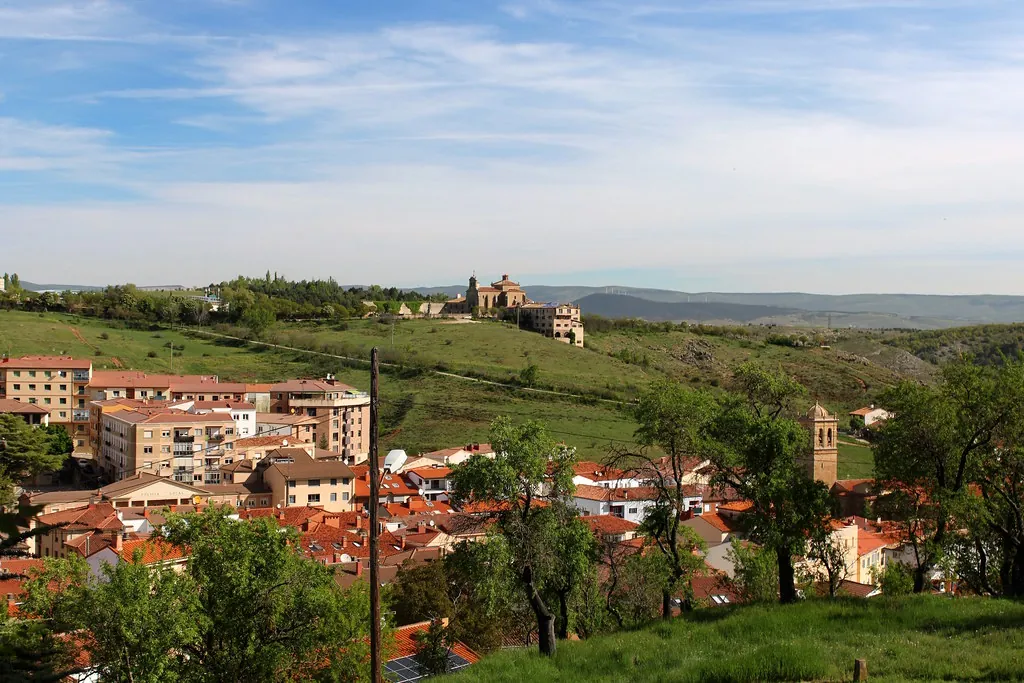
Stand at the top of Calle La Merced and the view explains the settlement pattern: gentle swells of cereal fields roll southwards until they melt into a pale sky. Albillos sits on the highest ripple, its stone houses forming a compact mound that can be crossed in five minutes yet needs half an hour if you keep stopping to read the hand-painted house names—Casa Pilar, Los Abuelos, La Reja Verde. The church tower, painted the same cream as the town hall in Burgos, pokes above the roofs like a bookmark in farmland.
Inside the parish church of San Pedro the temperature drops five degrees. The building is 16th-century, rebuilt after a fire, and still smells faintly of extinguished candles. There is no ticket desk, no audio guide, just a printed sheet taped to the pulpit asking visitors to close the door gently so the swallows don’t get ideas. On the side wall hangs a list of the 1931–34 municipal council: three farmers, a teacher and a woman who ran the grocery—ordinary surnames that reappear on the brass letterboxes outside every second house.
Walk the grid of lanes and you will notice the join between workday and weekend houses. Some doorways sport fresh geraniums and English car registrations; others have woodpiles stacked to shoulder height and a hunting dog chained to a drainpipe. Both types share the same thick stone walls, timber beams blackened by hearth smoke, and roof tiles the colour of burnt toast. Planning rules forbid plastic shutters or aluminium balconies, so even 1970s renovations keep the wooden variety, painted dark green or ox-blood red. The effect is harmonious without feeling museum-like—someone’s laundry still flaps above your head.
Food options inside the village are limited to the aforementioned bar, where a coffee costs €1.20 and the owner will apologise that the toaster is broken. For something more substantial you drive four kilometres to the N-620 roundabout and the harshly lit El Cerezo supermarket, whose rotisserie counter turns out juicy pollo asado for €6 a half-bird. Buy a bag of local beans—buttery alubias pintas—and you have the makings of a cocido that reheats well on a cottage stove. If you would rather be waited on, Burgos is twelve minutes away: enough time to justify a glass of Ribera del Duero before the lamb chops arrive.
Albillos makes no claim to nightlife, yet the darkness has its uses. Streetlights are switched off at midnight, and on clear evenings the Milky Way appears with an embarrassing brilliance. Walk 200 metres beyond the last house and you can pick out the Andromeda Galaxy without squinting. Bring a blanket; dew falls fast even in July, when daytime temperatures brush 32 °C but nights drop to a fleece-requiring 14 °C.
Cyclists like the place for the same reason astronomers do: empty roads. The BU-601 that links the village to Burgos carries more tractors than cars before ten o’clock, and the surrounding lanes are part of the official Camino de Santiago cycling variant. A gentle 30-kilometre loop south through Revillarruz and Quintanadueñas gives you wheat on one horizon and the distant blur of the Montes de Ayuela on the other, with only the occasional combine harvester to break the silence. Bike hire is possible in Burgos at Bicicletas Jaime (€20 per day); request a repair kit because the verge is littered with thistles that laugh at racing tyres.
Hikers have slimmer pickings. The council has way-marked a 7-kilometre circuit that starts at the cemetery, dips into two dry valleys and returns past an abandoned grain mill. The trail is signed but not manicured: expect overgrown nettles after rain and the faint possibility of meeting a loose galician cow. Proper boots are overkill; trainers suffice if you don’t mind dusty socks. Spring brings colour—poppies stitching red seams through the wheat—while October turns the stubble fields bronze and fills the air with the smell of straw.
Annual excitement peaks during the fiestas of San Pedro, around the last weekend of August. The population doubles as former residents drive back from Bilbao, Barcelona or Birmingham. A marquee goes up on the football pitch, the bakery-bar drafts in extra staff from Burgos, and Saturday night ends with a disco that thumps until the Guardia Civil remind the DJ of the noise ordinance. Sunday mass is followed by a communal paella cooked in a pan the size of a satellite dish; tickets are €8 and sell out by eleven. Visitors are welcome but anonymity is impossible—someone’s cousin will ask which house you’re staying in before you’ve swallowed your first mouthful.
Practicalities first: you will need a car. There is no railway, and the weekday bus from Burgos departs at 14:15 and returns at 17:30, which barely allows time for a coffee and a circuit of the church. Hire cars are available at Bilbao or Santander airports—both served by Ryanair from Stansted—then a straight 90-minute dash south on the A-68 and A-1. Valladolid is nearer (75 minutes) but flights are seasonal. In winter the meseta can be foggy; allow extra time and fill the tank because service areas are sparse.
Accommodation inside the village consists of two self-catering cottages advertised on Airbnb. Both have working fireplaces, beamed ceilings and patchy Wi-Fi. The larger sleeps six and opens onto a walled garden where you can barbecue the supermarket chicken; the smaller is attached to the owner’s grain store and comes with a resident tabby cat who expects breakfast. Prices hover around €90 per night year-round. If you crave hotel service, the nearest Parador is in Lerma, 33 kilometres away—a 17th-century ducal palace with four-poster beds and English-speaking receptionists.
Come with modest expectations and Albillos delivers a straightforward pleasure: the sound of Castile when the combine harvesters are silent and the wheat sways like water. It is not lovely in the picture-postcard sense; it is simply alive, honest and convenient enough to reach for a long weekend. Bring walking shoes, a taste for lamb and a willingness to say hello first. The village will do the rest.