Full Article
about Alfoz De Bricia
Ocultar artículo Leer artículo completo
The sheep block the lane east of Pedrosa de Bricia, and nobody hurries them along. A tractor idles, its driver leaning on the wheel, content to wait while the flock decides whether the verge looks tastier than the tarmac. In Britain this would spark a queue of hatchbacks and muttered irritation; here it's simply Thursday morning, and the clock runs differently.
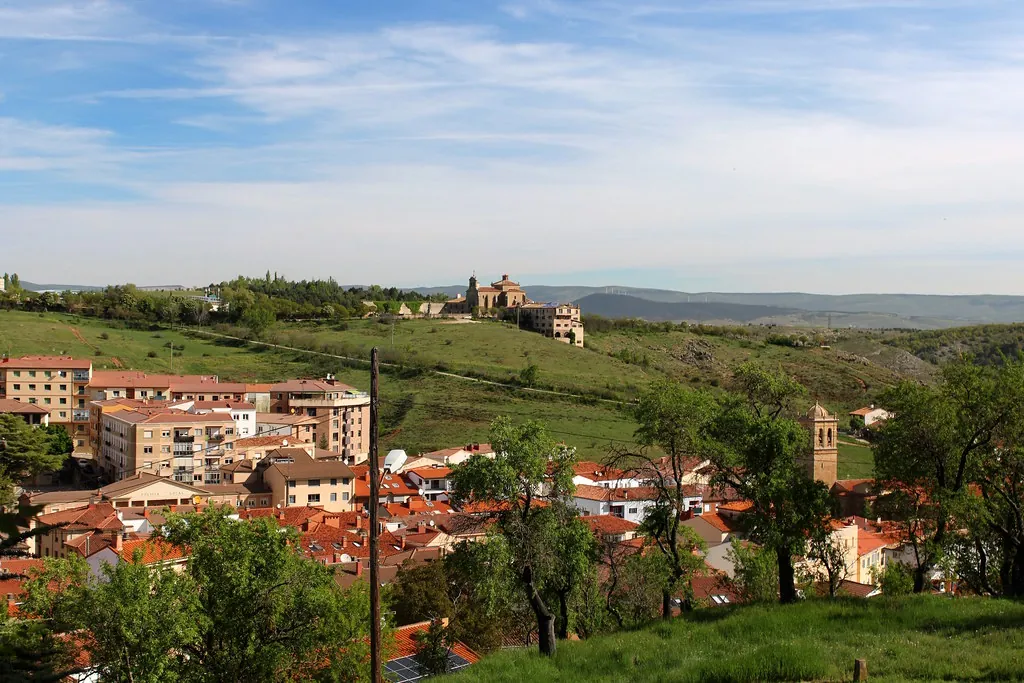
Alfoz de Bricia sits at the point where the Meseta starts to buckle towards the Cantabrian Mountains, forty-five minutes north-east of Burgos city. The municipality is less a village than a loose confederation of hamlets—Pedrosa, Bricia, Páramo, Villanueva, half a dozen others—scattered across wheat folds and sheep pastures that tilt gently northward. Stone houses hunker down against the wind, their timber doors painted the same ox-blood red you see all over rural Castile. Between settlements the lanes narrow to single-track; meet another car and someone has to reverse to the nearest passing place. Courtesy, not rage, usually decides who.
Horizon Lines
The land looks settled, but it's never static. In April the cereal fields flare emerald, then fade to parchment gold by late June. Walk the cart track from Villanueva to the ruined ermita above Páramo and you'll cross three micro-climates in twenty minutes: warm arable air in the valley, cooler breath from the pine plantation, a sudden blast of mountain wind on the ridge. At about 900 m, Alfoz is high enough for night frosts well into May; bring a fleece even if lunchtime feels Mediterranean.
Views stretch north towards the high peaks of Burgos—Pico Tres Mares still carries snow until June—but the drama is muted. These aren't the jagged Picos you see on postcards; they're a rumpled blue wall that reminds you the Atlantic is only sixty kilometres away. What you notice instead is the scale of empty space: skylarks, not silhouettes.
Stone That Outlasted Grandees
Every hamlet has its church, and none charges entry. The best is San Andrés in Bricia itself: twelfth-century Romanesque bones swallowed by later make-overs. Step inside and the nave smells of candle wax and grain dust; someone has stacked last year's maize cobs in the baptistry because the loft is full. The altar retablo is nineteenth-century folk Baroque, gilded wood flaking like sunburnt skin. A laminated sheet, typed on an antique Olivetti, lists the priests back to 1538—continuity a parish council in Norfolk would kill for.
Round the corner a granite coat of arms announces the house of the Hurtado de Mendoza, minor gentry who once controlled the grain mills along the Arroyo Boedo. Their mansion is now a farmhouse; calves peer through the noble archway. Across the lane a bread-oven bulges from a gable, its chimney still blackened. Someone will light it for the fiesta in September, producing fifty loaves before the embers die.
Paths Where the Map Runs Out
Public footpaths, in the British sense, don't exist. What you get is a lattice of farm tracks, many still used by ox-carts at harvest. The tourist office in Burgos will sell you a 1:25,000 map, then warn that the waymarks stop at the municipal boundary. Locals navigate by knowledge, not signage; stop to ask and you'll leave twenty minutes later with directions, a handful of walnuts and an invitation to look at newborn lambs.
A gentle circuit links Pedrosa–Villanueva–Páramo–Bricia in 11 km with under 300 m of ascent. You pass stone threshing circles, an abandoned limekiln, a meadow where lesser kestrels hunt grasshoppers. Mid-April brings cowslips and the first bee-eaters; mid-October rings with the metallic clack of shotgun barrels as farmers cull wood-pigeon for the pot. Wear boots after rain—the clay sticks like brick mortar.
What You'll Eat—and When You Won't
There are no gastro-bars, no Sunday supplement stylists. What you find is a single bar in each hamlet, open when the owner feels like it. Phone numbers are chalked on the door; ring and they'll come down with the keys. Order a caña and you'll get a slab of chorizo cut from a loop behind the counter, cheese that was wheels last week, bread baked that morning in Miranda de Ebro. Prices feel like time-travel: €1.80 for the beer, €3 for a ración of morcilla.
If the bar is shut, your fallback is the bakery in Quintanavides, six kilometres west (weekday mornings only). Buy a still-warm baguette, a fist of local queso de Burgos, tomatoes that actually taste of soil. Picnic tables beside the 12th-century bridge over the Rudrón make a serviceable dining room; the river holds wild trout you are not allowed to catch.
Fiesta Time, Village Time
Each hamlet keeps its own patronal feast between mid-July and early September. The biggest is in Bricia on the last weekend of August: mass at noon, procession at seven, paella for four hundred served on long tables in the square. Visitors are welcome but not fussed over; bring your own plate if you don't want disposable plastic. Dancing starts at midnight to a playlist that jumps from pasodoble to 90s Euro-dance, volume turned down only when the Guardia Civil cruiser rolls past.
Winter brings the matanza, the home slaughter of a family pig. It's no longer the communal event it was—EU rules don't favour open-air bloodletting—but you may still see a carcass hanging from a beam in December. Ask politely and someone will explain how the leg becomes jamón serrano, the backbone goes into cocido, the skin renders into manteca for next year's beans.
Getting There, Staying There
No train comes within thirty kilometres. From the UK, fly to Bilbao, collect a hire car and take the A-68 south for ninety minutes; after Miranda de Ebro the last 25 km are on the N-232, perfectly decent but unlit. Accommodation is limited: three village houses restored as tourist rentals (€70–90 per night, two-night minimum), booked through the provincial tourist board. Electricity is reliable; Wi-Fi less so—perfect if you meant to finish that novel.
Petrol stations close at 20:00; diesel is usually cheaper than in Britain, but fill up before Sunday. Mobile coverage is patchy between hamlets; download offline maps. If it snows heavily—the odd day most winters—the road from Quintanavides gets the plough first, Bricia last. Chains are sensible between December and March.
The Honest Verdict
Alfoz de Bricia won't change your life. It offers no Michelin stars, no selfie-magnet viewpoints, no artisan gin distilled in a former convent. What it does give is a slice of rural Spain that still functions for its own inhabitants rather than the Instagram grid. Come if you like the sound of sheep bells instead of ring tones, if you're happy to walk without waymarks, if you can cope with the possibility that lunch might be bread, cheese and a glass of wine you poured yourself. Stay away if you need room service, boutique lighting, or someone to curate your experience. The villages will still be here, doing what they've always done, whether you visit or not—and that, in 2024, feels almost radical.