Full Article
about Banos De Valdearados
Ocultar artículo Leer artículo completo
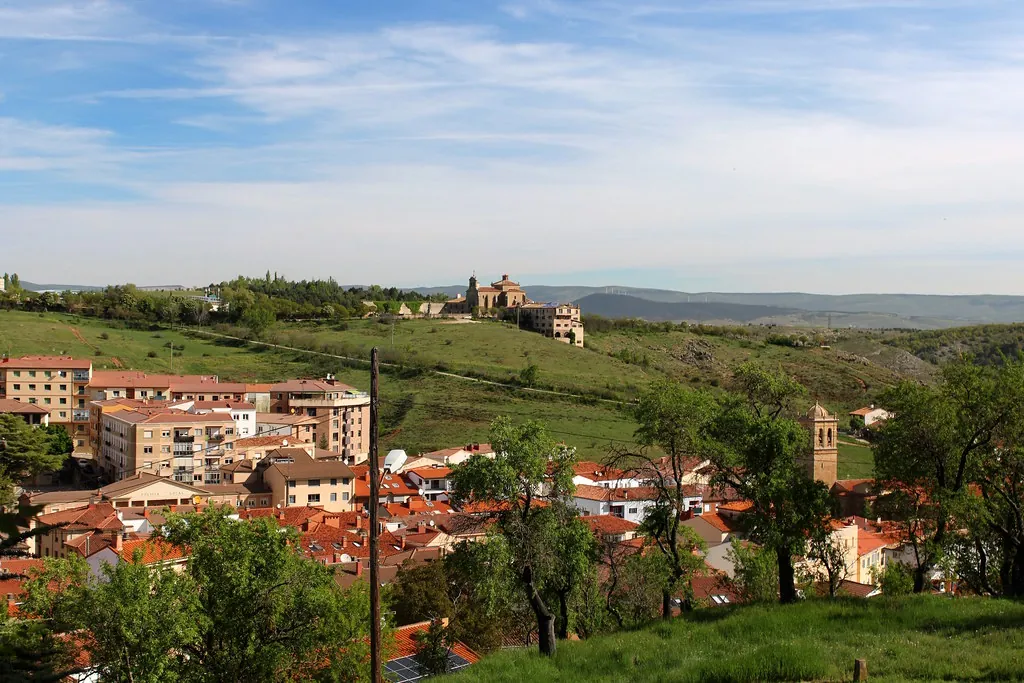
Look down any street in Baños de Valdearados and you’ll see chimney pots shaped like pointed wizard hats poking through the terracotta. They’re not decorative whimsy; they’re the only visible sign that beneath your feet lies a warren of hand-hewn cellars where the town’s wine rests at a steady 12 °C whatever the weather is doing above ground. Eight metres down, the sandstone walls are blackened by centuries of oak-barrel breath, and the air smells of must and tempranillo skins.
The village sits at 895 m on a rolling plateau of red clay that the Duero river has been patiently slicing away for millennia. Vineyards run right to the edge of the stone houses, so when the grapes change colour in late July the whole place appears to blush. There is no dramatic sierra to frame the view, just wide skies and the faint blue ripple of the Montes de Ayuela forty kilometres west. The horizon feels higher than the land, a trick of altitude that makes even midday seem leisurely.
Cellars you can walk into (if someone unlocks the hatch)
Roughly sixty families still maintain the subterranean bodegas, though only a dozen or so open them to outsiders. Ask at the bakery – the owner keeps the key to the oldest gallery, dug in 1643. He’ll lift the iron trapdoor in the pavement, lead you down a spiral stair no wider than a tractor tyre and switch on a single bulb that barely reaches the far wall. The floor is sandy; the ceiling low enough to make anyone over five-foot-ten duck. Barrels lie on their sides like sleeping seals, each chalked with the vintage and the name of the grandchild who will inherit the wine. Tastings are poured into plain water glasses; payment is whatever you feel appropriate – five euros is polite, ten earns a second top-up and a slab of sheep’s cheese wrapped in a paper napkin.
If you prefer a more conventional set-up, Bodegas Valdelosfrailes (a five-minute drive towards Gumiel de Mercado) runs hourly tours in English for €12, ending with three wines and a plate of morcilla. Their underground gallery is newer – tiled, lit, insured – but the stone passage still links back to the public network, and you can sometimes hear voices echoing from the neighbour’s cellar through the air vents.
Roast lamb and other midweek essentials
There are two bars in the village. Both serve menú del día Monday to Friday for €14: soup or salad, half a roast lechazo (suckling lamb the size of a paperback), wine and coffee. The lamb is seasoned only with salt and water; the skin crackles like well-buttered parchment. Vegetarians get a plate of pisto (ratatouille-ish) and a fried egg, which sounds apologetic but tastes of olive groves and summer thunder. Locals eat at two o’clock sharp; arrive at three and the oven is cooling.
Evenings are quieter. Kitchens close by nine, so if you want supper plan ahead or buy bread and chorizo from the tiny grocery on Plaza de la Constitución. British crisps do not exist; instead try the smoky pimentón ones made in Aranda – they stain your fingers red and pair alarmingly well with a chilled bottle of rosado.
Walking off the tempranillo
A 7-km loop starts at the church door, follows a dirt track between trellised vines, then cuts across a wheat field to the ruins of the Roman baths that gave the town its prefix. Only a waist-high wall remains, plus a trickle of warm sulphurous water that smells faintly of hard-boiled eggs. Information boards are in Spanish, but the gist is: legionaries soaked here, liked the wine, never quite left. The path re-enters town past the cemetery where every gravestone carries a small glazed tile depicting the deceased’s preferred tractor model – Massey Ferguson wins by a length.
Serious walkers can link up with the Ribera del Duero wine route, a marked trail that threads 21 km through five villages. The section from Baños to Peñaranda takes three hours, passes two unattended wine presses and ends beside a seventeenth-century arcaded plaza where storks nest on the church tower. Carry water; fountains are seasonal and the shade is sporadic.
When to come, and when to stay away
Late April brings almond blossom and daytime highs of 19 °C; nights still drop to 6 °C, so pack the fleece you wore in the Lakes. September is harvest: the air smells of crushed grapes, and you can watch pickers tipping fruit into tiny trailers towed by even tinier tractors. The village doubles its population – to about six hundred – but remains peaceful. August fiestas are another matter. brass bands march at two a.m., fireworks echo off the stone walls and every balcony sprouts a Spanish flag. It’s fun if you like that sort of thing; if you came for owl hoots and starry silence, book elsewhere.
Winter is sharp. At 895 m the meseta ices over, the bodega stairs turn lethal and many houses simply shut up while owners descend to Burgos. Accommodation exists – a stone cottage with under-floor heating – but check availability first; the British owner only lets it when he’s not using it himself.
Getting here without the school bus
The nearest railheads are Burgos (50 min) or Valladolid (55 min) from Madrid on the AVE. From either, a pre-booked taxi to Baños costs about €60; shared rides can be arranged through the Aranda tourist office if you don’t mind waiting for someone else’s flight to land. Car hire is simpler: Madrid airport, A-1 north, exit at Lerma, follow the N-122 past endless pylons and oil-pink sunflower fields. Total driving time: two hours fifteen, plus whatever the speed-camera lottery adds. There is no petrol station in the village; fill up in Aranda before the final 16 km.
Where to sleep? Apart from the aforementioned cottage, the municipal albergue occupies a refurbished manor house on Calle Real. Beds are €18, sheets €3, kitchen open until ten. It feels like a youth hostel minus the teenagers; in May you might share with a Dutch cycling club, in October with a pair of retired teachers from Norwich cataloguing birdlife. Booking is via the provincial website and essential at weekends.
The honest bit
Baños de Valdearados will not change your life. It has no Michelin stars, no spa, no coastline, no Gaudí curves. The mobile signal is patchy, the only nightlife is a bench outside Bar El Lagar and the church bell strikes the hour twice – once for God, once for the echo. What it does offer is a working slice of Ribera life where wine is still made the way it was before electricity, where lunch is timed by hunger not itinerary, and where a stranger who peers down a ventilation shaft will probably be handed a glass and asked what they think of the vintage. If that sounds like enough, come. If you need foam, fireworks and a beach, keep driving west until you hit the Atlantic.