Full Article
about Campillo De Aranda
Ocultar artículo Leer artículo completo
The thermometer outside the bakery reads 34°C at eleven in the morning, yet the staircase descending beneath Calle Real drops fifteen degrees in fifteen steps. Thirty metres underground, the bodega’s stone walls sweat; overhead, 600 oak barrels sleep in perfect darkness. This is Campillo de Aranda’s real street plan—one above ground for people, another below for wine.
A Plateau That Forgives Nothing
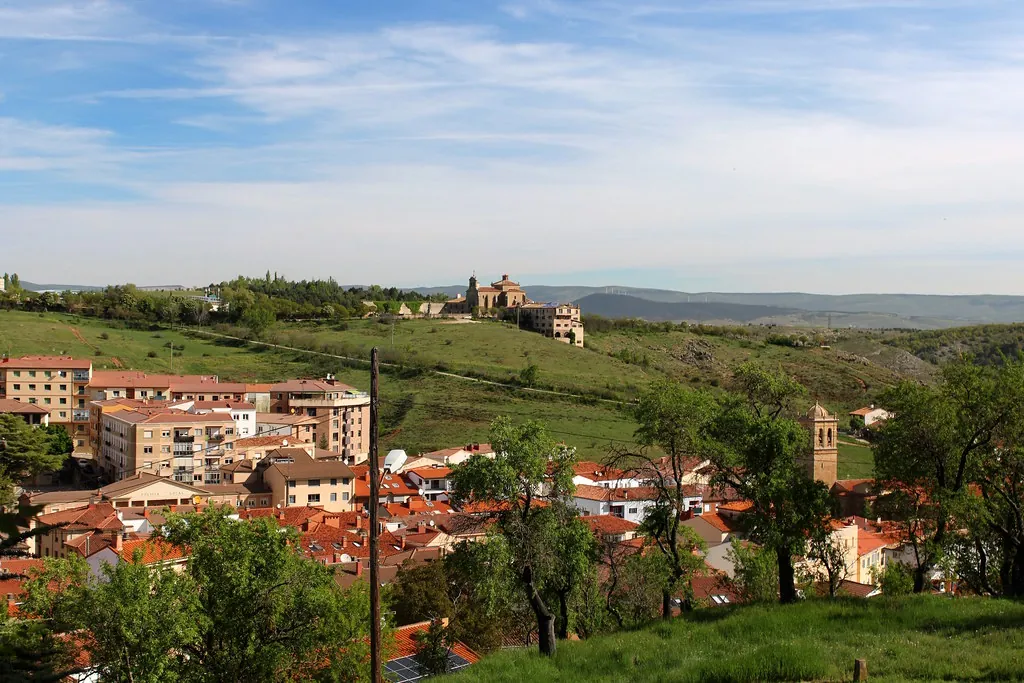
Campillo sits at 860 metres on the northern meseta, 18 km north-east of Aranda de Duero along the BU-901. The road climbs gently, then suddenly the land tips into the Arandilla gorge and the village appears—low, stone-coloured houses hunched against a wind that tastes of thyme and hot iron. In July that wind feels like a hair-dryer; in January it carries snow from the Sierra de la Demanda 40 km away. Nights are cold year-round; bring a fleece even in August.
The surrounding sea of vines belongs to the Ribera del Duero D.O., the stripe of plateau that produces Spain’s most expensive reds. Here the tempranillo grape is simply called tinto fino, and every family seems to own a few rows. Tractors outnumber cars three to one; the local school closes for the vendimia in late September because half the pupils are needed in the fields.
Subterranean Cathedrals
More than 300 wine caves lie beneath the modern pavements, hacked out of limestone between the 16th and 19th centuries. Most are private, their iron doors painted the same ox-blood red. Knock politely on a weekend and someone’s uncle will appear with a lantern and a rubber hose to siphon last year’s crianza straight from the barrel. Tastings cost €5–€8 for three wines; payment is a crumpled note slipped into a pocket, no cards, no receipt.
The largest public bodega, La Cueva de los Caldos, opens daily in summer. The tour lasts 45 minutes and ends in a cavern 23 metres down where the temperature holds at 12°C. British visitors usually emerge goose-bumped and mildly drunk; the complimentary pour is generous and the exit staircase steep.
What Passes for a Centre
There is no plaza mayor in the Castilian sense, just a widening of the main street where the 16th-century church of San Juan Bautista blocks the traffic. Its bell still marks the hours; at 13:00 the baker rushes out to pull down shutters, at 22:00 the last teenagers drift home. The building is plain sandstone, enlivened by a Baroque tower added after a lightning strike in 1743. Step inside to escape the sun: the interior smells of wax and extinguished candles, the roof beams are black with four centuries of incense.
Opposite, the only grocery opens 09:00–14:00, 17:00–20:30. Bread arrives at ten; if you want a baguette for lunch, queue at 09:55. The owner will ask where you are staying and, if you admit to a rural cottage, throw in a packet of detergent “because the washing machines out there never work properly.”
Eating Without Fanfare
Menus are short and seasonal. At Mesón de la Villa the choices are lechazo asado (half portion €18), morcilla de Burgos (€6), or a roasted red-pepper salad that arrives in a cereal bowl swimming with garlic and olive oil. Vegetarians survive on tortilla and queso de oveja curado, a nutty sheep cheese that could pass for a mild cheddar left in the airing cupboard. Local almonds appear as mantecados—crumbly shortbread biscuits sold by weight from the bakery; they travel well and survive the low-pressure hold of Ryanair.
Wine lists offer only Ribera del Duero; house reds start at €2.50 a glass and climb to €8 for a reserva. The waiter will ask whether you want it “frío” or “del tiempo”. Choose the latter—cellar temperature here is already perfect.
Walking It Off
A signed 6 km loop, the Ruta de las Bodegas, leaves from the church and circles the village through vineyards and wheat stubble. The path is a farm track; trainers are adequate, but open sandals collect thistles. Early May brings poppies and the distant clang of irrigation pumps; mid-October smells of crushed grapes and diesel. Interpretation boards appear every kilometre, though the English translations read like GCSE homework. Buzzards circle overhead; the only shade is an abandoned stone hut where shepherd and dog still shelter at noon.
For something stiffer, drive 12 km to the gorge at Hoces del Río Arandilla. A way-marked path drops 300 metres to the river, then climbs through junper and holm oak to a mirador that shows the meseta folding away like a crumpled tablecloth. Sunset is 21:15 in midsummer; take a head-torch for the return.
When to Come, When to Stay Away
Spring—mid-April to late May—delivers 22°C afternoons and meadows loud with larks. Hotel rooms are €45–€60 and you will share the village with perhaps a dozen Spanish weekenders. Autumn, mid-September to mid-October, coincides with the harvest: tractors trail mud into the streets, the air smells of fermentation, and every doorway displays plastic crates of purple grapes. Both seasons sell out the single three-star hotel and the two rural houses; book ahead.
July and August are honest. Daytime temperatures touch 36°C, the streets empty between 14:00 and 18:00, and the pool on the edge of town fills with shrieking children from surrounding villages. Accommodation drops to €35, but you will need air-conditioning and a tolerance for the nightly motocross practice on the waste ground behind the cemetery.
Winter is monochrome. The vines are black sticks, the sky pewter, the bodegas fragrant with oak and coal braziers. Snow falls two or three times; the BU-901 is gritted but side roads ice over. Still, the hotel’s restaurant serves the best cocido stew in the province and the caves remain a constant 12°C—bring a coat for the surface, not the depths.
Getting Here, Getting Out
Public transport is a polite fiction. Buses from Madrid (Estación Sur) run on Tuesday and Friday only, departing 15:00, arriving 18:15 after a change in Aranda. The return leaves Campillo at 07:10. Miss it and you wait three days. Car hire at Madrid-Barajas takes 1 h 45 m up the A1; fill the tank at Lerma—services are scarce north of there. There is no petrol station in Campillo; the nearest pump is 11 km back towards the motorway.
Mobile coverage flickers inside the old quarter; Vodafone disappears entirely in the caves. Download offline maps before you leave the hotel Wi-Fi. Cash is king—only the pharmacy accepts cards, and then reluctantly.
Last Orders
Campillo will never make the cover of a glossy Spain guide. It has no souvenir shops, no evening paseo of foreign accents, no Michelin stars. What it offers instead is a plate of roast lamb eaten to the sound of church bells, a glass of wine drawn from a barrel older than the waiter, and the realisation that the meseta is not empty—just quiet. Arrive with modest expectations and a full tank, leave with a boot full of bottles and the echo of subterranean silence in your ears.