Full Article
about Cardenajimeno
Ocultar artículo Leer artículo completo
The 07:14 bus to Burgos fills up fast. By half past, the bar on Cardeñajimeno's main street has switched the television from regional news to stock prices, and the first tractors are already threading between stone houses on their way to the surrounding wheat. Forty minutes later the same vehicles will be parked outside glass office blocks on the city's Avenida de Castilla y León, proof that this village of 5,000 is less a retreat from provincial life than its quieter annex.
At 930 m above sea level, the meseta air carries the dry, slightly metallic scent of cereal even in winter. The plateau's winds can knock a June temperature of 30 °C down to a fleece-requiring 18 °C within an hour, while January nights routinely dip to –5 °C. What the village lacks in altitude drama it makes up for in sky: an almost Nordic clarity after a cold front, followed by dust-bearing southerlies that tint the horizon the colour of toasted bread. Bring layers, and something to keep your hat from taking off.
Stone, adobe and the daily rhythm
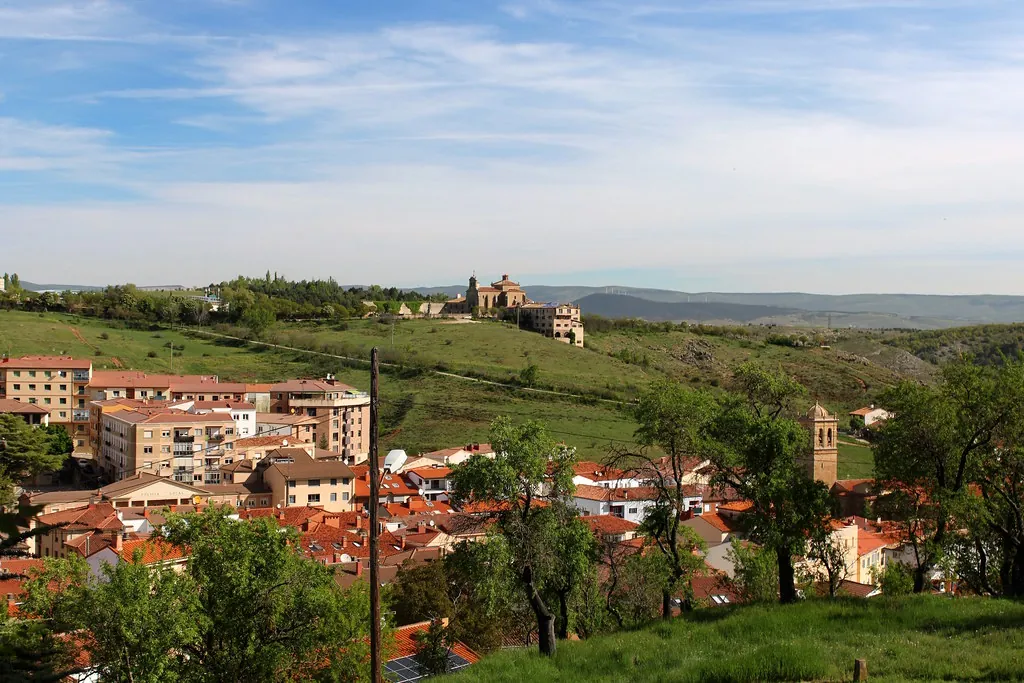
No souvenir stalls line the single main road, and the church bell still marks the quarters rather than any visitor itinerary. The 16th-century parish of San Andrés presides from a slight rise; its Romanesque doorway was recycled from an earlier shrine and the tower was rebuilt after lightning in 1874. Inside, the smell is of beeswax and burnt electricity rather than incense—Sunday mass at 11:00 draws thirty parishioners on a good week, fewer when harvest overlaps. Walk the side streets and you will see the hybrid architecture that defines the Alfoz de Burgos: granite blocks at ground level for the winter stables, sun-dried adobe above, later filled in with 1970s brick garages. A house with a freshly limed façade stands next to another whose roof beams have surrendered to the weight of pigeons. It is ordinary, and therefore honest.
Those walls enclose vegetable plots the size of a London driveway. On Fridays the produce travels the other direction: elderly women board the same Burgos bus with crates of lettuces bound for children who left for university and never quite returned. Return tickets cost €2.10 each way—buy them from the driver; contactless works, cash is preferred.
Walking without a summit in sight
The GR-82 long-distance footpath skirts the village, but most visitors simply follow the farm tracks that radiate like spokes. A recommended circuit heads south-east past the ruined threshing floors to the abandoned cortijo of Villanueva, 4 km out and back. The gradient is negligible, yet the open terrain offers no shade; set off before 10:00 or after 17:00 outside winter. Boot prints in the reddish clay betray the presence of wild boar, though you are more likely to spot a Montagu's harrier quartering the stubble. Cyclists can link minor roads into a 35 km loop through Rubena and Olmedillo; tarmac is good, traffic almost non-existent on weekdays, and the only climb worthy of the name rises 80 m over 3 km—barely a Berkshire incline.
Serious hill-walkers will be underwhelmed. The nearest summits worthy of the Ordnance Survey definition are the Montes de Oca, 40 km east, and even those top out at 1,350 m. What the area does offer is space: at dawn in April you can walk for an hour and meet only a mechanic from the Renault dealership exercising his pointer.
Eating between field and city
The village itself holds two cafés, one bakery and a butcher who doubles as tobacconist. The daily menú del día—three courses, bread, wine, water—runs to €12 at Bar El Mesón if you arrive before 15:00. Expect lechazo (milk-fed lamb) on Saturdays, judiones (broad-bean stew) on Thursdays, and industrial pudding every day. Vegetarians can usually negotiate an omelette, but vegans should plan ahead.
For anything more ambitious you will travel. Burgos is 13 minutes by car on the A-1, or 25 on the slower N-234 past the airport. In the capital the Michelin-listed Olaverri does modern takes on morcilla for around €35 a head, while the market hall sells tetilla cheese to take back to a village rental. The practical split is therefore: breakfast in Cardeñajimeno under the plane trees, lunch in Burgos, evening beer back in the square where the only traffic is the municipal sprinkler. A taxi home after midnight costs €22 fixed tariff—book before 21:00 or the single night driver clocks off.
Accommodation within the village limits is scarce. There is one three-key hostal above the pharmacy (doubles €55, Wi-Fi patchy) and a handful of weekend lets arranged through the council tourist office—ring +34 947 25 70 88, Spanish only. Campers head 8 km south to Fuentes Blancas, a 500-pitch site on the river Arlanzón open year-round; winter nights are bitter, but hot showers are included in the €19 tariff. Expect frost on guy-lines in December, and relief that you are not paying Burgos hotel prices during Holy Week, when triple-digit euros are normal.
When to come, when to stay away
April–May turns the plateau emerald; wheat heads appear like green catkins and temperatures hover between 8 °C at dawn and 20 °C by afternoon. September repeats the trick with gold instead of green. These shoulder months also coincide with migrant bird passage—bee-eaters in spring, cranes in October—yet you will share the viewpoint with at most a local dog walker.
July and August bring cloudless skies but also the meseta furnace: 35 °C by 13:00, little shade, and bars that shut between 16:00 and 20:00 while owners nap. The fiestas may tempt you—parish procession on 30 November, summer verbenas around 15 August—but be aware the village doubles in population for those weekends, and the sole cash machine runs dry.
Winter daylight lasts barely nine hours and the wind can rival the North Norfolk coast. If you do come then, base yourself in Burgos and treat Cardeñajimeno as a brisk excursion: bus out at 11:00, walk the 6 km circular, catch the 15:00 back before the temperature slips below 5 °C. Snow is rare but ice is not; farmers scatter straw on the patches that never see sun.
The honest verdict
Cardeñajimeno will never feature on a Spanish tourism poster. It has no cathedral, no artisan gin distillery, no boutique hotel. What it offers instead is a working snapshot of Castile: the smell of straw, the sound of a combine harvester at dusk, the sight of commuters swapping office lanyards for seed caps as they step off the evening coach. Come for a day to walk the wheat tracks, stay for a night if you value silence over room service, and leave understanding why half of Spain still lives in places the guidebooks ignore.