Full Article
about Cuevas De San Clemente
Ocultar artículo Leer artículo completo
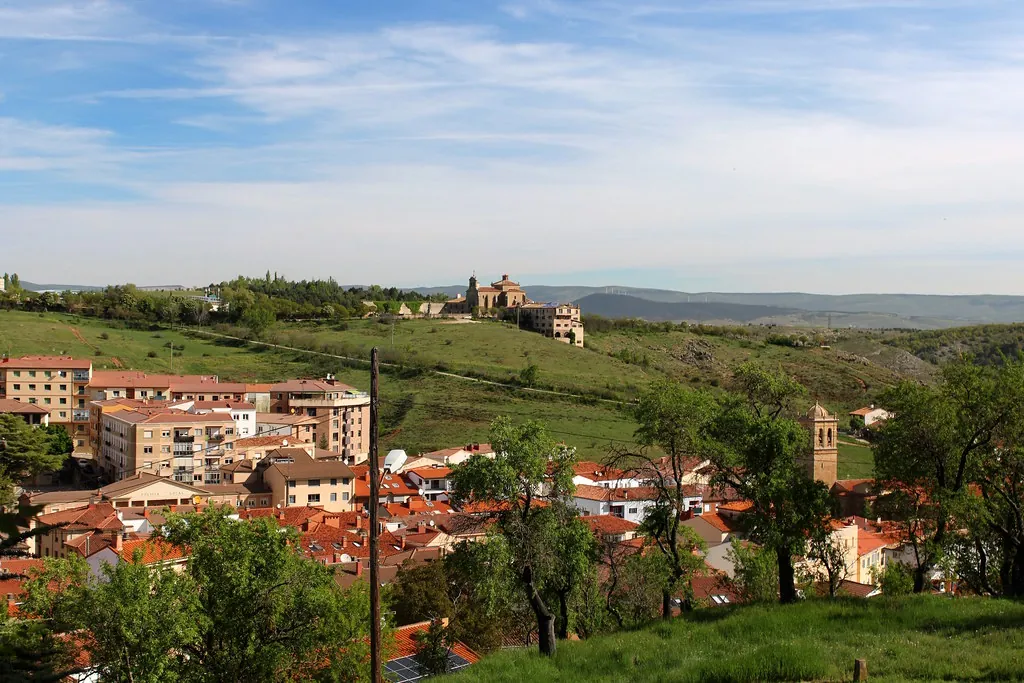
The stork on the church roof is the first thing you notice. It stands motionless, scanning the wheat stubbles that roll away in every direction, while the only sound is the wind rattling a loose piece of corrugated iron on a barn. Cuevas de San Clemente doesn’t announce itself; it simply appears after thirty kilometres of straight road from Burgos, a single file of stone houses wedged between two low hills. Blink and the village is gone, which is exactly how the sixty-odd inhabitants like it.
A place that forgot the hurry
There is no centre in the usual sense, just a widening of the lane where the 16th-century church and the old bread oven face each other across a patch of gravel. The oven still works – villagers fire it for the June fiesta and hand out cherry tarts – but on an ordinary Tuesday the square belongs to pigeons and the occasional delivery van. Mobile reception flickers in and out on Vodafone and EE; download your map before you leave Aranda de Duero because the only Wi-Fi belongs to the village association and they switch the router off at dusk.
Houses are built from what the fields provided: ochre limestone, mud bricks the colour of digestive biscuits, roof tiles thick enough to blunt a drill bit. Many still have the family name chiselled above the door and a stone bench where grandparents sit after the midday meal, jackets buttoned against the wind even in July. The climate is pure high plateau – blazing sun at noon, sharp chill once it drops behind the hill. Bring a fleece for 9 p.m. in August; in January the thermometer regularly slips below minus five and the lanes stay icy until ten.
Walking the dry-farming museum
Cuevas has no ticketed attractions, which saves deciding what to prioritise. Instead, the entire village operates as an open-air commentary on how people survive where rainfall struggles to reach 400 mm a year. Bodegas – small cellars – are dug horizontally into the sandstone behind houses; the temperature inside holds steady at 12 °C perfect for keeping wine made from the tempranillo vines that quilt the opposite hillside. One belongs to Julián the tractor driver: knock and he’ll show the press he inherited from his father, though he apologises that the new barrels are plastic because oak is too expensive now.
Paths leave the upper end of the village like spokes. The most useful heads south-east along the ridge, following a farm track used to check the irrigation pipes – redundant most years, but the council keeps them in case the clouds ever change their mind. After forty minutes the track drops into a shallow valley where cherry orchards suddenly appear, fenced against wild boar. Late May turns them into a constellation of scarlet fruit; owners welcome respectful pickers and charge three euros a kilo, half the supermarket price in Burgos. There is no shade; carry water and a hat because the Meseta gives nothing away for free.
When nothing happens after dark
Nightfall is the village’s secret weapon. Street lighting is deliberately weak – just enough sodium glow to stop you tripping on the raised doorstep outside number 14 – so the Milky Way spills across the sky like spilled sugar. Bring a tripod and you can photograph it from the churchyard; the stork nest silhouettes nicely against Scorpius. Silence is absolute. British visitors used to the background hum of an A-road notice their own heartbeat. One camper van couple admitted they left a day early because “it was too quiet to sleep”; everyone else stays up until two counting shooting stars.
If you need noise, come the first weekend of June. The fiesta honours San Clemente with a brass band bussed in from Covarrubias, a mass sung by a priest who once taught in Leeds, and a giant paella cooked in a pan that requires a tractor to move it. Emigrants return from Bilbao and Barcelona; second cousins compare notes on rent prices and Brexit. The bar is a trestle table in the square – beer two euros, plastic glass refundable if you remember to hand it back. By Sunday night the band has gone, the cherry tart crumbs are swept up, and the village sinks back into hibernation.
Eating (or not) between the wheat fields
There is no café, pub or restaurant. Zero. The last grocer closed when the owner retired in 2017, so stock up in Aranda de Duero (Condis on the south ring road has British staples: Tetley teabags, digestives, even Worcestershire sauce). Most visitors stay in one of the three village houses registered as casas rurales; they come with kitchens and the expectation you will cook. La Hornera will leave eggs, milk and sliced loaf on the table if you WhatsApp the night before – useful if you can’t face garlic-heavy migas at eight in the morning.
For an evening meal you drive fifteen minutes to Covarrubias. Mesón del Cid does a grilled lamb chop plate that avoids the region’s habit of drowning meat in olive oil; they’ll even swap chips for salad without argument. Reserve because half of Burgos appears at weekends. Taxi back costs €20–25 if you’ve been enthusiastic about the local Ribera del Duero; book before 22:00 because drivers turn their phones off at eleven.
The practical bit you’ll pretend you read later
Cuevas sits on the BU-911, a single-carriageway road that ribbons across the plateau to Santo Domingo de Silos. It is narrow, unlit and popular with combine harvesters that occupy the full width. Dip headlights early – locals interpret full beam as aggression. Petrol pumps are 25 km away in Lerma; when the low-fuel light pings you have enough for fifteen minutes of steady driving, no more. The weekday bus from Burgos to Santo Domingo will stop on request, but it often carries schoolchildren and leaves latecomers on the verge. Car hire is essential unless you enjoy hitch-hiking past fields of bored bulls.
Phone signal dies completely in the hollow below the church. Vodafone users may pick up a bar if they stand on the stone bench outside number 22; EE customers should climb the ridge behind the village and face north-east like a meerkat. There is no ATM – the nearest is inside the pharmacy in Covarrubias, commission €2.50.
Worth it?
Cuevas de San Clemente will never feature on a “Top Ten” list. It offers no souvenir fridge magnets, no sunset selfie platform, no craft brewery. What it does provide is a calibration point for urban clocks: a place where the day is measured by how far the stork’s shadow moves across the wall, and where the loudest sound at 3 a.m. is your own breathing. If that prospect thrills you, pack groceries and come. If it terrifies you, stay in Burgos and day-trip to the cathedral instead. The village will not mind either way – it has wheat to harvest and a sky that keeps turning whether anyone watches or not.