Full Article
about Haza
Ocultar artículo Leer artículo completo
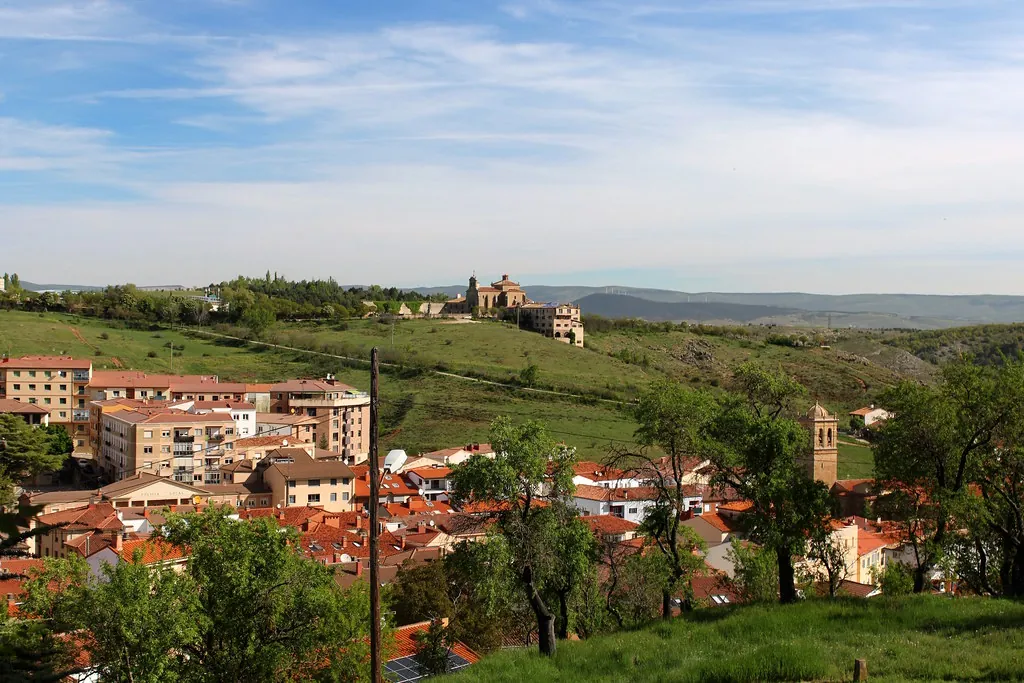
At 967 m above sea level, Haza sits high enough for your ears to pop on the final switchback from the A-1. The village appears suddenly: a sandstone wedge balanced on a ridge, its tower punching the same sky that herds the Duero valley mists each dawn. One moment you’re among wheat and sugar-beet, the next you’re looking down 200 m of cliff-edge vineyard that smells of wild thyme and hot slate. The temperature drops five degrees in summer, rises the same in winter; bring a fleece even in July.
Stone, Wind and the Smell of Fermenting Grapes
Haza’s walls once ringed a frontier post between Moorish Toledo and the Christian north. What remains is a 12th-century Torre del Homenaje and a collar of battlements just wide enough for two abreast. Walk the parapet at dusk and the stone glows the colour of pale ale; lights twinkle across the Riaza valley like a spill of low-watt stars. Inside the walls, lanes are barely shoulder-wide. Cobbles have been polished by 800 years of boots rather than tour buses; you will meet more cats than people.
The parish church of San Juan Bautista keeps its original Romanesque doorway, but the real sanctuary is underneath your feet. Locals call it el barrio de bodegas: a honeycomb of 150-odd cellars hand-chiselled into the rock. Chimneys the size of fence posts poke through the grass, exhaling cool air that smells of last year’s Tempranillo. Knock politely and someone may slide back a wooden hatch to reveal a 300-year-old press still dripping garnet must. No ticket office, no audio guide—just the guide’s own pride and a glass thrust into your hand.
A Half-Day Itinerary That Actually Works
British visitors usually slot Haza between breakfast in Burgos and a late lunch in Aranda de Duero, 35 minutes east. The formula works: arrive by 10 a.m., park on the rough lay-by outside the walls (free, ten spaces, if full wait ten minutes—turnover is brisk). Spend 45 minutes circling the walls, photographing the valley before thermals lift the haze. Duck into the church—door unlatched, donations box nailed to a pew—then descend the signed staircase to the bodega quarter. If Señor Raúl is about (look for the red Toyota pick-up) he’ll open Cave No. 14; his 2019 crianza sells for €9 a bottle, cash only.
By 11:30 the sun is over the yardarm and over the parapet. Walk the 1.5 km senda de los viñedos south to the ermita; the path is level, stroller-proof, and gives the same panoramas you paid for in the Picos last year—without the entry fee. Back in the village, the lone bar, Casa Cayo, serves coffee that tastes of chicory and gossip. They fire up the grill at 13:00; a quarter portion of lechazo (€18) feeds two if you order the Castilian soup starter—think garlic, paprika and a single perfect egg.
When Silence Turns Into Sunday Gridlock
Haza’s population swells tenfold on summer Sundays when Madrilenians reclaim grandparents’ houses. By 15:00 the lane resembles a Waitrose car park: Porsches squeezed between stone pillars, toddlers chasing feral hens. Come mid-week instead and you’ll share the streets with three retired jornaleros arguing over dominoes. Monday and Tuesday the bar is shuttered; bring water and an emergency pack of Hobnobs.
Winter brings its own theatre. At 1,000 m the village catches the Meseta’s first snow; the approach road is gritted late, if at all. A whiteout can make the tower look transplanted from Northumberland, but it also locks you in. Carry blankets and a charged phone—signal dies on the northern slope—and don’t trust Google’s “25 min to Aranda”; triple it when sleet is blowing sideways.
Beyond the Walls: Wine, Wheat and the World’s Largest Underground Cathedral
Five kilometres north, the Aranda de Duero cellar complex runs for 7 km beneath the town centre. English tours leave at noon and 5 p.m.; £10 gets you three generous pours and a history lesson in medieval engineering. Combine it with Haza and you can truthfully claim to have tasted Ribera at both artisan and industrial scale in one afternoon.
Cyclists can follow the signed Ruta del Ribera eastwards through quiet back lanes to La Horra (12 km), where Bodegas Portia’s Norman-Foster building looks like a stealth bomber landed among vines. Road bikes cope fine; hybrids better if you fancy the dirt track shortcut that drops 150 m in two kilometres—check rim brakes before you commit.
The Honest Verdict
Haza will not keep you busy for a week. It has no gift shop, no ATM, no artisanal soap scented with—whatever the marketing team dreamt up last Tuesday. What it offers is altitude-induced clarity: a place where you can hear a blackbird 300 m away, where the wine arrives without tasting notes, where the stone under your palm is the same the Moors failed to capture. Treat it as a breathing space rather than a destination and it repays the detour. Miss the lunch window, ignore the weather forecast or arrive expecting Cotswold prettiness and you’ll leave hungry, cold and mildly grumpy. Sometimes that’s exactly what travel should do—remind us that places are alive on their own terms, not ours.