Full Article
about Hontoria De Valdearados
Ocultar artículo Leer artículo completo
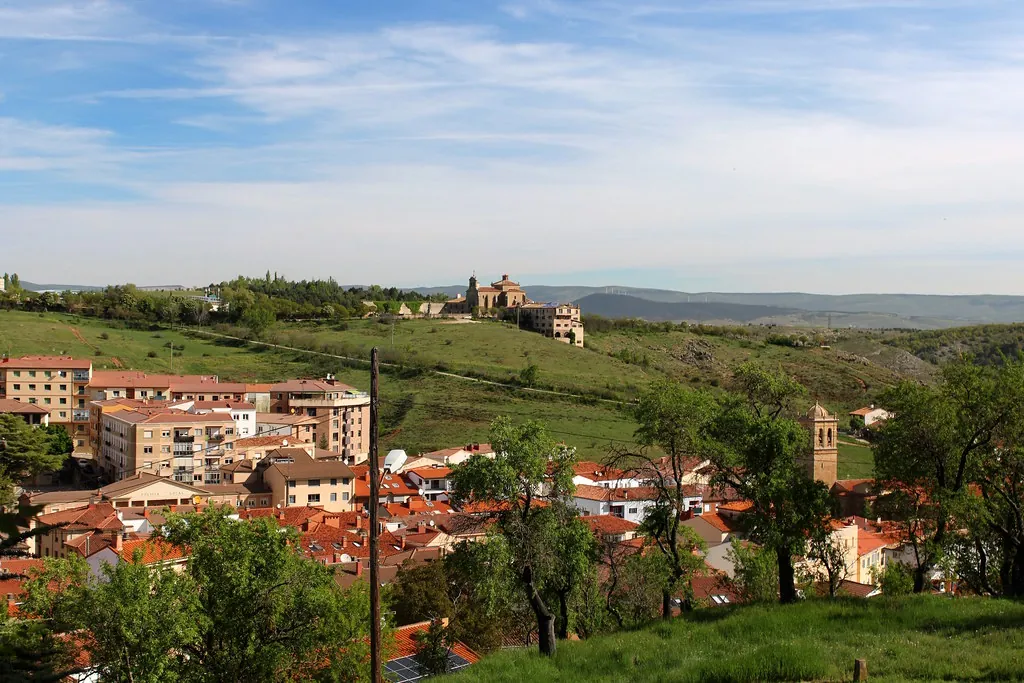
The thermometer on the stone wall read 4 °C at eleven in the morning, even though the Madrid guidebook we’d left in the hire car promised October sunshine. At 900 m above sea level, Hontoria de Valdearados makes its own weather. The wheat stubble crackled underfoot while the Sierra de la Demanda, already sugared with fresh snow, looked close enough to hit with a well-aimed olive stone. Up here the Duero plain feels less like a single landscape and more like three stacked on top of one another: vines at your feet, cereal in the middle band, pine forest on the ridge line. All of it empty except for a tractor and two elderly gentlemen sharing a cigarette outside the only open bar.
A village that keeps its wine underground
Hontoria’s population is 156 on the ayuntamiento website, 149 if you ask the barman, “plus the dogs”. Either way, the vines win by a factor of twenty. The grapes finish their journey in a warren of hand-cut cellars that spreads beneath the streets like a rabbit warren bored in limestone. Nobody has mapped the full network; owners simply knock through a shared wall when they need more room. Temperature holds steady at 12 °C whatever the weather upstairs, so the oldest galleries, some three storeys deep, still age the local tempranillo even when their stone staircases have worn to a smooth ramp.
There is no ticket office, no purple “Ruta del Vino” arrow. If you want to look inside you ask in the bakery, and someone’s cousin appears with a head-torch and a padlock key. We descended one near the church and emerged twenty minutes later smelling of oak and CO₂, blinking at the daylight and promising to return at seven for a tasting that cost €6 a head—cash only, no card machine, no printed receipt.
Stone houses, big doors, no postcards
The village architecture does not flirt with visitors. Houses are built from the same beige-grey stone that pokes through the fields, their roofs the colour of burnt toast. What decoration exists is accidental: a coat of arms eroded to the barely legible outline of a hawk, a wooden balcony warped so far that the railing touches the wall beneath. Gates are sized for ox-carts, not SUVs, so modern cars park skew-whiff against any available stretch of wall, hazard lights blinking like nervous eyelids.
Inside, rooms stay cool in summer and fridge-cold in winter. Most holiday lets have kept the original packed-earth floors; the owners will warn you to leave the heating on low all night or wake up to cracked plaster. Electricity is eye-wateringly expensive up here, so hot-water timers click on for exactly forty minutes morning and evening. British guests who ignore the instructions and take a second shower usually trip the fuse for the entire staircase, a fact discovered the hard way by a party of cyclists from Leeds last Easter.
Walking tracks that taste of thyme and diesel
Three way-marked paths leave the square, each one promising to be “flat-ish” according to the laminated card pinned outside the town hall. The 7 km loop south-east towards Gumiel de Izán crosses four cattle grids, two disused wine presses and one field where the path simply disappears into a freshly ploughed furrow. Farmers still work the land with 1980s John Deere tractors that smell of burnt red diesel; they will wave you through the dust cloud, but only after the job is finished. Timing matters: start by nine and you share the track with larks and the occasional hare. Wait until eleven and you’re ankle-deep in soil that’s just been turned for planting winter wheat.
Spring is the kindest season—green wheat, almond blossom and enough mud to make the descent interesting rather than suicidal. Summer turns the landscape beige by late June; temperatures brush 35 °C by noon and shade is as rare as a cashpoint. Autumn brings the vendimia: grapes harvested at night to keep the fruit below 14 °C, headlights carving white cones between the rows, walkie-talkies crackling in Castilian Spanish too quick for school-level comprehension.
Eating lamb that never saw grass
The local menu is blunt. Lechazo asado arrives on a clay dish the size of a bicycle wheel: milk-fed lamb, slow-roasted so the skin shatters like crème-brûlée while the meat beneath stays the colour of fresh putty. No herbs, no jus, just a jug of local crianza and a basket of bread that could stun a burglar. Vegetarians get roast peppers and the aforementioned bread; vegans should pack a sandwich. Pudding is usually queso de Burgos—loose, ricotta-texture cheese—drizzled with honey from hives parked among the sunflowers on the valley floor. A set meal in the only restaurant (open weekends only, ring the bell if the door is locked) costs €14 and includes wine that would retail in the UK for £12 simply because it carries the magic words “Ribera del Duero”.
When to come, what to bring, what to forget
Hontoria sits 1 h 45 min north of Madrid-Barajas on the A-1 toll road; the last 12 km are single-carriageway, perfectly smooth and entirely empty except for the occasional lorry hauling Duero wine to Bilbao docks. A car is non-negotiable—there is no railway, and the weekday bus from Aranda de Duero was axed in 2018. Fill the tank and buy groceries in Aranda; the village shop opens when the owner finishes her fieldwork, roughly 10 am to 1 pm on alternate weekdays, closed for the grape harvest all of September.
Phone signal is patchy. Vodafone users get two bars on the church steps; anyone on EE should expect to climb the ruined water tower for a single flickering dot. Download offline maps before you leave the motorway and bring cash in twenties—nearby wineries can’t always process foreign cards and the nearest ATM is a 20-minute drive back towards the toll road.
Accommodation is limited to six self-catering casas rurales and one two-room guesthouse. Prices hover around €80 a night for the house, however many people you squeeze in. Most properties lack a pool; summers are hot but nights drop to 16 °C, so you sleep with the windows open and wake to the smell of wood smoke from the neighbour’s kitchen. Winter is a different affair: snow arrives by December, the road is gritted sporadically and owners will ask to see snow chains before they hand over the key. If the white stuff is forecast, bring them or risk spending the night on the hard shoulder between kilometre posts 152 and 153, a mistake already chronicled by several British travel forums.
Parting shot
Hontoria de Valdearados will not change your life. It offers no souvenir fridge magnets, no flamenco nights, no sunset yoga on a rooftop terrace. What it does give is the sound of wind through 200-year-old vines, a glass of wine that has travelled fewer metres than your suitcase, and the dawning realisation that Spain still contains places where the weekend timetable is dictated by when the baker’s oven reaches temperature. Turn up with realistic expectations—plus a fleece, even in May—and the village repays you with silence big enough to hear your own pulse. Fail to plan and you may spend the evening eating crisps for dinner while the restaurant owner finishes his own harvest supper next door. Either way, you’ll leave with limestone dust on your shoes and a clearer sense of how high the Meseta really sits.