Full Article
about Madrigalejo Del Monte
Ocultar artículo Leer artículo completo
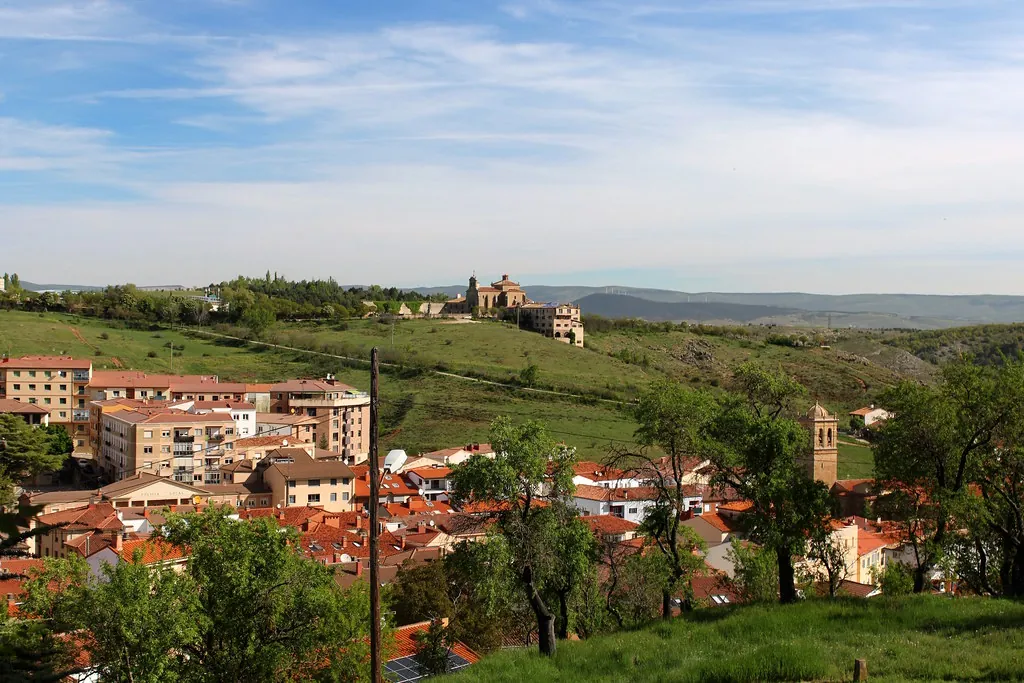
The church bell strikes noon and the only reply is a tractor changing gear somewhere beyond the stone houses. Madrigalejo del Monte, population 112, doesn’t do background noise. What it does do is horizon—wheat, barley and more wheat—rolling all the way to a sky that feels twice the normal height.
This is the Castilian plateau at 880 m, halfway between Burgos and Aranda de Duero. The village sits on a gentle swell; stand on the tiny Plaza Mayor and you can watch weather approach a good twenty minutes before it arrives. Winters are sharp—night frosts even in April—while July bakes the clay walls into pottery. Spring and early autumn give the kindest light and the least punishing walks.
A thirty-minute lap of honour
Start at the parish church, finished in rough-hewn limestone around 1650 and never enlarged since. The tower leans slightly north-west, the result of a lightning strike that locals still date by the harvest it interrupted. Inside, the single nave smells of candle wax and damp stone; the retablo is modest, painted in tobacco browns rather than gold, and all the better for it. Push the south door (it sticks in wet weather) and you emerge onto Calle Real, the village’s only through-road.
From here the pattern is simple: stone at the front, corral at the back, pantiled roof in between. Many houses carry weather-worn coats of arms—evidence of minor nobility who stayed to farm rather than flee to Madrid. Count five front doors and you reach the old grain store, now locked but still labelled “Alhóndiga 1902” in fading blue. Another three doors and the tarmac turns to packed earth; the village officially ends at a wooden gate where a hand-painted sign asks drivers to shut up the sheep.
The whole circuit takes twenty-eight minutes, including a polite chat with the woman who sells garlic from a plastic chair outside her garage. There are no souvenir shops, no interpretive panels, no ticketed anything. Bring water—public fountains were disconnected years ago.
What the brochures don’t mention
Madrigalejo del Monte is quiet to the point of echo. The only bar opens at 07:00 for the farm workers, closes at 14:00, and may or may not reopen at 20:00 depending on custom. Monday is reliably shut. If you need cash, a loaf, or a replacement phone charger, drive 11 km to Lerma before 21:00 or you’ll go without.
Mobile signal is patchy inside the stone houses; Vodafone works on the square, EE prefers the church steps. There is no petrol station—fill up on the A-1 before the turn-off. What the village does offer is darkness so complete that the Milky Way looks like cloud. On clear August nights amateur astronomers set up telescopes by the cemetery wall and invite whoever passes to look at Saturn’s rings.
Eating: travel by the plate
Food here is measured in kilometres, not Michelin stars. The lamb comes from flocks you can see grazing beyond the last streetlamp; the cheese is made in a shed 4 km south and sold wrapped in brown paper. Order cordero asado at the mesón in nearby Lerma and you receive a quarter-kilo of slow-roast suckling lamb, enough for two with leftovers. Morcilla de Burgos, the local blood sausage bulked out with rice, is served grilled until the skin blisters—ask for “tostada” if you prefer it less rich. Vegetarians survive on tortilla and salads; vegans should picnic.
Wine lists are short and local: Ribera del Duero reds dominate, fruitier than Rioja and easier on a palate used to claret. A glass rarely tops €2.50. Pudding is often skipped in favour of a chupito—tiny shot of orujo brandy that tastes of aniseed and makes the drive home seem warmer than it should.
Walking without waymarks
There are no signed footpaths, but the farm tracks heading east towards Hontoria de Cerrato are public and well used. A 6 km loop leaves the village past the ruined shepherd’s hut, skirts three cereal fields, then cuts back along the Arlanza irrigation ditch. Spring brings red poppies stitched through the wheat; late July turns everything bronze and rustles like dry paper. Stout shoes suffice—boots are overkill—and take a stick if you dislike dogs; guard dogs are tethered but vocal.
Cyclists favour the gravel lanes south to Melgar de Fernamental: flat, almost car-free, and blessed with shade from poplar wind-breaks. A mountain-bike or gravel set-up is wise after rain; the clay ruts like soap.
Festivals: when the village doubles
The fiesta mayor, held around 15 August, is the one weekend the population swells to 400. Emigrants return from Bilbao, Barcelona and Burgos; a fairground truck installs a dodgem floor on the football pitch. The highlight is the “suelta de vaquillas” on Saturday morning—half a dozen heifers trotted through the streets while teenagers show off. It is tamer than Pamplona, but still not for the RSPCA-minded. Evening brings a communal paella and a disco that thumps until 05:00, astonishing in a place where midnight is usually lights-out. If you crave silence, book elsewhere that night.
Autumn is mushroom season. Locals head to the scattered holm-oak groves after rain, baskets in hand, and will point newcomers toward “cagarrias” (field mushrooms) if asked politely. Never pick without guidance—two species here are liver-toxic and look depressingly similar to the edible ones.
How to get here, and away again
Fly to Santander with Ryanair from London-Stansted—morning flight, two-hour hop, no jet lag. Pick up a hire car, join the A-67 to Burgos, then the A-1 south for 40 minutes. Leave at junction 149, follow the BU-910 for 11 km of wheat-scented straight road; the village appears as a smudge of stone on the horizon. Total journey time from UK front door: under six hours if the M25 behaves.
Public transport exists only on paper. A school bus passes at 07:30 and 14:00, but drivers shrug at tourists. Taxis from Lerma cost €18 each way—book in advance because there are two cars for the whole district.
So, should you?
Madrigalejo del Monte will never compete with Segovia’s aqueduct or San Sebastián’s restaurants. It offers instead the rare sensation of space without sales pitch. Come if you like your Spain unfiltered: the smell of straw, the sound of boots on packed earth, the knowledge that the horizon you photograph today will be stubble tomorrow and ploughed the day after. Leave if you need lattes, laundry service, or anything open after ten. The village will still be there, quietly growing grain under that enormous sky, long after the last flight home has taken off.