Full Article
about Manciles
Ocultar artículo Leer artículo completo
The church bell strikes noon and nobody stirs. Not because the villagers are ignoring it—there simply aren't enough of them left to make a sound. With twenty-one residents registered and perhaps half that actually in residence, Manciles has reached a population density that makes the Scottish Highlands feel crowded.
This microscopic settlement sits forty-two kilometres south-east of Burgos city, planted squarely in the middle of Castilla y León's ocean of cereal fields. The approach road (the BU-550 if you're following GPS coordinates) runs ruler-straight between wheat and barley so uniform it looks ironed. The only vertical punctuation is the stone bell tower of the Iglesia de San Juan, rising like a ship's mast from a golden sea.
What passes for a centre
There is no plaza mayor in the usual Spanish sense, just a widened stretch of calle Real wide enough for a tractor to turn round. The church—late Romanesque with a Baroque hat added in the 1700s—faces three stone houses and a vacant lot where the school used to stand before it closed in 1978. Peer through the iron grille and you can still read the alphabet chart curling above the blackboard.
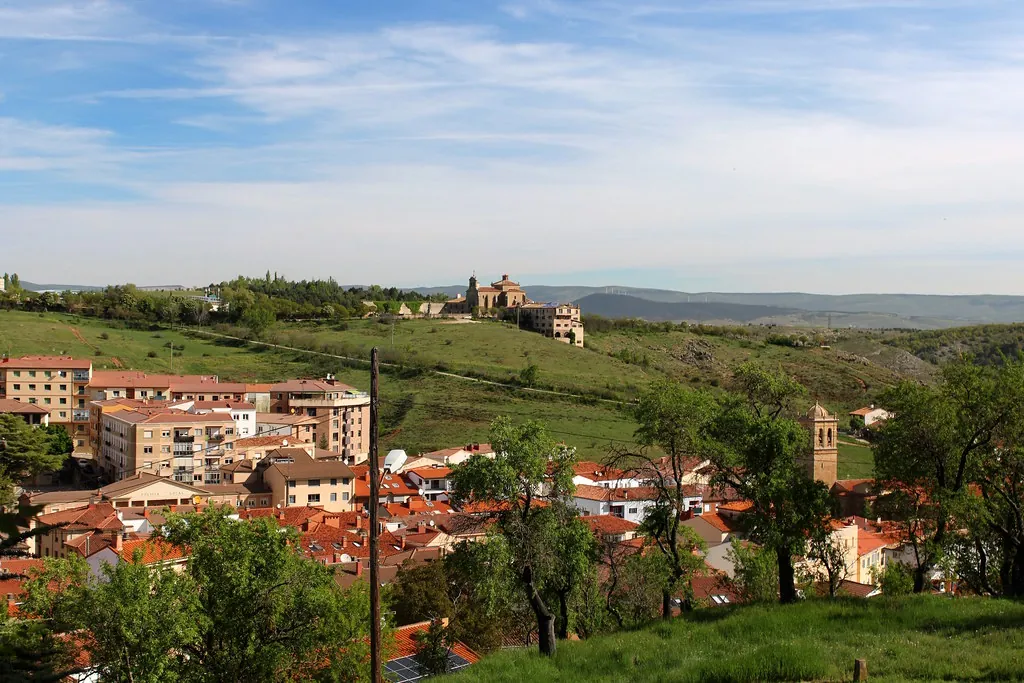
Around this accidental square the village arranges itself in two short streets and a handful of alleys so narrow that neighbours can shake hands from opposite upstairs windows. Construction is the local limestone, biscuit-coloured and streaked with iron, roofed in terracotta tiles whose curved profiles echo the rolling hills thirty kilometres south. Many houses wear their age proudly: wooden doors two metres high, iron knockers shaped like cucumbers, stone staircases that have lost their camber to centuries of boots. Others have fresh cement around the frames and PVC windows—holiday-home owners from Burgos city modernising on weekends.
The effect is neither museum nor building site, simply a place caught mid-breath between past and present. One frontage displays a carved coat of arms dated 1624; next door someone has parked a bright-green John Deere ride-on mower beside a pile of pallets waiting for the autumn bonfire.
Walking into nowhere particular
Manciles makes no claim to monuments, so the thing to do is leave. A lattice of farm tracks radiates outwards, signed only with the farmer's name and a warning to keep dogs on leads. Take the south-west track that leaves from the cemetery gate and within ten minutes the village shrinks to a Lego model on the horizon. The path—really two pale ruts in the grain—follows a low ridge that gives views north toward the Montes de Oca, blue-grey and rumpled like a discarded overcoat.
Spring brings the most immediate reward. From late April the fields stripe green and emerald according to crop stage, while the verges flare yellow with wild fennel and mallow. Larks rise vertically, hover, then parachute down singing. With binoculars you can pick out calandra larks, their underwings flashing white, or watch a hoopoe stride across a fallow patch like a bent walking-stick. The only soundtrack otherwise is the wind combing the wheat and, every half-hour, the distant metal whisper of the Madrid–Burgos AVE train you cannot see.
Summer walks demand an early start. By eleven the thermometer nudges thirty-five degrees and the path turns to talcum. Shade exists only where poplars line seasonal streams—usually dry by July—so carry water and a wide-brimmed hat. Autumn swaps glare for low, honeyed light and the smell of freshly cut straw; winter can surprise with snow that drifts across the unprotected track long after Burgos city rain has washed away.
Food that doesn't come from a menu
There is no bar, no shop, no petrol station. The last grocery closed when its proprietor, Doña Feli, died in 2003; the counter and National Lottery sign are still visible behind roller shutters painted institutional green. If you arrive without supplies the nearest loaf of bread is a fourteen-kilometre drive to Huérmeces, where the mini-market opens at nine and shuts at two.
What Manciles does possess is a handful of domestic kitchens that still follow the agricultural calendar. Visit in late November and you may catch the scent of chorizos curing over oak smoke in a lean-to. January means matanza time: extended families gather to slaughter a single pig and spend two days turning every gramme into morcilla blood-pudding, loin, and cecina air-dried in the attic rafters. The process is not staged for tourists; ask politely and someone might sell you a ring of chorizo for eight euros, tied with string and still warm from the smoker.
Otherwise, eat before you come or book a table in Covarrubias, twenty minutes south. At Asador El Lagar de Isilla they will serve you cordero asado—milk-fed lamb roasted in a wood oven until the skin forms a glass-like crust. It arrives on a metal plate with only a lemon wedge and a dish of roast potatoes, the meat so tender you portion it with a spoon. Expect to pay twenty-four euros for a half-lamb feeding two; they also offer a vegetarian bean stew if you telephone ahead.
When the village doubles in size
The feast of San Juan Bautista, held on the nearest weekend to 24 June, is the only moment Manciles feels obliged to acknowledge the outside world. A sound system appears in the church square, stringing coloured bulbs between houses that haven't spoken to each other since last summer. The evening mass overflows with grandchildren who normally live in Bilbao or Barcelona; after dark a disco-pub on wheels disgorges reggaeton across the fields until four in the morning. Sunday lunchtime the village lays on a communal paella cooked in a pan two metres wide; tickets cost ten euros and sell out by eleven o'clock.
For three days litter blows about and cars park in the wheat stubble. By Tuesday the bulbs come down, the sound system departs, and Manciles reverts to its default setting of wind and grain.
Getting here (and away again)
Unless you fancy a very expensive taxi, a hire car is non-negotiable. From the UK the simplest route is to fly Ryanair or easyJet into Santander: two hours' flight from London or Manchester, then ninety minutes' drive south on the A-67 and BU-550. Burgos airport is closer—twenty-nine kilometres—but only Vueling operates direct flights, and those via Barcelona add connections.
Road conditions are generally good, but the final three kilometres after Huérmeces narrow to single-track with passing bays; meet a combine harvester and you'll be reversing into a barley field. In winter carry snow chains: the plateau sits at 840 metres and drifting is common after January storms.
Accommodation choices are equally limited. Nobody has yet converted those empty houses into rustic-chic rentals, so you sleep elsewhere. The nearest casas rurales cluster in Covarrubias—Casa Galín offers two-bed cottages from seventy euros a night, including a wood burner and patchy Wi-Fi. Burgos city provides conventional hotels (NH Collection Palacio de Burgos, double room ninety euros) if you prefer a thirty-minute commute to silence.
The honest verdict
Manciles will not change your life. It offers no postcards, no fridge magnets, no epiphany at sunset. What it does provide is a calibration device for urban urgency: a place where the day's highlight can be watching cloud shadows slide across an unbroken wheat field, where the loudest noise at midnight is your own pulse. Come prepared—fill the tank, pack sandwiches, download offline maps—and you can spend a day walking through landscape that has fed Spain since the Romans. Leave before you get restless; the village will still be there, exactly as inactive as you left it, waiting for the grain to turn gold again.