Full Article
about Merindad De Rio Ubierna
Ocultar artículo Leer artículo completo
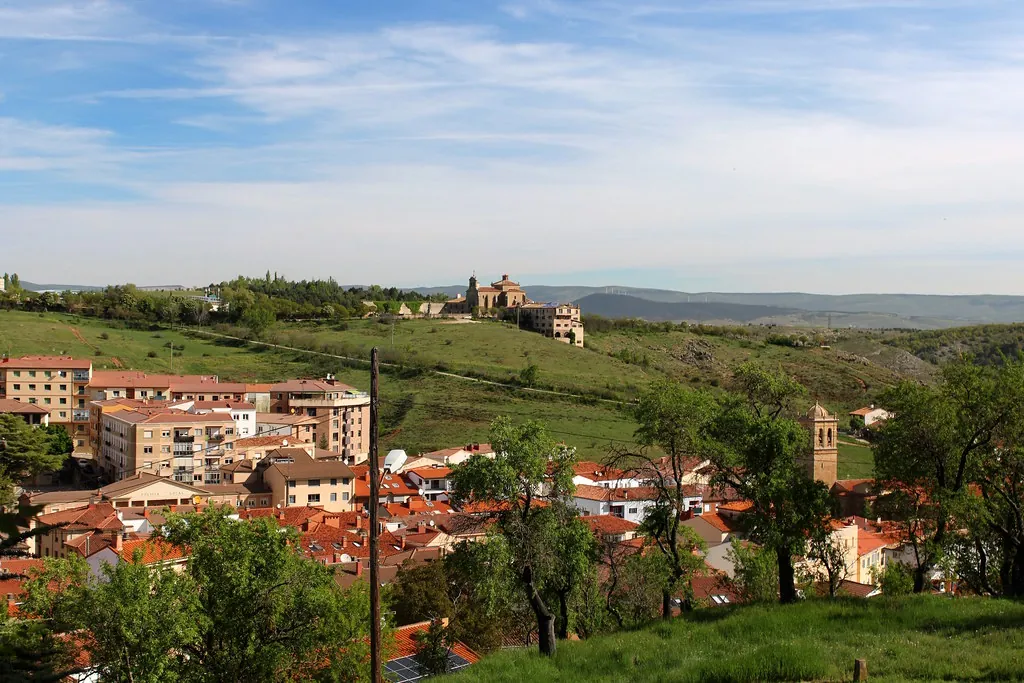
The road leaves Burgos in a hurry, racing north on the N-623 towards Santander, then suddenly remembers itself and peels off onto narrower tarmac. Twenty minutes later, the Altos de Burgos plateau breaks into folds of grain and ochre, and you’re in Merindad de Río Ubierna—five thousand souls spread across a constellation of hamlets that refuse to cluster. No single plaza dominates here; instead, each settlement keeps its own horizon, linked by the river that gives the comarca its name and by farm tracks that double as walking routes when the wheat is low.
A parish church, a crested house, a bar that may open
Sotopalacios, the largest nucleus, still only just tops nine hundred inhabitants. Its church tower rises like a compass needle above wheat and sunflower plots, while storks clatter across roofs that once belonged to minor nobility. Stone coats-of-arms poke out above doorways—griffins, castles, the odd faded fleur-de-lis—reminding visitors that this quiet grain belt sat on the wool road from the northern meseta to the Cantabrian ports. Peek into the porch of the parish church and you’ll find a Romanesque capital reused as a holy-water stoup: sculpture recycled through centuries of modest conquest.
Head two kilometres east to Quintanilla Sobresierra and the scale shrinks further. The church of San Martín squats at the edge of the fields; its south doorway is pure twelfth-century limestone, the carvers’ chisel marks still sharp where vines and mythical beasts wrestle for space. Inside, the nave is cool, dim and scented with candle smoke—no interpretation panels, no gift shop, just a printed notice asking you to close the door against pigeons. If you want to get in outside mass times, telephone numbers for two key-holders are painted on the wall; ring, wait, and someone in overalls will probably trudge over with a three-kilo iron key.
Peñahorada, west of the main road, offers a different lesson: how ordinary houses become quietly extraordinary. Granite footings, adobe upper walls, timber balconies painted the colour of ox-blood—every dwelling is a palimpsest of materials that were lying about when the previous roof blew off. Nothing is “restored” in the glossy sense; walls are patched, roofs re-tiled, generations stitched together with mortar and pragmatism. Between the lanes, elderly residents still keep their own threshing floors, stone circles now filled with potted geraniums or the occasional trampoline. It is conservation by everyday use, and it feels more honest than many heritage schemes.
Following water and ridge
The Ubierna itself is smaller than the name suggests—a modest trout stream that slips through poplar galleries and under medieval pack-horse bridges. A way-marked footpath shadows it for fourteen kilometres, starting from a ruined mill outside Sotopalacios and finishing at the San Felices hermitage, 180 m above the valley on a whale-back hill. The climb is short but sharp, on a stony mule track that forces you to look at your boots rather than the view—until, suddenly, the crest flattens and the whole plateau tilts away. Northwards, the cordillera of the Cantabrian mountains shows its teeth; southwards, the wheat ocean ripples towards Burgos cathedral spire, visible on clear days twenty kilometres off.
Spring brings the best light: sharp mornings when dew silvers the stone walls and larks lift from furrow to sky. In high summer the track is furnace-hot by eleven o’clock; start early, carry more water than you think you need, and expect thistles to snag your trousers. Autumn smells of crushed fennel and drifting stubble smoke, while winter can lay down a skin of ice that makes the limestone slabs treacherous—still doable, but walking poles help.
Cyclists find the same route gentle enough on a gravel bike, though you’ll share the harder surface sections with the occasional tractor hauling grain to the co-operative silo at Villalbilla de Burgos. Drivers, take note: secondary roads are narrow, with no shoulder and deep drainage ditches. Meeting a combine harvester is a game of chicken you will lose.
What lands on the plate
There is no gastro-revolution here, and that is half the point. Lamb comes from flocks that graze the surrounding esparto grass; order lechal asado at Hostal-Restaurante Río Ubierna in Sotopalacios and you get half a milk-fed lamb, crisp skinned and served on a pewter plate with only roast potatoes as wing-men. A full portion feeds two hungry walkers for €26; ring 947 29 40 29 before 11 a.m. if you want it guaranteed at lunch time, because the oven only takes so many. The same family kitchen dishes out morcilla de Burgos—blood sausage bulked with rice and faintly spiced with cinnamon—plus local white beans stewed with compango, the collective name for chorizo, pancetta and morcilla ends. Vegetarians get a menestra of seasonal vegetables, but vegan travellers should plan ahead; animal fat is the default cooking medium.
Outside Sotopalacios, options shrink. One bar in Quintanilla opens weekends, another in Peñahorada keeps odd hours linked to the owner’s farm work. Pack a picnic if you’re unsure: bread from Burgos, sheep’s-milk cheese from the village of Pampliega, and a bottle of crianza from the Arlanza valley twenty minutes east. Drinking water fountains exist in most squares; locals use them, tourists needn’t fear.
When the villages remember they’re Spanish
Fiestas are hyper-local and rarely advertised beyond a hand-stapled poster on the church door. Sotopalacios stages its patronales around 15 August—procession, brass band, paella popular cooked in a pan the size of a satellite dish, and late-night outdoor dancing that finishes only when the generator runs out of diesel. Quintanilla Sobresierra waits until the second weekend of September, when ex-villagers drive back from Burgos or Bilbao, cars parked in cereal stubble, children let loose with footballs and churros. The spring romería to San Felices, usually the first Sunday after Easter, is the most inclusive: mass in the meadow, everyone clutching portable chairs, followed by cocido stew served from dust-covered caldrons and a communal clean-up that shows how litter-picking can be a social sport. Foreign visitors are welcomed, though you’ll be expected to join the queue for food and wash your own plate.
Getting there, staying over, knowing when to leave
Public transport is patchy. ALSA runs one daily bus from Burgos to Sotopalacios at 14:15 (€2.35, 35 min); the return leaves at 07:10 next morning, which suits day-trippers poorly. A taxi from the capital costs about €30—worth sharing if three or four of you are exploring. Car hire remains the sensible choice; the turn-off is clearly sign-posted at kilometre 15 on the N-623, and all villages have at least a strip of roadside parking.
Accommodation is limited to the twelve-room Hostal Río Ubierna (doubles €55, heating but no air-conditioning) and a handful of village houses let privately through the regional tourism board. Weekends in late spring get busy with bird-watchers from Madrid; reserve or arrive mid-week for peace. Mobile coverage is generally 4G on high ground but falls to 3G in the valley bottom—enough for maps, not for streaming.
Come for two nights and you can walk river, ridge and lane, eat well, and still be back in Burgos for the cathedral’s 09:30 chapter mass the following morning. Stay longer and the silence starts to work on you: the way cloud shadows migrate across wheat, how a distant tractor’s cough is the only punctuation for hours. Merindad de Río Ubierna offers no postcard punchline; instead it gives you Castile in miniature—granite, grain and a horizon that lets the eye stretch without spending a euro.