Full Article
about Moradillo De Roa
Ocultar artículo Leer artículo completo
The tractor stops at 11:47. Not because the driver fancies a coffee, but because the grapes have reached the winery gate at Legaris and the queue stretches back along the single road that doubles as Moradillo de Roa's high street. In a village of barely 170 souls, harvest day traffic means three vehicles and a wheelbarrow.
This is the Ribera del Duero without the coach parks. Twenty-five kilometres south-east of Aranda de Duero, the meseta lifts another 150 metres and the thermometer drops a precious two degrees. The result is Tempranillo that keeps its acidity, earning Legaris's "Village Wine" 97 points from Decanter and a quiet following among British independents who sell it for £28-32 a bottle. What the critics rarely mention is that you can taste it in the very barn where the grapes arrive, provided you emailed ahead.
Stone, Soil and Silence
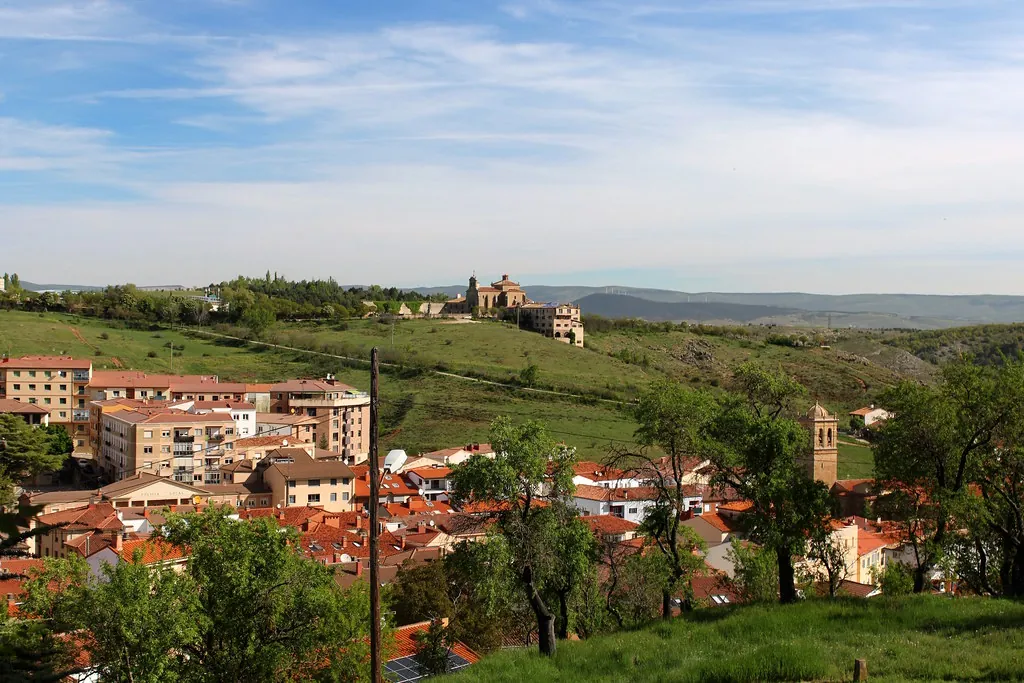
Moradillo sits on a shallow ridge; walk fifty paces north and the land falls away into a sea of trellised vines that runs unbroken to the horizon. Walk fifty paces south and the same happens again. The village is essentially a ship's bridge built from ochre stone, designed for looking out rather than showing off. Houses are low, roofs are clay, and the church tower serves as both landmark and weather vane. Mobile signal fades in and out; offline maps save arguments.
The architecture is practical rather than pretty. Adobe walls half a metre thick keep rooms at 19 °C even when the plateau tops 35 °C in August. Many façades still carry the iron rings once used to tether mules; today's tractors are too wide for the narrow lanes, so farmers park on the edge of the fields and walk in. Visitors quickly adopt the same habit – there is simply nowhere to leave a car in the centre without blocking somebody's granary door.
A Wine Story Told in Three Glasses
Legaris owns most of the surrounding vineyards, but the project still feels like an oversized village cooperative. Tours start on the loading bay where a digital screen flashes the sugar level of each gondola as it tips. From there it's down a spiral staircase into the barrel hall, 8 metres underground and mercifully cool even at midday. The standard tasting runs to three wines: a bright unoaked Tempranillo that sells in Spain for €9, the 94-point crianza, and the flagship "Village Wine" drawn from 70-year-old bush vines on the slope behind the car park. Spittoons are provided; few people use them.
Booking is non-negotiable and Mondays are dead – the winery gates stay locked. English tours usually depart at noon, which dovetails neatly with the restaurant timetable opposite. If you arrive unannounced, the best you can hope for is a polite shrug and directions to the vending machine in nearby Roa.
Roast Lamb and Other Certainties
There is exactly one place to eat within the village boundary: Restaurante La Posada de Moradillo. It opens at 14:00 sharp, closes when the last lamb shoulder is sold, and doesn't do vegetarian alternatives with any enthusiasm. Order the cordero lechal – suckling lamb that has never eaten grass, slow-roasted in a wood-fired oven until the rib bones pull out like birthday candles. A half-kilo portion feeds two comfortably and costs €26; chips arrive automatically, salad has to be requested. The local sheep's cheese is mild, closer to Wensleydale than Manchego, and travels well if you fancy smuggling something pungent home in your suitcase.
The wine list is short and proud: every bottle comes from within 8 km. House red is Legaris's basic Tempranillo poured from a 50 cl carafe for €6; ask for tinto de verano if you want it lengthened with lemonade and served over ice – acceptable at lunch, frowned upon after 19:00.
Walking It Off (or Not)
A 5-kilometre loop heads west along a farm track, dips into a dry ravine, then climbs back through vineyards planted on their own rootstock – rare in Europe since phylloxera. The path is signed but faint; download the GPS trace from the tourist office in Roa first. Setting off at 17:00 gives you golden hour light and a decent appetite for dinner, though carry water – there is no shade and summer temperatures can still top 30 °C at dusk.
Cyclists find the going gentle: gradients rarely exceed 4 % and tarmac is smooth thanks to the grape lorries. A popular 25-km circuit threads south to La Horra and back, passing three family bodegas that will open for tastings if you telephone the day before. Bike hire, however, means a 40-km drive to Aranda – plan ahead or bring your own.
When to Bother, When to Stay Away
Late April and early October bracket the best of Ribera. Spring brings luminous green shoots and night temperatures that still demand a jumper; autumn offers rust-coloured vines and the mild hubbub of harvest without the tourist crush of neighbouring La Rioja. August is frankly hot, often 38 °C by 15:00, and many locals simply down tools and head to the coast. Winter is quiet, occasionally snowy, and almost everything is shut.
Accommodation options inside the village amount to two privately owned casas rurales, three bedrooms each, booked months in advance by Spanish weekenders. The nearest reliable beds are in Aranda's Hotel Aranda or the parador in Lerma, both 25 minutes by car. Public transport does not exist; a hire car is essential unless you fancy a very expensive taxi from Madrid airport.
The Honest Verdict
Moradillo de Roa will never fill a day on its own. It works as a detour between Segovia and Bilbao, or as a palate cleanser after the cathedral fatigue of Burgos. Come for the wine, stay for lunch, take your photos before the sun drops behind the Duero valley. Then leave the villagers to their grapes and their silence – they'll be back at work at sunrise, and the tractor will still be first in the queue.