Full Article
about Nebreda
Ocultar artículo Leer artículo completo
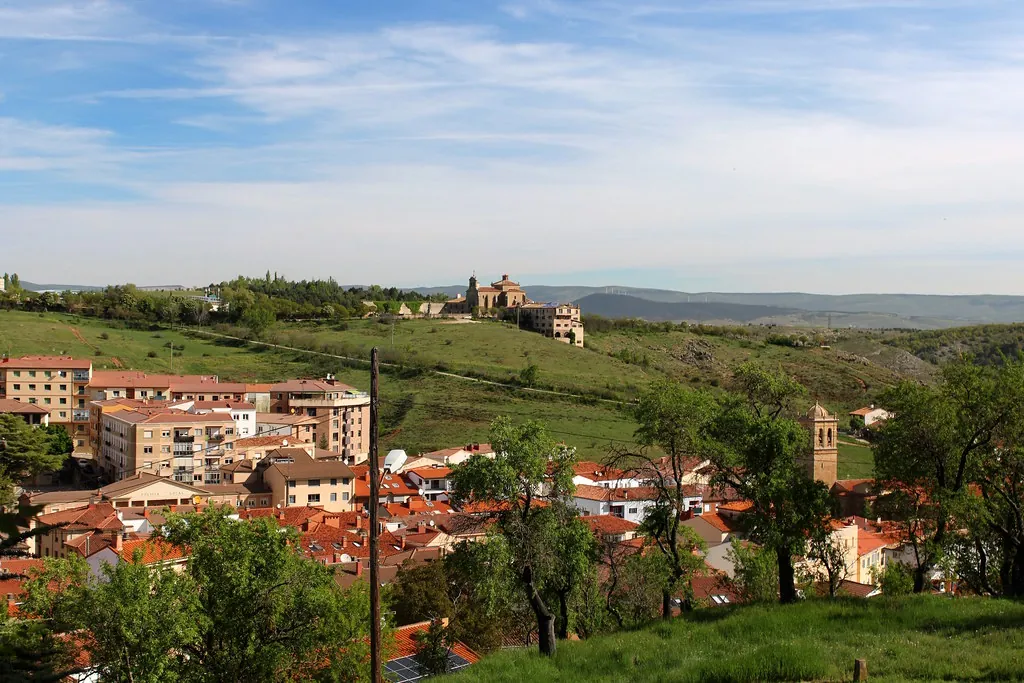
The first thing you notice is the horizon tilting. After two hours of arrow-straight wheat fields on the A-1 from Madrid, the tarmac suddenly lifts, the Sierra de la Demanda pushes upwards, and Nebreda appears—stone houses clinging to a ridge at 920 m, high enough for the air to smell of pine rather than dust. No brown tourist signs announce it; the turning is a modest right-hander just past a filling station that sells rabbit wire and chorizo by the kilo.
A village that forgot to modernise (almost)
Nebreda’s population has slipped below five hundred, but the place feels neither abandoned nor artificially pretty. Stone walls bulge, timber doors hang slightly askew, and the weekly grocery van still toots its horn on Tuesdays. Mobile reception is patchy enough that locals step into the square to take calls, nodding to whoever happens to be feeding the pigeons. The only new-build is a glass-and-steel bus shelter erected in 2018; it still has no buses, so teenagers use it as a shaded skate ramp.
Architecturally, the village is a primer on rural Castile. The parish church of San Andrés shows every century from Romanesque to Rajoy: a twelfth-century apse, baroque tower paid for by wool money, and a 1960s concrete porch added after a tractor damaged the façade. Walk round the outside first—the carved capital showing a farmer throttling a fox with one hand while clutching a medieval mobile phone (or so it looks) is worth the detour.
From the church, narrow lanes drop to the old threshing floors, stone circles now carpeted with wild thyme. Here and there a noble coat of arms pokes out, hinting that Nebreda once supplied knights to the Reconquista wars. The houses are still occupied, but the grander rooms are used for storing maize; swallows swoop through broken balconies with the nonchalance of landlords.
Walking without waymarks
There are no official hiking loops, which is precisely the attraction. Farm tracks strike out across the cereal plateau and, after 3 km, dive into pine and juniper as the slope steepens towards the Urbión peaks. One easy outing follows the gravel lane signed “Ermita de Santa Ana 4 km”; it tops out at a shuttered hermitage with views west over the Duero basin. On a clear day you can pick out the slate roofs of Santo Domingo de Silos, 25 km away, and the thin blue ribbon of the Arlanza river.
Spring is the kindest season—green wheat ripples like the sea, and the air smells of fennel and wet earth. Summer turns the palette to bronze; temperatures can still hit 35 °C at midday, but nights drop to 15 °C, so bring a fleece even in August. Autumn brings migrant storks and the smell of new wine from backyard cellars. Winter is when you discover Nebreda’s altitude: snow can block the BU-811 for a morning, and the village fountain ices over, so locals revert to carrying water in plastic jerrycans. If you visit between December and February, carry chains and expect half the bars to be shut—though the one that stays open will feed you fabada thick enough to stand a spoon in.
One bar, one hostal, no souvenir shops
Hostal San Antonio squats on the main square like a squat toad of granite. It has six rooms, wi-fi that works in the corridor if you stand on the left leg, and a restaurant whose full menu fits on a laminated A4. The star attraction is the pincho tabernero—chunks of pork loin flash-fried with garlic and piled on farmhouse bread. Order it with a caña of Alhambra; the total comes to €4.50, and nobody rushes you. Breakfast is coffee, churros and a shot of anis if the barman thinks you look peaky. The only alternative is Bar Cristina at the crossroads, which opens at 6 am for field workers and closes when the owner’s mother says the rosary is finished. Stock up before Sunday: the nearest supermarket is twenty minutes away in Salas de los Infantes, and it shuts for siesta.
How to get here (and why you might share the road with sheep)
Bilbao is the closest major airport—hire a car, leave the ring road at Junction 5 for the A-68, then swing onto the CL-116 after Burgos. The last 12 km snake through holm-oak country; watch for shepherds moving flocks between pastures—they have right of way and they know it. Santander is slightly nearer but involves a toll tunnel. Public transport exists on paper: a Monday-only bus from Burgos at 14:15, returning at 6 am Tuesday. In practice, the driver sometimes decides the weather looks iffy and stays home. Cycling is increasingly popular: the climb from the Arlanza valley gains 400 m in 8 km, enough to make thighs buzz, but traffic is light and the descent smells of warm pine and clattering goat bells.
When the village wakes up
Nebreda’s fiestas patronales land on the third weekend of August, when emigrants flood back from Bilbao and Barcelona. The population quadruples, the square becomes an open-air kitchen, and teenagers who’ve never met dance to reggaeton until the church bell rings 4 am. The high point is the Sunday toro de fuego: a framework of fireworks strapped to a wooden bull is wheeled through the streets; spectators dodge sparks, laughing, then dive into the hostal for iced lemonade laced with orujo. If crowds aren’t your thing, come for San Blas on 3 February instead. The morning procession involves just twelve men, two drums, and a statue of the saint wrapped in a scarf. Afterwards everyone queues at the bakery for panecillos de santo—aniseed buns stamped with the village initials, best eaten warm while the mist lifts off the fields.
What Nebreda does not do
There is no artisanal cheese workshop, no vineyard offering tastings in designerised barns, no boutique hotel with yoga at dawn. Night-life is a choice between the hostal television (always tuned to the bullfighting channel) or leaning on the bonnet of your car to watch shooting stars. If it rains, you will get bored—unless you enjoy counting the seventeen different ways Castilian roofs leak. And if you arrive expecting waiters fluent in English, you will end up communicating by pointing at the nearest pig.
That, of course, is the point. Nebreda offers a slice of interior Spain before Instagram found it, a place where the bread is baked by someone whose grandfather delivered it on a mule, and where the mountain starts to muscle up behind the wheat. Come for the silence, stay for the pork fat, and leave before the road ices over.