Full Article
about Olmillos De Muno
Ocultar artículo Leer artículo completo
The church bell strikes noon and nobody looks up. Not the elderly man methodically sweeping his stone doorstep, nor the woman hanging sheets from a wrought-iron balcony that might predate the Spanish Civil War. In Olmillos de Muñó, timekeeping remains the province of roosters and church towers, not smartphones—though you'll spot plenty of those too, clutched by returning grandchildren who've escaped to Burgos or Madrid but return for their mothers' roast lamb.
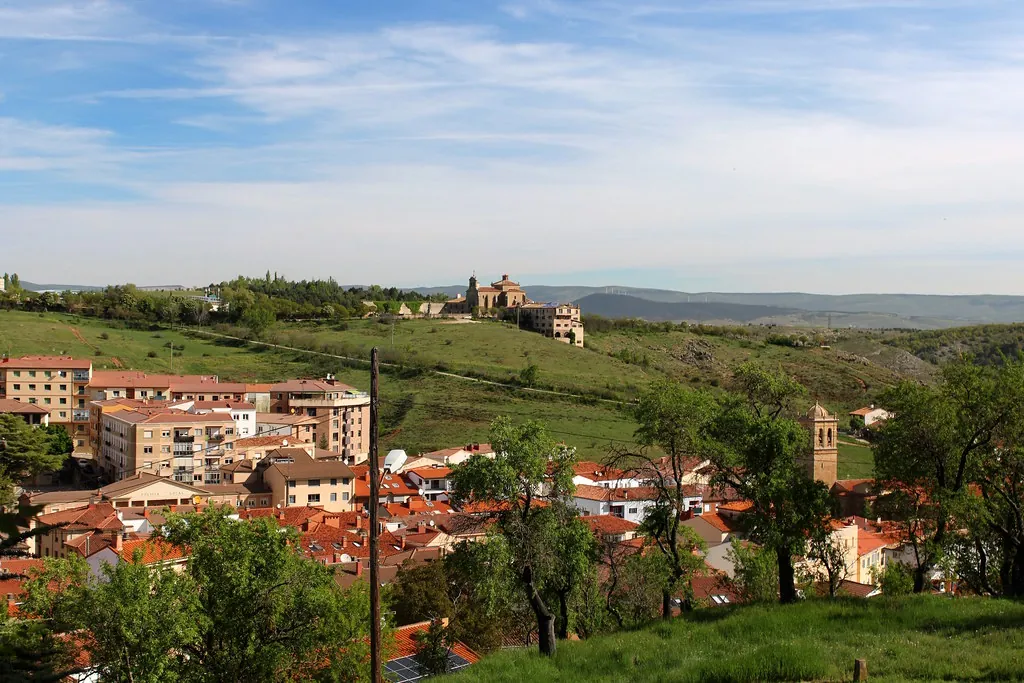
Forty kilometres south-east of Burgos capital, this Castilian farming settlement squats at 840 metres above sea level on Spain's northern plateau. The altitude matters: summers arrive later and winters bite harder than along the coast. When Madrid swelters at 38 °C, Olmillos might still manage a breathable 30 °C, but January nights routinely drop to –5 °C. Bring layers, whatever the season.
Stone, Adobe and the Smell of Woodsmoke
The village layout follows a logic shaped by wind and wheat. Houses huddle close, their two-metre-thick walls sharing body heat, while narrow lanes angle to deflect the relentless cierzo that sweeps across Tierra de Campos. Construction is a patchwork: bottom courses of honey-coloured limestone quarried nearby, upper sections of adobe brick slathered in lime wash the colour of old bones. Timber portals—some dating to the seventeenth century—hang heavy on blacksmith-forged hinges. Peer closely and you'll spot a faint coat-of-arms here, a mason's mark there; the village never had enough wealth for grand palaces, so the ornamentation is subtle, almost embarrassed.
There is no ticket office, no interpretation board, no multilingual audio guide. Instead, the parish church of San Pedro rises above the rooftops like a weather-worn bookmark. Built in stages between the fifteenth and eighteenth centuries, it mixes late-Gothic ribs with a Baroque tower patched after a lightning strike in 1892. The interior is refreshingly spare: no gilded excess, just stone softened by candle soot and the smell of beeswax. Drop a euro in the box and the sacristan will switch on the lights long enough to reveal a rather fine sixteenth-century Flemish panel of the Crucifixion, lugged here across the Pyrenees when this region still bankrolled Castile's wars.
A Walk That Measures the Year
Circle the village perimeter in April and the horizon glows emerald with young wheat. By July the same fields have turned a metallic gold that hurts the eyes; the air smells of straw dust and hot pine resin from the scattered carrascas—scrub holm oaks that farmers leave for shade and truffle symbiosis. A simple 6 km loop heads south on the dirt track signed to Villariezo, passing an abandoned palomar—a cylindrical dovecote whose 300 nesting holes once supplied both fertiliser and Sunday lunch. Continue to the ridge and you'll look back on Olmillos as a dark smudge against an ocean of cereal, the church tower the only vertical punctuation between earth and sky.
The route is flat, but don't underestimate the plateau's exposure. There is no tree cover, no café kiosk, and mobile reception flickers. Carry water, a hat, and expect to meet more hares than humans. Early mornings bring hen harriers quartering the fields; at dusk you might spot a red fox trotting along the irrigation ditch, already tolerant of tractors but not of clumsy photographers.
Roast Lamb and the Logistics of Hunger
Traditional cooking here is a calendar written in smoke. Lechazo—milk-fed lamb roasted in a domed clay oven—appears only at weekends because mid-week ovens stay cold to save firewood. The single restaurant, Casa Juan, opens Friday evening through Sunday lunch; outside those windows you eat by invitation or you don't eat at all. Phone ahead (+34 947 10 20 34) and don't ask for vegetarian options beyond tortilla. If you crave variety, drive 18 km to Lerma where the ducal parador serves the same lamb with starched napkins and Rioja by the glass, but the flavour is identical because both kitchens source from the same abattoir in Aranda.
Self-caterers stock up in Burgos before arrival. The village shop keeps surreal opening hours: 09:00–11:00 and 17:00–19:30 except Thursday afternoon when the owner visits her sister in Melgar. Bread arrives in a white van at 11:15; if you miss it, there's sliced Bimbo until tomorrow. Cheese lovers should look for Queso de Burgos, a snow-white fresh curd sold in plastic tubs—tangy, slightly sour, delicious drizzled with local honey that costs €6 a jar from the beekeeper whose garage smells of wax and petrol.
When the Village Remembers It Has Visitors
August turns the social tide. The fiesta mayor begins on the 15th with a procession behind a silver-coated Virgin, brass band slightly out of tune after decades of the same sheet music. Temporary bars serve calimocho (red wine and cola, an acquired taste) and paper cones of crisps. Fairground rides—swings, a small Ferris wheel—are trucked in from Valladolid and erected by men who work through the night with head-torches and roll-ups. For three days the population quadruples; second-home owners park BMWs beside rusted Seat 600s that still run on prayer. Then, as suddenly as it arrived, the carnival folds itself into lorries and silence reclaims the square.
Outsiders are welcome but not essential. Nobody will offer you a bilingual menu or accept credit cards; cash remains king and Spanish is the only language spoken above playground level. Attempt a greeting—"Buenos días, ¿qué tal?"—and faces relax; ignore the courtesies and service stays brisk to the point of curt.
The Practical Bit Without the Bullet Points
Driving from Santander ferry port takes two hours on the A-67 and A-1 motorways; fill the tank at Burgos because rural pumps close on Sundays. Public transport is theoretical: one daily bus at 07:10 to Burgos, returning at 18:45, timed for schoolchildren and pensioners, not tourists. Accommodation is limited to three self-catering cottages (€70–€90 per night, two-night minimum) and a quartet of rooms above Casa Juan—simple, clean, Wi-Fi that copes with email but buckles under Netflix. Book through the village website (olmillosdemuno.es) and expect to pay in cash on arrival.
Spring brings carpets of crimson Adonis poppies between the wheat rows; autumn paints the stubble fields bronze and fills the air with the smell of freshly split oak ready for winter stoves. Both seasons offer eight-hour walking days without the furnace heat of July or the knife-cold of January. Winter itself can be magical—snow dusts the terracotta roofs and silence deepens until you hear your own heartbeat—but mountain roads ice over and the church heating breaks down with dependable Castilian punctuality.
Leaving Without the Hard Sell
Olmillos de Muñó will never feature on a glossy regional brochure. It lacks a boutique hotel, a Michelin star, and that essential Spanish marketing hook—a castle you can sleep in. What it offers instead is a calibration of scale: horizons so wide they shrink your worries, and a community small enough that the baker remembers your order after two visits. Come if you are content to trade adrenaline for amplitude, and if you can accept that the most enduring souvenir is the smell of woodsmoke in your clothes long after the flight home.