Full Article
about Padilla De Arriba
Ocultar artículo Leer artículo completo
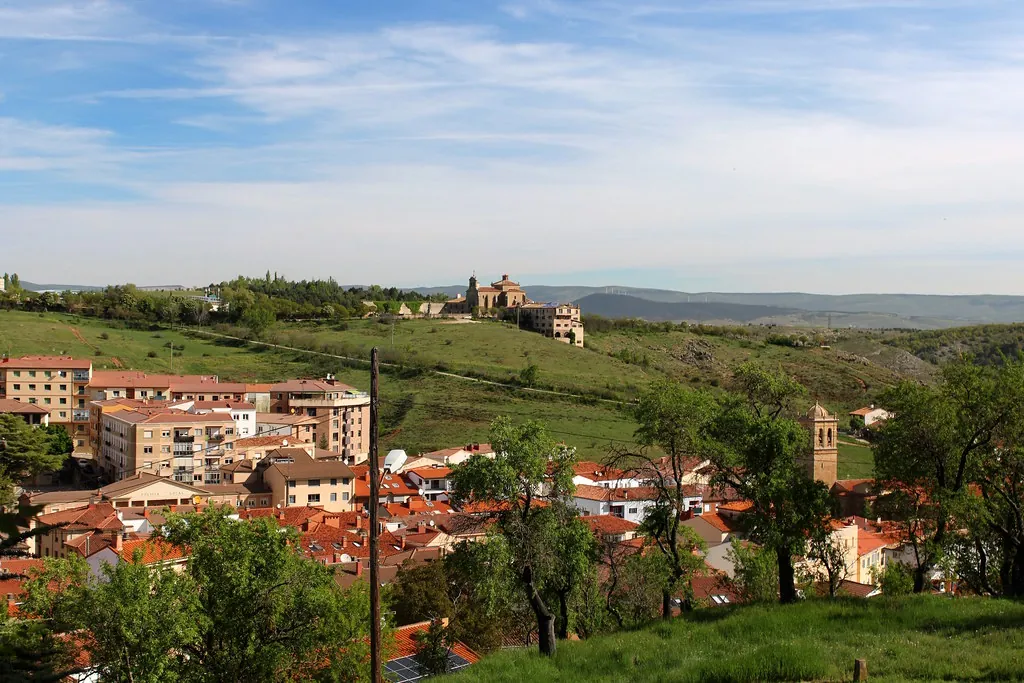
The church bell strikes eleven and nobody looks up. In Padilla de Arriba, timekeeping is for the swifts that wheel above the terracotta roofs, not for the handful of men nursing coffee in the only bar open before lunch. They talk about rainfall, not interest rates, and their hands are the colour of the ploughed earth visible from every window. This is northern Burgos province, 900 metres up on the Castilian plateau, where the horizon sits so far away it seems to need anchoring.
Stone, adobe and silence. The village arranges itself around a single axis: Calle Real, barely two hundred paces from the last wheat field to the 17th-century parish tower that doubles as landmark, compass and mobile-phone mast. Houses are built for work, not ornament—thick walls, timber beams, doorways wide enough for a hay cart—yet someone has still bothered to edge a window in faded blue, or train a vine across a crumbling lintel. The effect is accidental beauty rather than self-conscious restoration, the difference between a lived-in wax jacket and one bought ready-scuffed in Borough Market.
Walk the grid of three streets and you will meet more tractors than people. Census figures hover around ninety, though locals mutter that the registrar counts ghosts: the retired shepherd who keeps his house but sleeps at his daughter’s in Burgos city, the Madrid couple who arrive only for August. Even so, the place functions. The bakery van calls Tuesday and Friday, the mobile library parks outside the ayuntamiento every fortnight, and the doctor holds surgery on Thursdays—provided the wind isn’t too strong for the single-engine plane that hops between village airstrips up here.
Light that Paints its Own Canvas
Come for the sky. Castile’s plateau is a half-mile closer to the sun than London, and the air is scrubbed clean by Atlantic weather that has already dropped its rain on the Cantabrian coast. Dawn starts grey-pink, turns metallic gold, then drains to white heat by noon. In high summer that light flattens wheat stubble into brass filings; in April it strokes the young barley so gently the fields look air-brushed. Photographers settle on the low ridge south-west of the village—follow the farm track past the ruined cortijo, mind the unleashed mastiff—where a 270-degree sweep gives you cloud shadows racing across forty kilometres of biscuit-coloured earth. No ruined abbey in the middle distance, no photogenic shepherd. Just land, sky and the argument between them.
The walking is easy because the land says so. A lattice of grain-dusty lanes links Padilla to its even smaller neighbours: Padilla de Abajo four kilometres west, Villanueva de Arriba a gentle 6 km north. Marking is sporadic—an occasional yellow stripe on a gatepost—yet navigation is simple: keep the telegraph poles on your right and the castle-shaped water tower on the horizon dead ahead. Spring brings calandra larks and the rare great bustard; October brings shotgun echo as local hunters sweep the stubble for partridge. There is no gift-shop OS map; the bar owner will draw you one on the back of a lottery ticket, and his directions will be accurate within a tractor’s length.
What Arrives on the Back of a Lorry
Food tastes of the mileage it hasn’t done. Market day is Wednesday, when a white Merc with MURCIANOS painted on the cab pulls into the plaza and unloads tomatoes that still hold the morning warmth. The village shop—open 9-12, 5-7, closed for siesta and saints’ days—stocks lentils from Tierra de Campos and chorizo made by a grandson in Miranda. Expect no deli counter: the ham is clamped to a stand on the counter and sliced to weight, wax paper optional. For a sit-down meal you have one option, the bar whose dining room is upstairs past the slot machine. Menu del día runs to €12 and three courses: sopa castellana thick with bread and paprika, lechazo roast until the rib bones flex like plastic forks, flan strong enough to taste of real vanilla. They will not offer a vegetarian alternative; order the lentils and pick out the bits of morcilla if you must.
Those chasing gastro bragging rights should lower their zoom. The nearest Michelin mention is 45 minutes away in Aranda de Duero, an underground grill cathedral where lamb is seared over vine shoots. Padilla’s cooking is domestic, seasonal and stubborn. In late winter women still gather in one kitchen to hand-mince the annual supply of chorizo, filling the street with garlic steam sharp enough to make eyes water two doors down. Ask politely and you might leave with a vacuum-packed coil; payment is refused, but a bottle of half-decent Rioja pressed into their hands will be accepted.
When the Village Remembers Itself
July 16th turns the clock back forty years. The fiesta patronal in honour of la Virgen del Carmen drags exiles home from Valladolid, Bilbao, even Basildon. For forty-eight hours the population quadruples, generators power fairy lights between the plane trees, and a sound system replaces the bell as timekeeper. Saturday night is the verbena: grilled sardines, paper plates, children still awake at 2 a.m. dancing to Los Chunguitos played far too loud. Sunday brings a procession, the statue shouldered by men whose suits look kept in mothballs specifically for this duty. Visitors are welcome but not announced; buy a raffle ticket for the ham, stand when the brass band strikes up, and nobody will ask where you’re from.
Come August 15th the script repeats on a smaller scale for the Assumption, then the village exhales and returns to its default hush. By September the swifts have left, the wheat fields are clipped stubble, and the evening air carries the metallic scent of slurry spread for next year’s crop. Winter arrives early; at 900 m the first frost can hit mid-October, and when the norteblows across the plateau the thermometer drops to minus twelve. Snow is rare but traffic-stopping: the road from Burgos is cleared only when the farmer who owns the tractor gets round to it.
How to Get Here, Why You Might Bother
Burgos city, with its high-speed rail link to Madrid and A1 motorway, lies 55 minutes south by car. From there the CL-126 is a single-carriagement march through wheat ocean signed only for those already certain of their destination. No trains, no buses, no Uber. Hire a car at the airport or accept that you are not the target demographic.
Accommodation is the limiting factor. There is no hotel, no casa rural with boutique toiletries. What exists are two privately owned village houses offered by word-of-mouth: three bedrooms, wi-fi that flickers when the microwave runs, €70 a night if you promise to water the geraniums. Book through the municipal website—one page, Spanish only, reply within 48 hours if the clerk remembers the password. Otherwise base yourself in Aranda or even Burgos and day-trip; the hour’s pre-dawn approach on empty roads is itself a lesson in scale.
So why come? Because somewhere between the dog that follows you for the hell of it and the old man who insists the English built the local reservoir (they didn’t, but arguing is futile), the plateau gets under the skin. Padilla offers no spectacle, only continuity: the same fields, the same families, the same sky that once guided shepherds home before electricity. You will leave with dust on your shoes and no fridge magnet to show for it. Ten miles down the road you’ll realise the silence is missing. That, and the light on the wheat at 7:23 a.m.—a shade no London gallery has ever managed to hang.