Full Article
about Pedrosa Del Paramo
Ocultar artículo Leer artículo completo
The wheat stops only because the horizon does. Stand on the single traffic-calming bump at the entrance to Pedrosa del Páramo and every direction looks like the same sheet of pale green or biscuit gold, depending on the month. There is no dramatic gorge, no almond terraces, no ochre village cascade—just the Meseta stretched tight as drum-skin beneath a sky that feels twice the normal height. It is the sort of landscape that makes you realise how much of Spain’s tourist imagery is built on exceptions rather than the rule.
What the map doesn’t warn you about
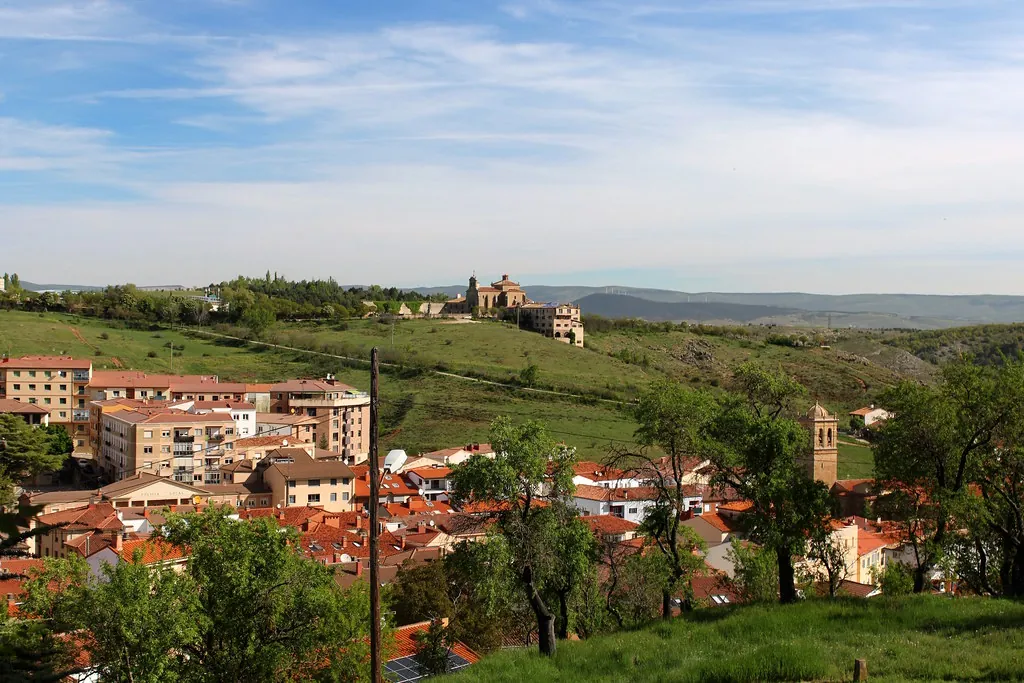
Burgos city, with its Gothic cathedral and €3 menú del día bars, sits ten kilometres north. From there the BU-11 slips past industrial estates and the Michelin factory, then thins into a two-lane strip that points at the emptiness. Pedrosa appears suddenly: 500 souls, one tractor showroom, a pink church tower and a cluster of low houses the colour of dried clay. The village is not hidden; it is simply unannounced.
Most visitors arrive by accident, usually on a cycling holiday that promised “flat stages through cereal country”. They roll in looking for a cash machine and discover there isn’t one. The nearest ATM is back in Burgos; the only shop opens for two hours in the morning and sells tinned tuna, brioche and coal-effect electric heaters. Stock up before you leave the city—especially water, because the surrounding tracks are long, shadeless and notoriously dry.
Architecture without ornament
Pedrosa’s builders had two preoccupations: winter wind and summer furnace. Houses are squat, walls nearly a metre thick, windows the size of post-box slots. Adobe, rammed earth and later brick are rendered the same dusty shade so that additions merge into the original like geological layers. Here and there a 1950s balcony in wrought iron sprouts from a fifteenth-century façade, creating a collision of centuries that somehow looks logical under the white light.
The fifteenth-century church of San Juan Bautista keeps the plaza in proportion. Its tower houses a single bell that marks the hours with the enthusiasm of someone who has forgotten the script after the sixth stroke. Step inside and the temperature drops ten degrees; the smell is of candle grease, old paper and stone that has never quite dried. No audio guide, no gift shop, just a printed A4 sheet laminated in 2003 and corrected in biro when the priest changed.
Walking the chessboard
A grid of dirt lanes fans out from the plaza, each one ruler-straight and edged with wheat. These caminos were laid long before GPS; they follow the Roman obsession with cardo and decumanus and make navigation idiot-proof. Pick any track, walk twenty minutes, and you will reach another village—Villalbilla, Castrillo del Val, Rubena—each as small and self-contained as the last. Distances feel shorter than they are because the land is table-flat; distances also feel longer because the wind keeps asking why you bothered.
Spring brings larks and a brief, almost Irish green that lasts until mid-May. After that the palette hardens to bronze. By July the heat shimmers like petrol fumes; cyclists report handlebars too hot to grip. Autumn is the kindest season: stubble fields turn sepia, the sky rinses to porcelain, and you can walk at midday without wilting. Winter is another country altogether. Night frosts are routine, the wind carries ice splinters, and the village’s population seems to halve as farmers drive to coastal second homes. If you insist on a winter visit, bring the same kit you would for the North York Moors in February.
Food that doesn’t explain itself
There is no restaurant in Pedrosa. The bar opens at 7 a.m. for coffee and churros, closes at 3 p.m., reopens at 8 p.m. for beer and crisps—timing is approximate and subject to the owner’s granddaughter’s school play. The menu scribbled on a paper tablecloth lists “caldo, lechazo, postre casero” and refuses to elaborate. Lechazo is roast suckling lamb, served in the medieval style: no vegetable garnish, no mint sauce, just a mound of pink-white meat and a clay dish of roasted potatoes that taste of wood smoke and lamb fat. Vegetarians get tortilla, salad and a lecture on the historical necessity of mutton.
For variety you drive ten kilometres north to Burgos and join the queue at Casa Ojeda for morcilla rice and a bottle of tinto that costs less than a London pint. Back in Pedrosa, breakfast the next day will be a two-euro coffee and a slab of sponge cake that the waitress’s aunt baked for the local fiesta; she will wrap the leftover slice in foil “for the road” even if you protest you’re flying Ryanair home.
Silence as an amenity
The village’s greatest luxury is acoustic. After 11 p.m. the only sound is the grain dryer in the cooperative on the edge of town, a low mechanical heartbeat that keeps the wheat from mould. Without light pollution the Milky Way looks like someone spilt sugar on slate. On clear nights amateur astronomers set up tripods between the wheat rows and expose for Orion; local dogs sniff the equipment, then trot away, bored.
Birders arrive in March and October, scanning the thermals for Montagu’s harriers and lesser kestrels. The open fields make spotting easy; the same openness means there is nowhere to hide when the weather turns. A sudden paramero wind can rip the lens cap off your binoculars and send it rolling towards Aranda de Duero, thirty kilometres south.
How to do it (and how not to)
Fly to Bilbao or Santander; either airport is a ninety-minute drive on fast dual-carriageway. Hire cars with decent air-con are non-negotiable—summer asphalt reaches 50 °C and Spanish engines do not appreciate British thrift on the specification sheet. There is no railway, no coach, no Uber. Sat-nav will try to route you down a farm track; ignore it and stay on the BU-11 until you see the tractor showroom with a deflated balloon shaped like a John Deere logo.
Accommodation choices are binary. Stay in Burgos at the Abba Hotel, praised by British reviewers for “UK-standard heating and English-speaking reception”, or rent the only foreigner-friendly cottage, a place called Castle Goyito on OwnerDirect (three bedrooms, Wi-Fi that remembers dial-up). The cottage is actually a converted grain barn; swallows nest in the eaves and the owner leaves a bottle of local wine and instructions not to grind coffee after 10 p.m.—the walls are thick but the neighbours are thicker.
Do not come hunting souvenir tea towels. Do not expect picturesque. Pedrosa del Páramo offers something narrower and, to a certain mindset, finer: a slice of Spain that tourism forgot, where the day is measured by the shadow of the church tower across the plaza and by the faint diesel rumble of the combine heading out at dawn. If that sounds like an hour of curiosity rather than a long weekend, stay in Burgos and drop in for coffee. If it sounds like respite, bring sturdy shoes and stay until the wheat turns gold.