Full Article
about Pinilla Trasmonte
Ocultar artículo Leer artículo completo
The Hour When the Fields Turn Gold
Stand on the cement patio of the church square at 19:30 on a late-July evening and the whole plateau flickers like a switched-on light bulb. Wheat stubble catches the lowering sun and reflects it back in one continuous sheet of amber that runs clear to the horizon. Somewhere beyond the line of poplars a tractor idles; closer, a swallow repeats the same low circuit above the roofline. Pinilla Trasmonte has no viewpoints, no miradores, no ticketed sunset platforms—just this square, a bench, and a view that feels almost illegally wide.
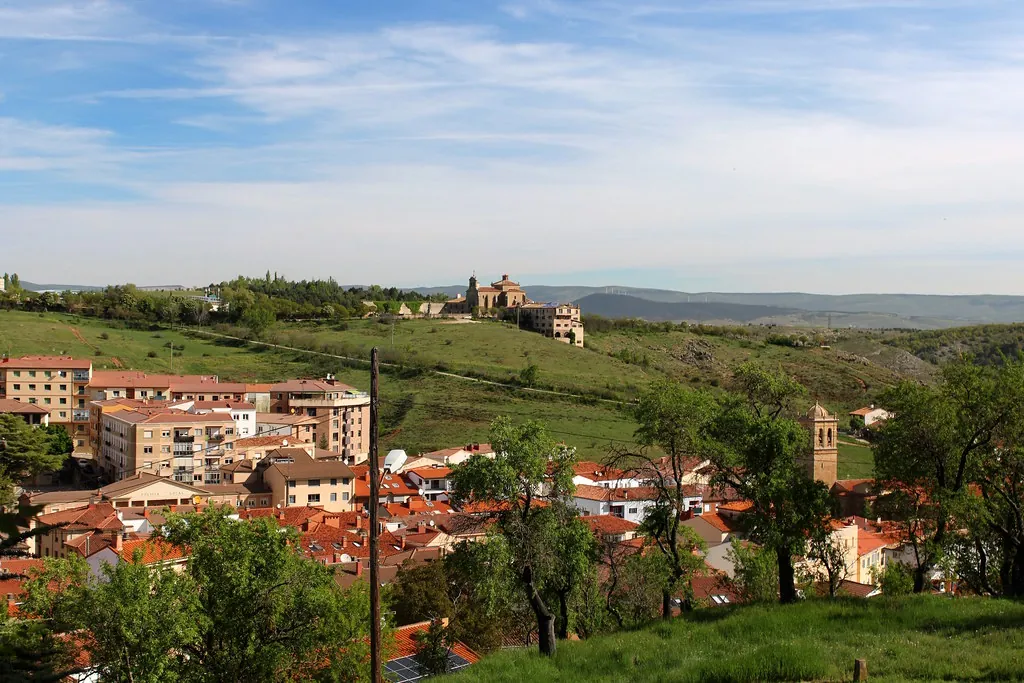
The village—166 people, one bar, 100 km of cereal fields in every direction—sits on the northern lip of the Meseta, 917 m above sea level. That altitude keeps nights cool even when Madrid is still dripping at 30 °C; it also means the first frost can arrive in mid-October, turning the clay lanes hard as brick and sending locals scurrying for their wood piles. Come prepared: many holiday cottages quote “heating available” as an optional extra, and British lungs notice the thin, dry air on the first uphill walk from the car.
A Grid for Grain, Not for Tourists
Pinilla’s streets were laid out for ox-carts, not for guidebooks. Two parallel lanes run east–west; three shorter ones cross them at right angles. That is it—no medieval alleys, no baroque façades, no artisan ice-cream. What you do get is a textbook of rural Castilian building materials: ochre limestone at the base, sun-baked adobe above, red roof tiles held in place by fist-sized stones. Many houses still have the original stone mangers inside the entrance arch, where animals once waited while grain was threshed on the cobbled floor above.
The 16th-century church of San Andrés squats at the geometric centre, its tower short and square because wind here can top 70 km/h in March. Step inside and the air smells of candle wax and damp straw; the altarpiece is plain pine, painted in ox-blood red and flaking gently. No audioguues, no donation box welded to the wall—just a hand-written notice asking visitors to close the door so the swallows don’t nest on the pulpit.
Outside, the only commercial activity is the bar “Casa Cayetano” (open 08:00–14:00, 17:00–22:00, closed Tuesday). A coffee con leche costs €1.20, a caña of Arlanza red €1.50. They serve lechazo—milk-fed lamb roasted in a wood-fired clay oven—only on Sundays from October to May. Order a quarter portion (€18) unless you fancy half a kilo of meat before midday.
Walking the Arithmetic of Wheat
Pinilla sits inside a 12-km-wide bowl of gently rolling fields. Every square metre is accounted for: wheat, barley, rapeseed, fallow. The tracks that divide the plots are wide enough for a combine harvester, so walkers can stride side-by-side without squeezing into nettles. Distances are honest: the signed circuit to the abandoned village of Revenga is 7 km flat, 1 h 45 min, zero shade—take water and a hat. In April the verges explode with crimson poppies and the air smells of damp chalk; in August the same walk is a crunch through waist-high stubble and the scent is warm straw and diesel.
Birdlife is subtle but plentiful: calandra larks rise like helicopters, great bustards stalk the fallow strips, and red kites circle overhead whenever a tractor disturbs voles. Bring binoculars and you can tick off 30 species before lunch without leaving the parish boundary.
Cyclists appreciate the almost total absence of traffic. The BU-9204 to Lerma carries four cars an hour at peak; every other lane is asphalted but empty. A 40 km loop south to the Arlanza monastery of Santa María de Retuerta and back is rolling rather than hilly—perfect on a hybrid after the Rioja leg has been worked off.
What You’ll Eat—and When You Won’t
Castilian menus don’t do small plates; they do roasts. The local formula is: legume soup, roast meat, custardy dessert, coffee. Vegetarians will survive on cheese, eggs and the occasional pisto (ratatouille), but expectations should be calibrated accordingly. Specialities worth the calories:
- Lechazo asado: suckling lamb, slow-roasted at 200 °C until the skin forms a brittle parchment. Texture closer to pulled pork than to British lamb—no mint sauce required.
- Queso de oveja curado: firm sheep cheese aged six months, nutty rather than salty, excellent with chestnut honey.
- Torreznos: strips of pork belly cold-cured overnight, then sizzled until blistered. Think posh pork scratchings with a soft centre—dangerously easy with beer.
The nearest restaurant open seven days is in Lerma (20 km). In Pinilla itself meals must be ordered ahead; most cottage owners supply a list of cooks who will deliver a cocido or roast to your door if you ring the night before. Supermarket choice is limited to the village shop: tinned tuna, UHT milk, local wine, no fresh fish. Stock up in Aranda de Duero (35 km) before you arrive—especially if you land on a Sunday, when everything from petrol stations to cash machines shuts by 14:00.
Winter Silence, Summer Reunion
Climate governs the social calendar. From November to March the plateau empties: wind whistles across bare earth, wood smoke hangs in the streets, and the bar shortens its hours to 11:00–14:00. Night temperatures drop to –8 °C; pipes freeze if the heating is set too low. This is the season for writing projects, long walks in fleece, and evenings by the fire with a €6 bottle of Arlanza crianza.
June brings the first swallow, the first terrace table, and the slow return of families who left for Burgos or Madrid. The fiestas patronales—held the weekend closest to 15 August—triple the population. A sound system appears in the square, roast lamb is served from a canvas tent, and teenagers dance until 04:00. By 07:00 the square is spotless again; the only evidence is the faint smell of beer and the tyre marks of the generator van.
Getting Here, Getting Out
Pinilla is not on the way to anywhere famous. The nearest railhead is Burgos-Rosa de Lima, 52 km north; high-speed trains link it to Madrid in 1 h 32 min. Valladolid airport (95 km) has Ryanair flights from Stansted on Mondays and Fridays. Car hire is non-negotiable—there is no daily bus, and the one weekly school run does not accept suitcases. The final 12 km from the A-62 motorway twist through wheat fields and over stone bridges wide enough for one cart; GPS often places the village 300 m east of reality—follow the church tower, not the sat-nav arrow.
Leaving is easier: Madrid is 1 h 40 min on the AP-1 if you depart before 08:00; after 10:00 lorry traffic turns the motorway into a crawl. Many visitors tag on two nights in Segovia or Valladolid before flying home, breaking the rural quiet with a final hit of Roman aqueduct or tinto de verano on a plaza.
The Deal, Plainly Stated
Pinilla Trasmonte offers space, silence and a chance to calibrate your internal clock to sunrise and sunset rather than to email alerts. It does not offer room service, nightlife, or souvenir magnets. Mobile signal is patchy; Wi-Fi depends on the cottage. Rain can strand you indoors for 24 h; the nearest doctor is 20 km away. Accept those terms and the reward is one of the clearest night skies in Europe: step outside at 23:00, let your eyes adjust, and the Milky Way looks like a smear of chalk across black slate. No app, no audio guide—just the same view the shepherds had four centuries ago, minus the flock bleating somewhere below the church wall.