Full Article
about Rubena
Ocultar artículo Leer artículo completo
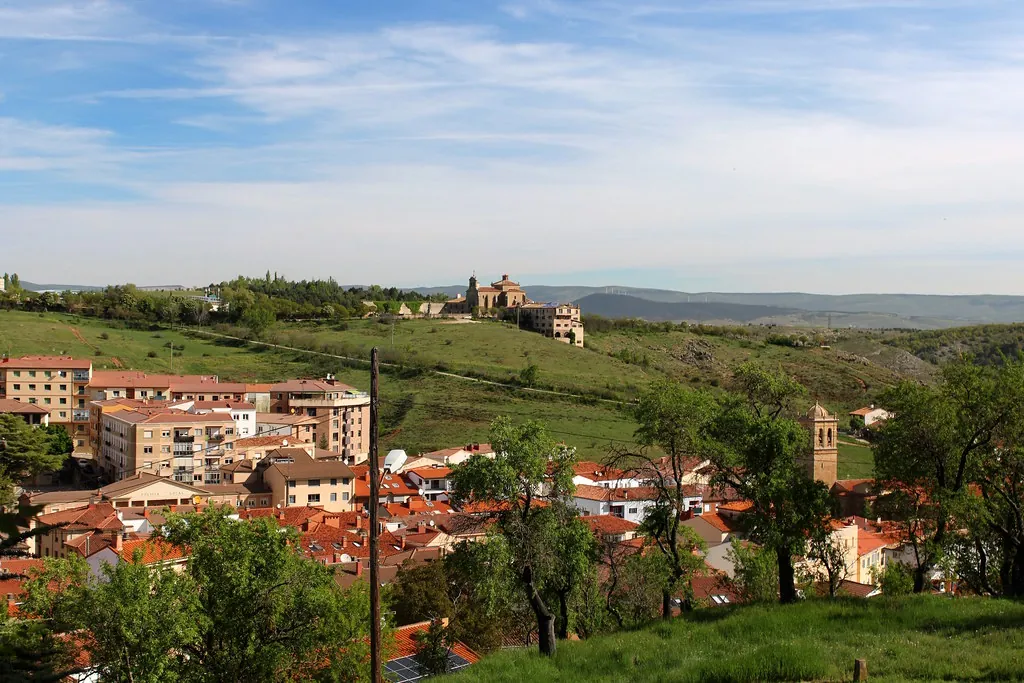
The church bell strikes noon and the only reply is a tractor engine ticking itself cool outside the bar. Rubena sits 828 metres above sea level on the first swell of the Cantabrian slope, close enough to Burgos for commuters to clock the city’s cathedral on clear days, yet still high enough for the air to carry the resinous smell of pine rather than diesel. At this altitude the Meseta is no longer the flat tabletop shown on Spanish school atlases; it begins to crack into gentle ridges that give the horizon a pulse.
Most British visitors meet the village at 60 km/h, slowing for the N-623 roundabout after a dawn landing in Santander. The first houses appear as low, honey-coloured cubes set back from the carriageway, their clay-tiled roofs weighted with stones against the wind that rolls down from the Sierra de la Demanda. It is not a dramatic entrance—no gorge, no castle—but it is unmistakably Castilian: the colour of soil and straw, the sound of sparrows in the plane trees, the sense that the day will be decided by how fiercely the sun burns the dew off the barley.
A village that refuses to be a suburb
Rubena’s population hovers around five hundred, yet the place behaves like a town that has misplaced its centre. There is no postcard plaza mayor ringed with geraniums; instead, the heart is a triangle of asphalt where the road to Cardeñajimeno peels away from the main drag. On one side stands the 1950s ayuntamiento, its brickwork the shade of stewed tea; opposite, the Bar Rubena does a €1.20 coffee and keeps the same hours as the agricultural co-op next door—open early, shut for siesta, open again when the grain lorries return.
Walk fifty metres down any side street and the village reverts to its farming past. Adobe walls bulge like risen loaves, and the stone thresholds are worn into shallow saucers by decades of hobnailed boots. Some houses have been enlarged with glass-brick stairwells that catch the light like cider jars; others remain exactly as their occupants left them in 1975, the year the Burgos factory gates began to siphon workers off the land. The result is neither museum nor suburb, but something more honest: a place negotiating its own continuity.
Paths that remember wolves
Behind the last row of gardens the cereal plain unrolls in kilometre-wide stripes of green and umber. A grid of farm tracks, wide enough for a combine harvester, invites walkers to step out without the Spanish habit of asking permission. Head north-east for twenty minutes and you reach the Arroyo de las Ollas, a seasonal stream that in May still runs ankle-deep over quartz gravel. Cross the concrete ford and the path climbs a low ridge where the wind carries the cold smell of pine plantations. Up here the view opens south towards Burgos, the cathedral spire floating like a hypodermic above the haze.
Maps mark the route as PR-BU 72, but no one in the bar uses the number. Ask for “el paseo de las antenas” and you will be directed to the TV mast on the skyline, a 6 km loop that gains 200 metres and can be walked in ninety minutes. Mountain boots are overkill; trainers suffice in dry weather, though after rain the clay sticks like wet biscuit. The reward is a 360-degree panorama: the Cantabrian cordillera bruised with storm cloud to the north, the Meseta stretched like ironing board to the south, and, in between, Rubena reduced to a smear of terracotta among the wheat.
Food at the edge of closing time
Gastronomy is not the village’s strong suit. The single restaurant, attached to the Hotel Ciudad de Burgos on the southern bypass, shuts its kitchen at 22:30 sharp; arrive at 22:31 and the receptionist will apologise while pointing you towards a vending machine of crisps. Those who time it correctly find a menu written in felt-tip on a brown paper roll: morcilla de Burgos the size of golf balls, lechazo roasted until the ribs separate like burnt twigs, and the local queso fresco—mild, crumbly, acceptable even to children who have reached their weekly jamón threshold. A three-course meal with wine costs €18; the house tinto arrives chilled, as is customary on the high plateau where summer nights can still dip to 12 °C.
If you are self-catering, the Saturday morning market sets up from 08:00 to 13:00 beside the pharmacy. Three stalls suffice: one for chorizo that has been smoked over oak offcuts, one for honey from villages higher in the Montes de Oca, and a third selling misshapen vegetables that would be rejected by a British supermarket yet taste unmistakably of soil and frost. Bring cash; the nearest ATM is at the BP station on the A-1 slip road two kilometres away and it has been known to run dry on Sunday nights when the Santander ferry disgorges its load of returning expats.
Seasons that argue with each other
Spring arrives late. April mornings can begin at –2 °C, the wheat bristling with rime, yet by midday the thermometer has sprinted to 18 °C and villagers shed their coats like snakeskins. May is the kindest month: larks overhead, barley heads luminous, the air scrubbed by Atlantic fronts that still have enough moisture to raise cumulus over the plain. Autumn is equally brief but theatrical; in October the stubble fields glow like brushed brass and the sky performs a daily colour chart from duck-egg to bruised violet. Summer is a different proposition. The sun arrives at 06:30 and by 10:00 the tracks are ankle-deep in dust. Walkers are advised to carry water: the agricultural fountains are capped to prevent pesticide runoff, and the bar does not reopen until 18:00.
Winter is when Rubena remembers it is 828 metres closer to the stars. Night temperatures of –8 °C are routine; the church bell rope stiffens like wire, and the petrol station sells antifreeze in five-litre drums. Snow is infrequent but not unknown—when it comes the village closes in on itself, the road to Burgos whitened by salt trucks, the silence so complete you can hear the wheat stubble creaking as it expands. On those days the hotel bar fills with lorry drivers playing cards and the smell of diesel stoves. It is not unpleasant, merely austere, the sort of weather that makes a double-glazed room and a hot shower feel like advanced civilisation.
A pause, not a destination
Rubena will never compete with the cathedral treasury or the Atapuerca archaeological site twenty minutes up the road. What it offers is a calibrated pause: a place to stretch legs after the overnight ferry, to let children race along a farm track without worrying about traffic, to stand on a ridge and understand that Castile is not flat but gently, stubbornly breathing. Stay an hour, stay a night, but do not expect epiphanies. The village’s modest gift is simpler: a reminder that the Spanish interior is still lived-in, still argued over by seasons, still audible if you stop the car, wind down the window, and listen for the tractor engine cooling in the noonday heat.