Full Article
about San Mames De Burgos
Ocultar artículo Leer artículo completo
The church bell strikes eleven, and the only other sound is grain shifting in the back of a farmer's Land Rover. San Mamés de Burgos doesn't do fanfare. Twelve kilometres north-east of Burgos city, this agricultural settlement of roughly five thousand souls offers something harder to package than monuments or Michelin stars: a live demonstration of how Castilians have lived with the soil for generations.
Stone, Brick and the Wide Sky
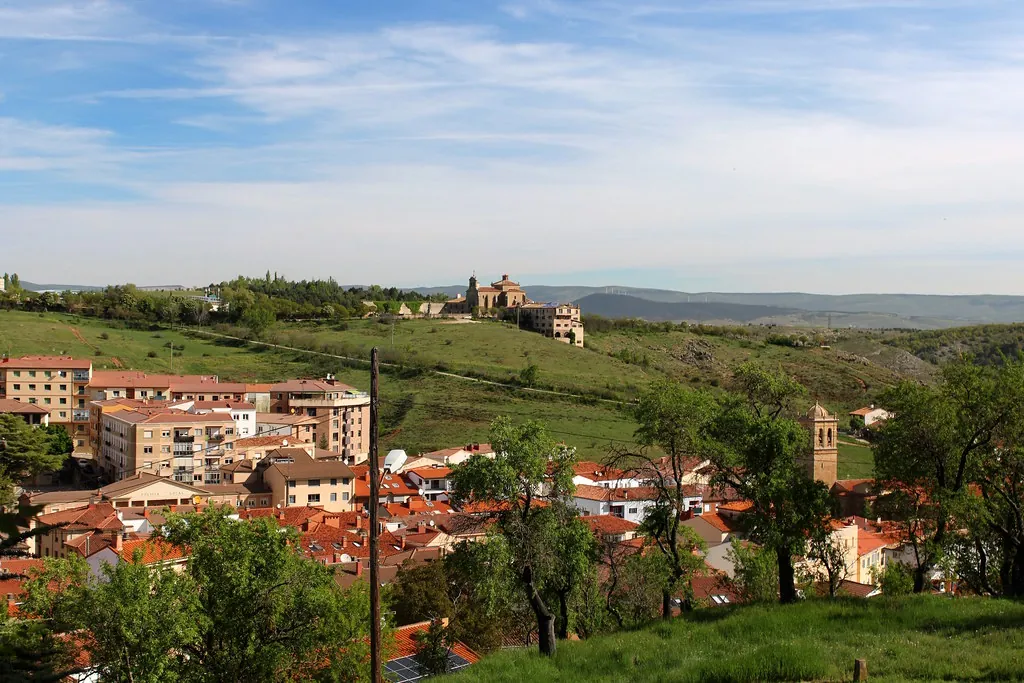
Approach by the N-I and the horizon flattens into textbook meseta: brown fields, poplar windbreaks, the occasional corrugated barn. The village appears as a low ripple of terracotta roofs; no dramatic hilltop silhouette, just houses parked beside the road where the wheat meets the asphalt. That lack of topography is precisely why the medieval community chose the spot—rich alluvial soil, a dependable spring, and enough space for ox-carts to turn.
Building materials confess the climate. Granite footings resist frost heave, brick absorbs the midday heat, and whitewashed tapial (mud-rendered walls) throws sunlight back at the sky. Window openings are modest, eaves are deep, and every second gable carries a pair of stork nests the size of satellite dishes. The overall colour scheme—ochre, rust, pigeon-grey—matches the post-harvest stubble that surrounds the place from July onwards.
There is no formal casco histórico, simply a grid of lanes wide enough for a tractor and a nod. The parish church of San Mamés rises at the geometric centre, its square tower patched with rebuilding campaigns that date from Romanesque to restoration grant 1998. Step inside and the temperature drops ten degrees; the interior smells of candle wax, old paper and stone kept in perpetual shade. A 16th-century polychrome of the patron saint—complete with lion, the obligatory attribute—survives in a side chapel, though the paint is now the colour of weak tea.
Working Fields, Working Appetites
Visit at 07:30 any weekday and you'll meet the day-shift leaving the cooperative: overalls the shade of Burgos ham, phones tuned to Cadena SER, thermos flasks clipped to handlebars. By 08:00 the same men (and a growing number of women) are guiding giant green combines across leased parcels that stretch to the horizon. Wheat and barley dominate, with rotating plots of vetch and sunflowers to rest the ground. Spring brings a brief, almost shocking emerald palette; by late June the land turns gold so uniform it could be CGI.
This is not a landscape that sells fridge magnets, yet it rewards patience. Bring binoculars and you'll spot calandra larks tumbling over the fallow, or a lone booted eagle riding the thermals. Photographers do well in the "golden hour" when the low sun throws long shadows from hay bales and the stucco walls glow like toasted almonds.
Hunger follows inevitably. The village bars (there are two, plus a bakery that doubles as a café) serve the carbohydrate armour of the plateau: torreznos—crisp strips of cured pork belly—sopped up with quartered bread still dusty from the flour mill at neighbouring Villalbilla. A plate costs around €4; a coffee, €1.20. Those wanting something more formal drive the ten minutes to Miranda de Ebro for grilled lechazo (milk-fed lamb) or the twenty minutes into Burgos for the full morcilla-and-rib repertoire.
Walking Without Altitude
The absence of mountains doesn't mean you stay indoors. A lattice of dirt tracks links San Mamés with hamlets such as Solarana and Espinosa del Camino—names that appear on no souvenir map. Distances are honest: strike out north and in 45 minutes you reach a ruined shepherd's hut beside a spring where the water is so mineral-heavy it leaves a rust rim on the plastic cup chained to the well. The terrain is flat, the navigation idiot-proof, and the only hazard is an over-enthusiastic guard dog behind a fence plastered with faded "Prohibido Pasar" signs.
If you insist on contours, the Sierra de la Demanda begins 40 km south; here you can climb to 2,000 m and be back in San Mamés for supper, though that rather misses the point of staying in a place that measures time by sowing seasons rather than Strava segments.
Festivals Measured in Decibels and Kilos
San Mamés keeps its fireworks for mid-August when the patronal fiesta occupies three days of processions, brass bands and outdoor dancing that finishes when the baker starts his ovens at 04:00. Numbers swell as returning families squeeze hatchbacks into any gap wider than a wheelbarrow. The local council lays on a giant paella in the sports pavilion; tickets are €6 and you bring your own spoon. A quieter, more idiosyncratic celebration happens in late October with the matanza weekend: locals slaughter a couple of pigs in the old style, then spend the afternoon stuffing morcilla in a garage perfumed by woodsmoke and anisette. Outsiders are welcome, but vegetarian friends should plan a day trip to Burgos cathedral that Saturday.
Getting There, Getting Fed, Getting Cold
Access: From Burgos bus station, a regional Linecar service runs four times daily (fewer at weekends), dropping you on the main road a five-minute walk from the centre. A single ticket is €1.65. With wheels, take the N-I towards Vitoria and peel off at kilometre 245; the ring road means you can be parked before the CD finishes. Car hire at Burgos rail station starts at about €35 a day for a Fiat 500.
When to come: April–mid-June and mid-September–October give you daylight without furnace temperatures; expect 20 °C afternoons and sweater evenings. July and August regularly hit 35 °C; the village empties after lunch as even the dogs seek shade. Winter is a different austerity: blue skies, minus 5 °C at dawn, and a wind that feels personal. Snow is rare but possible; if it arrives, agricultural traffic keeps the arterial roads clear long before the gritter reaches suburbia.
Where to sleep: San Mamés has no hotel. The nearest beds are in Burgos (everything from €45 hostals to the four-star NH Collection) or at rural casas rurales in nearby Tardajos and Castrillo del Val—expect €70–90 for a two-room cottage, firewood included. Book ahead during fiesta weekends; the diaspora returns and sofas fill fast.
A Final Dose of Honesty
Come here looking for castles, artisan gin or Insta-backdrops and you'll leave within the hour. Stay for half a day, however, and the village starts to calibrate your sense of scale: how big a hectare feels under a hoe, how loud a single tractor can be at dawn, how the smell of rain on dry earth travels faster than WhatsApp. San Mamés de Burgos offers no souvenir except perhaps a pocketful of wheat picked from the verge—illegal, technically, though the farmer will probably pretend he hasn't seen. Plant it in a window box back home and you'll grow your own patch of Castile, complete with the slow, unshowy rhythm that keeps this corner of the mesada alive.