Full Article
about Susinos Del Paramo
Ocultar artículo Leer artículo completo
Horizon, Wind and a Village that Fits in One Breath
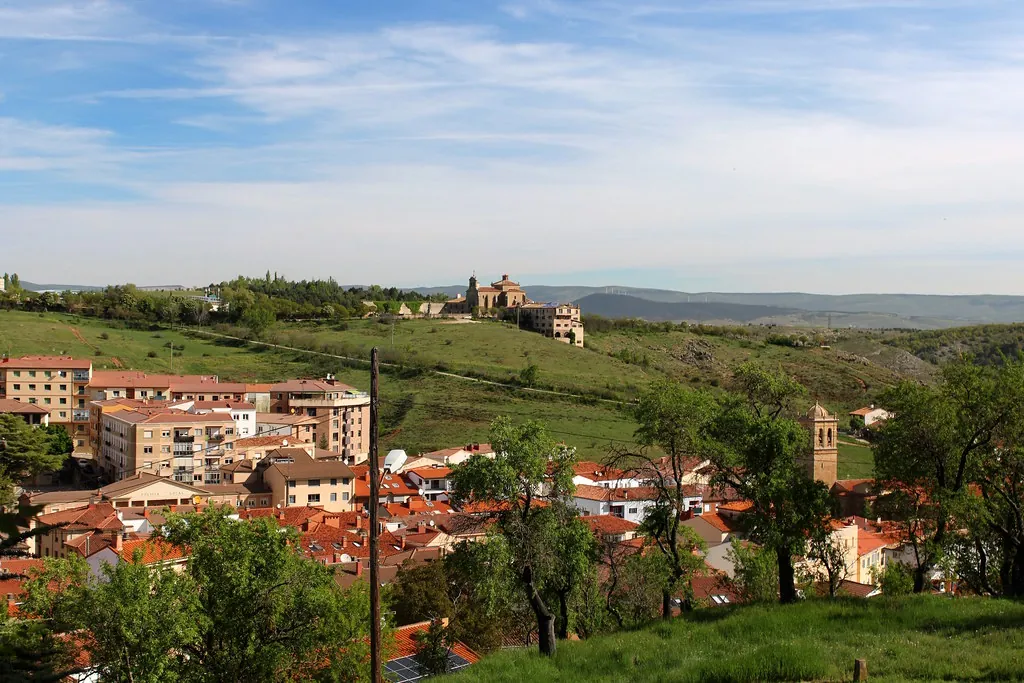
Stand on the edge of Susinos del Páramo at seven-thirty on an April morning and you will count more skylarks than chimneys. The village—barely thirty stone houses, a church and a playground—sits on the Burgos plateau like a full stop at the end of a very long sentence of wheat fields. There are no gift shops, no interpretation centre, not even a bench with a view. Instead you get 360 degrees of sky and the faint smell of wet chalk from soil that has just been turned for spring barley.
The plateau is called the páramo, a word that sounds romantic until you learn it simply means “barren plain”. Here the land is so flat that a tractor two kilometres away looks like it is driving on the rim of the world. Roads run ruler-straight; poplars huddle in thin lines to mark where streams ought to be. The only thing that rises is the church tower, and even that struggles to reach the height of a London double-decker.
A Walk that Lasts the Length of a Song
From the single zebra crossing—painted in 2019 after a farmer’s dog was hit—any stroll is automatically a country walk. Head north past the last house and the tarmac gives up. A sandy track continues between fenced plots, each the size of four football pitches. After ten minutes the village is behind you and the only soundtrack is wind rattling in phone wires. If you meet anyone, it will be a man on a quad bike checking rain gauges or a retired teacher with binoculars looking for Dupont’s lark, a bird so fussy it only nests in bare stubble.
Cycling is easier than walking because the ground is so level. Bring your own bike—there is no hire shop for 40 km—and you can do a 25-km loop south to Revilla del Campo and back without climbing more than thirty metres. The roads are empty enough to ride two abreast, though you may have to swerve around sun-bathing lizards. In July the asphalt shimmers; in January a northerly can make your eyes water so hard you need to stop to blink.
Lunch Options: One Bar and a Plan B
Susinos itself has one bar, La Parada, open Thursday to Sunday, hours that shrink without warning if the owner’s granddaughter has a football match. Inside, the menu is written on a paper napkin: morcilla de Burgos (blood sausage bulked out with rice, milder than Stornoway), queso de oveja curado (sheep-milk cheese with the texture of old Cheshire) and a bowl of sopa de ajo—garlic soup with a poached egg floating like a tiny life raft. A plate of each, plus a caña of amber lager, costs €9.50. Cards are accepted only if the terminal feels like working; bring coins.
If the roller shutter is down, drive eight kilometres east to Villalbilla de Burgos where Hotel Rural Los Faroles does a three-course menú del día for €14 including wine. Locals lunch at two; turn up at three-thirty and the kitchen is mopping the floor. On Sundays you need to book or you will end up eating crisps in the car.
When the Village Throws a Party
The fiesta mayor happens on the last weekend of August. The population quintuples as grandchildren, emigrants and the merely curious return. A sound system is wedged into the back of a Transit van, fairy lights are strung between houses and the village square becomes an open-air dance floor. Saturday night ends with a communal barbecue: half a lamb per table, salted the night before and grilled over vine cuttings that crackle like damp logs. If you are invited, bring a bottle of something cold and do not expect to leave before three in the morning. The next day mass is at noon; the priest has learned to keep the homily short because half the congregation is hung-over.
For quieter spectacle, come in late October when the stubble is burned off in controlled lines. Flames two metres high travel faster than a brisk walk, lighting up the dusk and filling the air with the sweet, almost toffee-like smell of straw carbonising. Stand up-wind or your jumper will smell like a campfire for weeks.
Getting There Without Tears
The simplest route from Britain is to fly Ryanair to Santander, pick up a hire car and head south on the A-67, then west on the A-231 for ninety minutes. Petrol is cheaper at the supermarket filling station in Burgos than on the motorway; top up before you turn off. The last 12 km are on the CL-127, a road so straight locals use it as a ruler when marking out fields. You will pass three villages that look identical; Susinos is the one with the yellow-painted school gate.
There is no railway, and the weekday bus from Burgos—one midday departure—turns around in the next village, so unless you fancy hitch-hiking back, a car is mandatory. Phone coverage is patchy; download an offline map before you leave the dual carriageway. Parking is anywhere that does not block a gate; tractors have right of way and they will not slow down for a photo opportunity.
What to Pack for a Place that Forgot Shops
Susinos has no chemist, no cash machine, no bakery and, crucially, no petrol. Bring:
- A twenty-euro note tucked in the glovebox for bar bills.
- Suncream in summer; UV is fierce at 900 m and shade is theoretical.
- A light fleece even in July—night temperatures can drop to 12 °C once wind gets involved.
- Water if you plan to walk; the only public fountain is often dry while the council fixes a pump.
If you need plasters, paracetamol or a replacement phone charger, the nearest shop is a Spar in Belorado, 18 km away, closed daily between two and five.
A Sunset that Does Not Need Instagram
Evening is the village’s best trick. At nine o’clock in May the sun sits so low that every wheat blade casts a shadow three times its length. The stone walls turn the colour of burnt butter and the church tower projects a shadow that stretches clear across the main road into the fields. By nine-thirty the sky has done its daily rotation through peach, mauve and bruised violet; by ten the first bats flicker overhead and the temperature falls off a cliff. Stand still and you can hear grain stalks rustling like tissue paper.
Stay overnight and you will also hear silence—real silence, the kind that makes your ears invent noises. A dog barks three farms away; the echo seems to bounce off the sky itself. Light pollution is nil: on moonless nights the Milky Way looks like someone has spilled sugar on black marble. Bring a tripod if you own one; constellation shots work even with a phone.
The Honest Verdict
Susinos del Páramo will not keep you busy for a week. It might not keep you busy for a full day. What it offers instead is scale: a place small enough to walk across in five minutes yet surrounded by enough space to make you feel briefly unnecessary to the world’s machinery. Come if you like your landscapes empty, your villages obstinately real and your evenings dictated by sunset rather than last orders. If you need souvenir fridge magnets, artisan gin or a soft-play centre, keep driving—the A-231 will deliver you to Burgos soon enough.