Full Article
about Torrepadre
Ocultar artículo Leer artículo completo
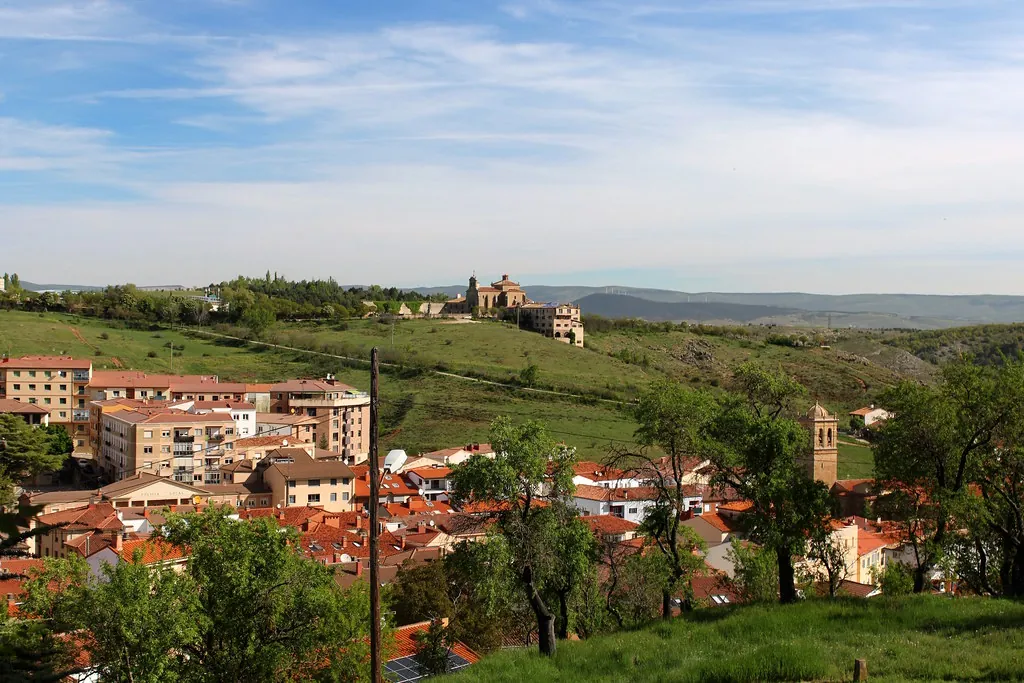
Thirty kilometres north of Burgos, the wheat fields stop swishing long enough for you to notice the stone bell-tower that has named this scatter of low houses since medieval times. Torrepadre—literally “Tower of the Father”—is not a place that shouts. Its soundtrack is wind rattling dry thistle, the squeak of a metal weather-vane, and, at seven each evening, a single church bell that measures out the day for the 500 souls who still live here. No motorway exits, no gift shops, no sea view: just the high Castilian plateau stretching uninterrupted to a horizon so straight it could have been drawn with a ruler.
The Architecture of Survival
Cast stone, timber painted ox-blood red, and adobe baked the colour of biscuit: every house in Torrepadre is built from whatever lay within donkey-cart distance. Look closely and you’ll spot the mason’s marks—small crosses, arrows, initials—chiselled into door jambs in the 1600s when wool money paid for thicker walls. Many ground-floor doorways still have the iron pintel where the mule was tethered overnight; upstairs, wooden balconies are no wider than a farmer’s outstretched arms, sized for drying maize rather than posing for photographs. The parish church of San Pedro keeps its romanesque north portal, but step inside and you’ll find the nave roof held up by 19th-century pine trunks, each one numbered so that when the death-watch beetle strikes, the right beam can be lowered and replaced without scaffolding blocking the single aisle. It is maintenance by intuition, the same pragmatism that turned abandoned bread ovens into chicken coops and, in one case, a surprisingly cosy holiday let booked through the ayuntamiento for €45 a night (cold-water tap only; shower is across the courtyard).
Walking the Invisible Coast
Torrepadre has no sea, yet the plateau behaves like a motionless ocean. Spring ploughing turns the earth into long, regular waves that reflect dawn light so cleanly you can navigate by it; by July the same fields become a blond, rustling tide that hides larks, partridges and the occasional Montagu’s harrier. Two way-marked footpaths strike out from the village: the 7 km Ruta de los Cercados heads west past stone-walled sheep folds, while the 12 km Circuíto de la Encina curls south to an ancient holm oak whose trunk needs four people to encircle it. Both tracks cross loose red clay that cakes to walking boots after rain; take the farmer’s advice printed on the laminated map in the bus shelter—“If the soil sticks to your heel, turn back or you’ll carry half the province home.” Cyclists can follow the quiet BU-404 towards Miranda de Ebro, averaging one car every ten minutes and views that flatten to abstraction under big skies. There is no bike hire in Torrepadre; Burgos-based Orbea shop will deliver for €25 if you book two days ahead.
What Arrives on the Back of a Truck
The weekly mobile market parks in the Plaza Mayor every Wednesday at ten sharp: white vans from Valladolid sell tangerines, washing-up bowls, and the kind of bras whose straps double as tow-ropes. The butcher’s counter fits in a refrigerated trailer; ask for “morcilla de arroz” and you’ll be handed a ring of black pudding still warm from the family matanza—€6 a kilo, cash only. For anything fancier the village relies on the weekly Mercadona run organised by the pharmacist: hand over your list by Monday evening, receive vacuum-packed lamb shoulder, Greek yoghurt or gluten-free biscuits on Thursday for a 10% handling fee. Eating out means driving: Casa Ramón in neighbouring Sotopalacios (11 km) does slow-roast suckling lamb for €22, but they want a phone call before noon or the oven stays cold. In Torrepadre itself, Bar Cristóbal opens when the owner’s arthritis allows; if the metal shutter is up, order the set menu—sopa castellana, migas with grapes, and half a carafe of Ribera del Duero—for €12. Close the door on your way out; nobody staffs it on quiet afternoons.
The Calendar that Regrows a Village
August’s fiestas may look modest—one fairground ride, a bingo tent, mass followed by a foam party in the polideportivo—but they perform demographic magic. Emigrants who left for Bilbao factories or Barcelona building sites return with car boots full of txakoli and French cheese, swelling the population to almost a thousand for four days. The highlight is the toro de fuego: a papier-mâché bull loaded with fireworks that career after teenagers down Calle San Roque while grandparents watch from kitchen chairs placed safely behind water-spraying firemen. If you prefer quieter customs, visit in late September for the vendimia blessing when the priest sprinkles the first grapes; afterwards locals walk the harvest route to Villadiego, pausing for cold beer at a 1950s petrol station that still measures wine into plastic jugs under an antique shell sign. Winter has its own austere beauty—hoar frost outlines every thistle head—but temperatures drop to –8°C and the single grocery shuts at 1 p.m. sharp; bring supplies or you’ll be knocking on neighbours’ doors for milk.
Getting There, Staying Sane
From the UK, fly to Bilbao, collect a hire car, and take the A68 south for 90 minutes; after Miranda de Ebro turn onto the BU-404 for the final 20 km of empty two-lane. Public transport is possible but masochistic: ALSA coach from Madrid to Burgos (2 h 30), then regional line to Fresno de Río Tirón, where the last 12 km needs a taxi booked the previous day (€30). A three-night stay is enough to walk the circuits, photograph the cereal stages, and learn that the village’s idea of rush hour is two tractors meeting at the bread van. There is no hotel; accommodation is either the aforementioned church-adjacent studio, a room in the casa rural “El Pajar de Teresa” (€70, sleeps four, wood-burner but no Wi-Fi), or a pilgrim bed in nearby Monastery of Silos whose Gregorian chant at 7 a.m. doubles as an alarm clock. Phone reception improves if you stand in the middle of the football pitch; 4G appears, then vanishes with the next cloud shadow.
Torrepadre will never tick the bucket-list boxes—no Gaudí, no Michelin star, no beach volleyball. What it offers instead is a calibration of scale: endless land above, patient stone below, and a community small enough that the baker notices if you take your coffee elsewhere. Visit, and the silence stops feeling empty; it becomes a space where your own footsteps sound like conversation.