Full Article
about Valdeavellano de Tera
Church of the Assumption;Hermitage of the Espinillas
Hide article Read full article
At first light, when the sun begins to touch the slopes of the Sierra de Urbión, the streets of Valdeavellano de Tera are still partly in shadow. A car starts somewhere, a door shuts, and little else breaks the quiet. The air often comes down cool even in summer, carrying the dry scent of nearby pinewoods, mixed with wood smoke when the colder months arrive.
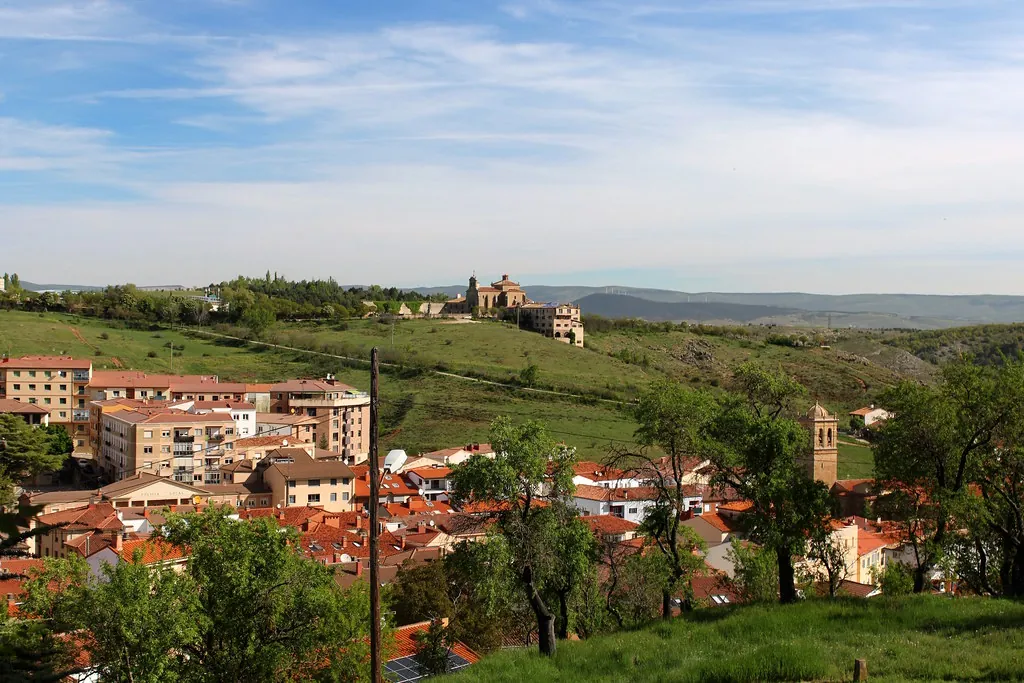
Valdeavellano de Tera is a small village in the north of Soria, just over a thousand metres above sea level, in the upper valley of the river Tera. A little over two hundred people live here, and that shapes the pace of daily life. Streets are calm, there is little rush, and many houses remain closed through the winter.
Homes follow the pattern typical of this part of Castilla y León: dark stone, thick walls, sloping tiled roofs and relatively small windows. This is not decorative. Winters here are harsh, and for months the wind comes down from the sierra with force, so buildings are designed to withstand cold and snow.
The river Tera runs close by, though not directly through the centre of the village. Even so, it defines the surrounding landscape: damp meadows, lines of poplars in lower areas, and higher up, patches of pine forest that grow denser towards the mountains.
Walking through the village
The layout of Valdeavellano is simple. Short streets, some gently sloping, tend to lead back towards the area around the church. There are no major landmarks, yet small details give a clear sense of place: darkened wooden gates, stacks of firewood neatly arranged against walls, and the occasional bench where neighbours gather in the late afternoon.
The parish church stands at one of the central points of the village. It is austere, built of stone, with little decoration. From the small open space around it, the scale of the settlement becomes clear: low roofs, chimneys, and in the distance the bluish outline of the sierra on clear days.
A slow walk without a fixed route suits this setting best. Attention tends to settle on everyday scenes: a vegetable garden behind a wall, a chicken coop, tools resting by a doorway. These details say as much as any monument.
Paths into the Tera valley
Leaving the built-up area, dirt tracks begin almost immediately. Locals use them to reach vegetable plots, meadows and nearby woodland. They are generally wide and fairly level at first, opening out towards fields and grazing land.
Here, the Tera valley forms a quiet landscape. Plots are marked by low stone walls or wire fencing, poplars rustle when the wind picks up, and patches of scrubland release the scent of thyme in spring, when small flowers appear among the undergrowth.
Longer walks are possible by linking several of these rural paths. It is worth checking a route beforehand or carrying a map, as not all paths are signposted and some split off between fields.
On clear days, birds of prey can often be seen gliding above the valley. Locals speak of red kites and other species that take advantage of the air currents descending from the sierra.
The landscape through the seasons
The feel of Valdeavellano de Tera changes noticeably over the year. In spring, the valley turns greener and the river Tera usually runs stronger. Its sound becomes more present when approaching the banks.
Summer brings bright days, though the sun is intense at midday. Walking is more comfortable early in the morning or towards evening, when the air cools again.
In autumn, the nearby pinewoods keep their deep green while the poplars shift to yellow. Paths fill with fallen leaves and the smell of damp earth becomes more noticeable.
Winter is severe. Frost is frequent, snowfall is not uncommon, and the streets grow quieter still. After fresh snow, the village can be covered in a white layer that softens every sound.
Festivities and daily life
Celebrations are mostly concentrated in the summer months, when relatives who live elsewhere return and the village becomes livelier than usual. There are religious events, shared meals and music in the square, all within the atmosphere of a small community where most people know each other.
For the rest of the year, life is much calmer. Activity revolves around fieldwork, tending vegetable gardens and the daily routines of those who remain throughout the seasons.
When to go
Spring and early autumn are generally the most pleasant times for walking around Valdeavellano de Tera. The landscape feels active and temperatures allow for unhurried exploration of the surrounding paths.
In summer, it is best to avoid the middle of the day if heading out into the countryside. In winter, checking the weather in advance is advisable, as roads in the area can be icy on colder mornings.
Valdeavellano de Tera is not a place of major attractions. It is somewhere to slow down, listen to the wind moving through the pines, and observe how life unfolds in this upper stretch of the Tera valley.