Full Article
about Valles De Palenzuela
Ocultar artículo Leer artículo completo
A combine harvester occupies the entire lane. The driver lifts one hand in apology, then returns to easing grain into the trailer that crawls beside him. You are eight kilometres from anywhere that appears on most maps of northern Spain, and the queue behind the harvester—two tractors and a Dutch-registered camper—has no choice but to wait. Valles de Palenzuela doesn’t do rush hours; it does harvest, and the calendar is written in soil.
A parish of parishes
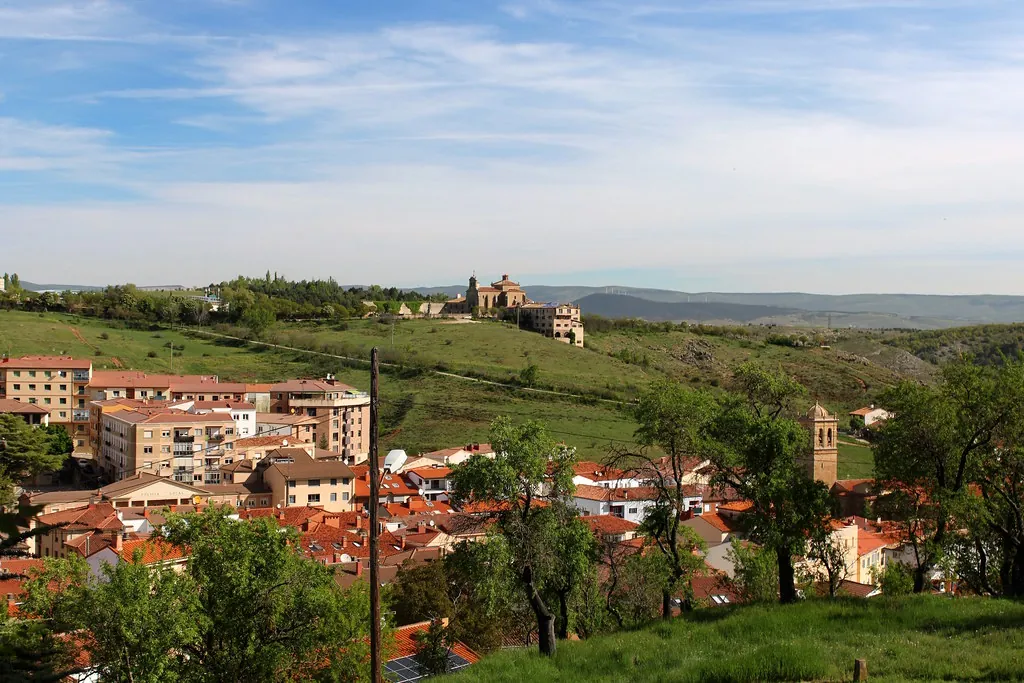
The municipality is less a village than a loose federation of hamlets—La Vid, Arroyo, Quintanilla, half a dozen others—scattered across a shallow cereal bowl 800 m above sea level. Each nucleus keeps its own stone church, its own feast day, its own threshing floor turned into a car park. Population totals hover around five hundred, though the exact figure depends on whether the wheat contractor’s family is in residence. Adobe walls the colour of dry biscuits sag politely against the wind; storks colonise every belfry. The only public building that shows signs of recent paint is the cemetery, where plastic flowers outnumber the living.
Between settlements the land opens into a striped rug of barley, wheat and fallow. In April the green is almost luminous; by mid-July the stalks have bleached to the shade of untreated floorboards. The horizon ripples rather than rises—this is not the jagged Spain of postcards but the high Meseta, where the sky does the scenic work.
What passes for a high street
There is no centre to Valles de Palenzuela, and therefore no centre-of-village rules. The last bar closed when the owner retired in 2019; the nearest supermarket is a twelve-kilometre drive to Peral de Arlanza, a place distinguished chiefly by having a freezer aisle. Travellers need to arrive self-sufficient: bread bought in Burgos, fruit in Belorado, emergency tonic water in Castrojeriz. Phone reception flickers between Vodafone and nothing; EE users should expect to converse with livestock.
What the area does possess is grain-fed lamb, morcilla stuffed with rice rather than oatmeal, and soft Burgos cheese that spreads like butter. Order them in the casa rural the night before and they appear on the dining table in earthenware cazuelas, the lamb already hacked into manageable ribs, the wine a young tempranillo from the Arlanza valley that costs €7 in the Co-op and tastes like honest Tuesday night. Nobody will offer you a menu; you eat what the cook’s mother froze after the last family christening.
Walking without waymarks
Footpaths exist because farmers need to reach their plots, not because a regional government officer once printed a brochure. Set off south from La Vid and you meet a track so wide it could accommodate a combine—because it does. After forty minutes the cereal gives way to a shallow ravine where holm oaks provide enough shade for a sandwich. Buzzards mew overhead; the only other sound is the soft crackle of dry stalks rubbing in the breeze. There is no loop, no recommended time, no gift shop selling fridge magnets at the end. Turn round when the water bottle is half empty.
Cyclists can follow the same lanes, though the surface varies from packed clay to fist-sized limestone. A mountain bike is advisable; a city hybrid will pinch-flat on the flints. The reward is kilometre after kilometre of private skyline—no traffic, no billboards, occasionally a dog that has heard of bicycles but never actually tasted one.
The temperature surprise
At 800 m the nights stay cool even in August. British visitors fresh from Andalusian patios should pack a fleece and expect condensation on the car windscreen. Frost is possible in October, snow plausible by January; the municipality owns one small gritter and hires it out to neighbouring villages like a favoured cousin. Summer rentals are traditional cottages with walls sixty centimetres thick—wonderfully insulated once the sun goes down, but ovens between two and six in the afternoon unless the owner has installed split-unit air-conditioning. Check before booking; photographs of beams and fireplaces rarely show the wall-mounted remote.
When the fields empty
August fiestas rotate through the hamlets like a travelling circus. Each parish honours its patron with a mass, a procession, a foam machine in the square and a disco that finishes when the generator runs out of diesel. Visitors are welcome, though nobody will explain what is happening; you simply find yourself handed a plastic cup of calimocho and ushered into a conga line behind the village brass band. Fireworks are let off at head height, health and safety being a distant urban rumour.
Outside fiesta week the calendar is agricultural. Ploughing starts when the soil is damp enough to hold a furrow; harvest begins once the grain rattles in the husk. If you arrive between seasons the place can feel abandoned—shutters closed, bread van already gone, only the storks clacking on their chimney-top nests. Emptiness is part of the deal; complaining about it is like grumbling that the sea is wet.
Getting here, getting away
The practical route from Britain is to fly Ryanair or EasyJet into Santander, collect a hire car, and head south on the A-67 for ninety minutes. Bilbao adds thirty minutes of motorway; Madrid involves a fast train to Burgos followed by a forty-five-minute cross-country dash. A car is non-negotiable—there is no railway station, no bus shelter, no Uber. Fill the tank in Burgos because motorway services close for siesta and rural pumps still display prices in peseta-era fonts.
Accommodation is limited to a handful of casas rurales, mostly converted stables or haylofts. Expect Wi-Fi that drops when someone microwaves supper, hot water that arrives in generous but finite tanks, and a checkout time dictated by the cleaner’s need to get back to her tomatoes. Prices hover around €90 a night for a two-bedroom house; breakfast ingredients are left on the table because nobody is going to fry your eggs.
Worth it?
Valles de Palenzuela will never feature on a “Top Ten Spanish Villages” list; that is precisely why some people cross half a continent to sit beside its wheat fields. If you need souvenir shops, yoga retreats or a choice of three restaurants, stay on the coast. If you are content to watch a harvester crawl across the horizon while the cheese warms to room temperature, this is the place to do very little, very thoroughly. Bring a book, bring cash, and remember to pull over when the grain trailer blocks the road—traffic flows again once the last kernel is aboard.