Full Article
about Villalmanzo
Ocultar artículo Leer artículo completo
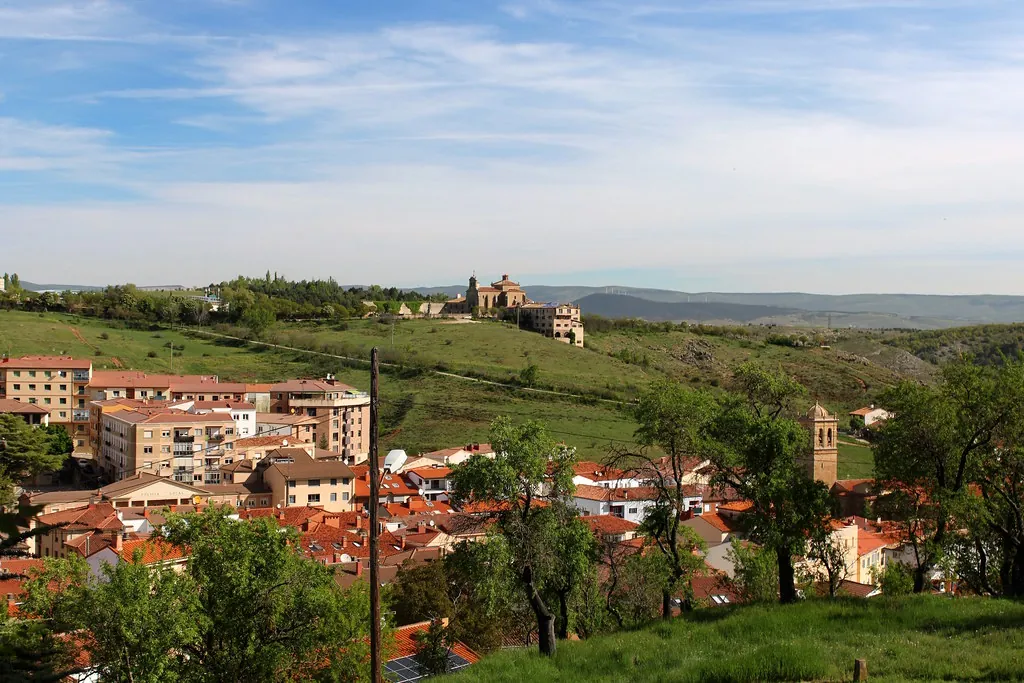
The church bell strikes eleven. A tractor rumbles past. Otherwise, silence. Not the awkward hush of a place forgotten, but the deliberate quiet of a village that never bought into hurry. Villalmanzo, 35 km south of Burgos, sits on the Meseta plateau with the confidence of somewhere that knows exactly what it is: a working grain village of five hundred souls, stone walls the colour of toast, and skies wide enough to make a Londoner blink.
Most visitors barrel past on the BU-900, chasing the cathedral at Burgos or the vineyards of Arlanza. Those who turn off find a grid of sandy lanes, houses still roofed with terracotta arabesques, and a single bar that unlocks at eight, locks again at noon, reopens when the owner finishes his siesta. There is no tourism office, no gift shop, no multilingual brown signs. Instead, there is space—square kilometres of wheat, barley and sky—and the small epiphanies that come when nothing demands your attention.
A village that refuses to pose
The first thing you notice is the scale. From the plaza by the ayuntamiento every street runs dead straight to open country. Five minutes in any direction and boot leather meets dust. The second thing is the building material: ochre limestone carted from nearby quarries, soft enough to dent with a fingernail, hard enough to last four centuries. Adobe fills the gaps, straw still visible in broken corners. You will not find geranium-draped balconies or colour-washed facades. Beauty here is a by-product of use: a wooden door hinged with hand-forged iron, a grain loft vent cut like a star, the way afternoon sun slips through a gap in the wall and pools on beaten earth.
The 16th-century church of San Andrés anchors the western edge. It is kept unlocked only on Sundays and fiesta days; the rest of the week you fetch the key from María at number 17 Calle Mayor. Inside, the air smells of candle wax and damp stone. A single nave, whitewashed every decade, holds a baroque retablo whose gilt has mellowed to the colour of strong tea. Look up and you will see roof timbers numbered in Roman numerals—medieval flat-pack assembly. The bell tower houses one of the oldest working clocks in the province; the mechanism still needs winding by hand twice a week. Volunteers draw up a rota, same families since 1932.
Walking into nothing—and liking it
Leave the village by the track behind the cemetery and within ten minutes Villalmanzo shrinks to a dark smudge against bleached grassland. The Meseta rolls out like a calm sea, the horizon so level you could balance a spirit level on it. Waymarks consist of tractor ruts and the occasional concrete post. Distances feel elastic: a copse that seems a brisk stroll away takes forty minutes to reach. In April the fields glow an almost Irish green; by July the same land turns brass-yellow and the soil cracks like overcooked cake. Buzzards quarter the verges; crested larks rise, sing, drop back into stubble. There are no benches, no litter bins, no interpretation boards—just you, the wind, and the knowledge that if you twist an ankle the nearest house is the one you passed twenty minutes ago.
A gentle circuit threads south to the abandoned railway halt at Villamartín de San Martín, a ghost platform where steam engines once stopped for milk churns. Allow two hours there and back, carrying water. The return path climbs a low ridge; from the crest Villalmanzo appears suddenly, the church tower a ship’s mast in an ocean of straw. Sunset backlights the stone to the colour of marmalade. It is the sort of view that makes you stop, hands on hips, and realise you have not thought about email for three hours.
What you will eat—and when you will eat it
Food is straightforward, local and rigorously seasonal. The village shop, open 09:00-13:00 and 17:00-20:00 (closed Sunday afternoon and all day Monday), stocks tinned tuna, rubbery tomatoes and the best morcilla de Burgos you will ever fry. Each coil costs about €3; the label lists pigs from the next valley. There is no café, but the bar, La Parada, serves coffee from 08:00 and pours beer until the last customer leaves. Midday menu del día (€12, wine included) might be menestra de verduras followed by chuletón al estilo meseteño—a T-bone the size of a small laptop, served rare unless you specify otherwise. Vegetarians survive on queso de Burgos, a crumbly fresh cheese that tastes of meadow grass, and patatas a la importancia, potato slices dipped in egg then fried in olive oil. Pudding is usually rice pudding dusted with cinnamon; order it, if only to watch the owner’s wife stir the pot with the same wooden spoon her mother used.
Evening dining is trickier. Kitchens close at 21:30 sharp; turn up at 21:35 and you will be offered crisps and forgiveness. If you are staying in a casa rural—there are six, all converted farmhouses—buy supplies before 13:00 or you will discover that the nearest supermarket open on a Sunday is in Melgar de Fernamental, 10 km away. ATMs follow the same rule: bring cash or prepare to drive for petrol-station sandwiches.
When to come—and when to stay away
April and May are the kindest months. Days reach 18 °C, nights hover around 7 °C and the wheat is that improbable emerald that makes photographers curse their cameras for never getting the shade quite right. September repeats the trick with added stubble gold and migrating storks. Mid-winter is another country: grey sky presses down like a saucepan lid, fog lingers until noon and the thermometer can scrape –8 °C. The village is beautiful then, if you like your beauty austere, but services shrink to a skeleton. The bar may open late, the shop may not open at all, and the countryside becomes a place where you really do need that waterproof you optimistically left in the car.
August belongs to the fiestas. The celebrations for San Andrés (30 November) were moved to the first weekend of August so emigrants could return. Friday night starts with a procession, brass band slightly out of tune, children scattering flower petals that blow straight into neighbours’ faces. Saturday brings a foam party in the plaza—yes, even here—followed by a communal paella for 400 eaten at trestle tables. Fireworks are modest; the mayor sets them off from a wheelbarrow. If you want small-town Spain with its hair down, this is the time, but book accommodation early and expect noise until 04:00. The rest of the year Villalmanzo goes back to being itself: a place where the loudest sound at 15:00 is a distant dog and the most urgent decision is whether to walk north or south.
The practical bit you cannot ignore
You need a car. There is no railway station, no bus stop, no Uber. From Bilbao the drive is 90 minutes on the A-1, exit at Lerma, then 25 minutes of ruler-straight country road where you will meet three vehicles, two of them combine harvesters. Parking is wherever you can tuck a wheel without blocking a grain store. Mobile signal hops between one bar and none; download offline maps before you leave Burgos. Petrol pumps live in Melgar or Lerma—ignore the fuel gauge at your peril. Pack boots, a fleece for after dark, and, if you are British, teabags. The nearest pint of milk is UHT and the locals like it that way.
Leaving without promising to return
Villalmanzo will not change your life. It will not give you cocktail-hour stories to impress Hampstead. What it offers is simpler: a calibration of scale. You arrive thinking the world is crowded; you leave remembering that in half an hour you can walk beyond the last house and hear only your own breathing. The village asks nothing of visitors except a little respect: close gates, nod at passers-by, do not expect contactless payment. Turn the car key, roll back towards the motorway and the Meseta recedes in the rear-view mirror—flat, stony, indifferent, and somehow already missing you. You may never come back. But the next time someone mentions “real Spain”, you will picture a limestone tower against an empty sky, and the wind that speaks louder than traffic.